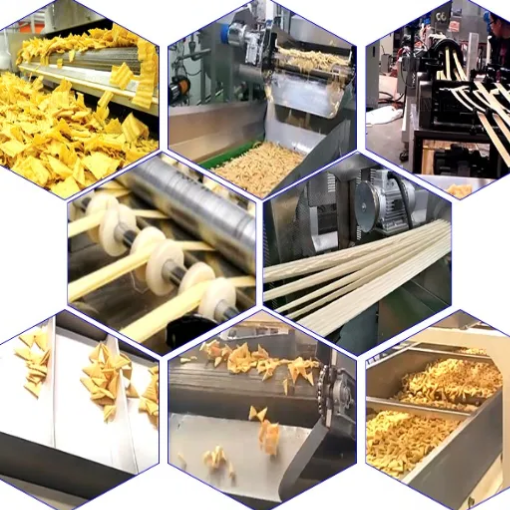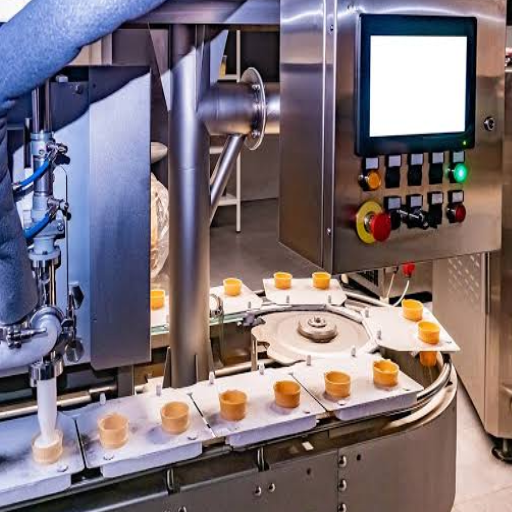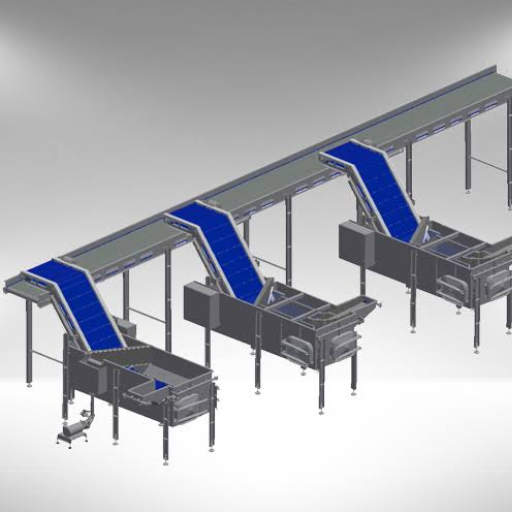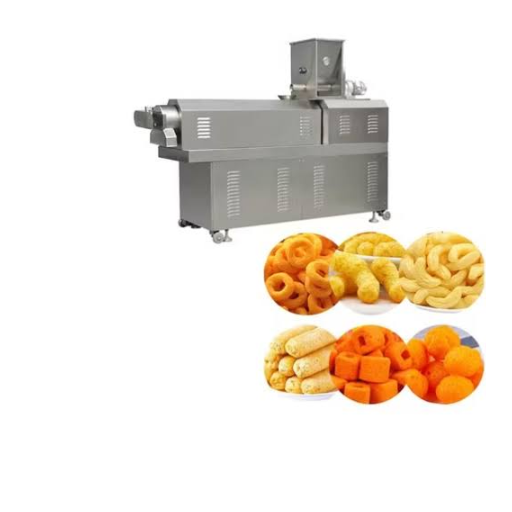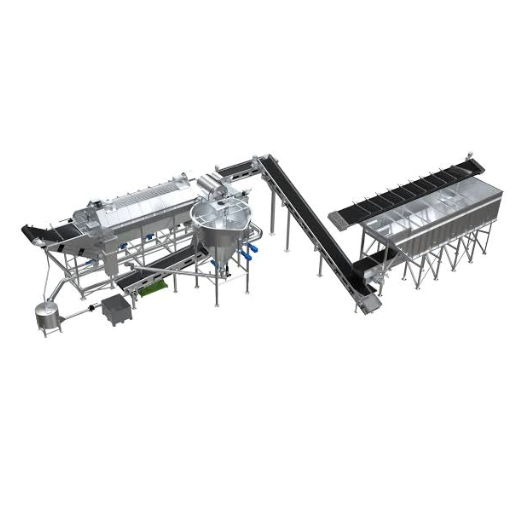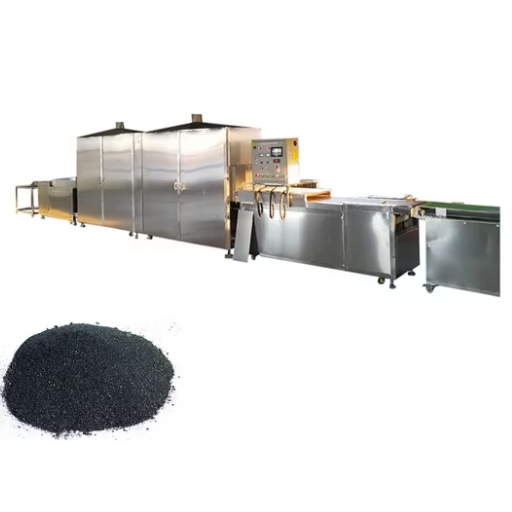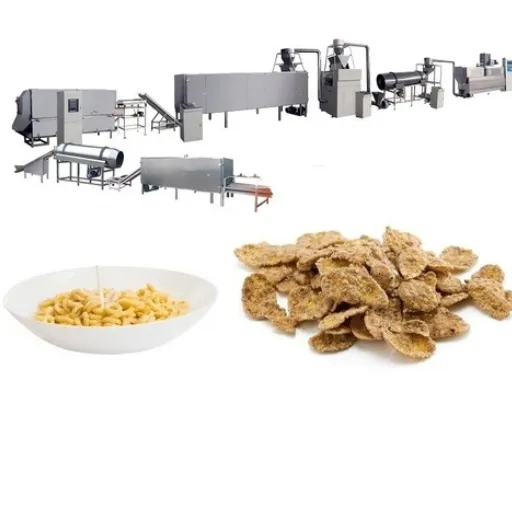
A twin screw extruder corn flakes system is the core machine that cooks, gelatinizes, and shapes corn dough into pellets that are later flaked and toasted into breakfast cereal. It replaces traditional batch cooking with a continuous, automated process that delivers consistent quality at anywhere from 100 kg/h to over 1,000 kg/h.
But not every corn flakes extruder machine is built the same. When Priya Sharma, a production manager in Mumbai, upgraded her family’s snack plant to cereal production, she assumed a bigger motor would solve everything.
Six months later, she was still fighting uneven pellet size, die blockages, and texture complaints from her retail partner. The real issue wasn’t power. It was screw configuration, moisture control, and die design.
In this guide, you’ll learn how a twin screw extruder makes corn flakes, which specifications actually matter, how to size one for your output goals, and how to keep it running efficiently for years.
Key Takeaways
- A twin screw extruder cooks corn flour into gelatinized pellets in seconds using heat, pressure, and mechanical shear.
- Co-rotating intermeshing screws outperform single screw extruders for corn flakes because they mix better, handle moisture more reliably, and self-clean.
- Capacity tiers range from 5–100 kg/h lab units to 1,000+ kg/h industrial systems, with Chinese-made lines typically costing 8,000–8,000–100,000+.
- Critical specs include screw diameter, L/D ratio, screw configuration, motor power, barrel temperature zones, and die design.
- Feed moisture (12–18%), barrel temperature profile, screw speed, and die pressure are the operating parameters that most affect flake quality.
What Is a Twin Screw Extruder for Corn Flakes?
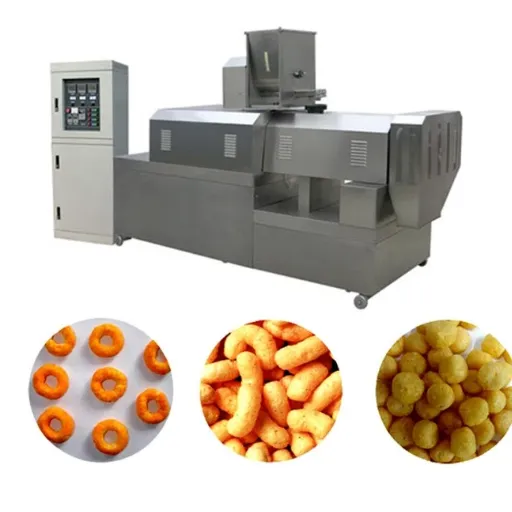
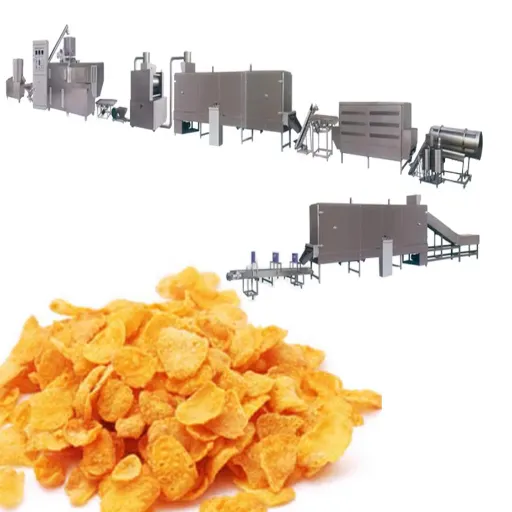
A twin screw extruder for corn flakes is a continuous cooking and forming machine. It takes a blend of corn flour or grits, water, and additives and transforms it under high temperature, pressure, and shear into a cooked, plasticized dough. That dough is forced through a shaped die and cut into small pellets. Those pellets are then flaked, dried, toasted, and packaged.
Unlike traditional batch cooking in large steam vessels, extrusion uses high-temperature short-time (HTST) processing. The corn mixture cooks in seconds rather than minutes, which preserves more nutrients, reduces energy use, and enables precise control over texture.
The “twin screw” part refers to two intermeshing screws that rotate inside a heated barrel. In most food applications, the screws are co-rotating, meaning they turn in the same direction. This design creates intense mixing, uniform heat distribution, and a self-wiping action that keeps the barrel clean.
Within a complete corn flakes production line, the extruder sits between mixing and flaking. It is the single most important determinant of product consistency, throughput, and recipe flexibility.
How a Twin Screw Extruder Corn Flakes System Works
The corn flakes extrusion process can be broken into four stages:
- Ingredient feeding and preconditioning — Blend corn flour with water and additives to 12–18% moisture.
- Extrusion cooking — Heat and shear the mixture to 120–150°C to gelatinize starch.
- Die forming and pellet cutting — Force dough through a die and cut into uniform pellets.
- Flaking and toasting — Press pellets into thin flakes, dry, and toast for the final product.
Ingredient Feeding and Preconditioning
Corn flour or grits — usually 60–80 mesh — is blended with water, sugar, salt, malt syrup, and any vitamins or minerals. The target moisture content is 12–18%. Some systems include a preconditioner that injects steam and water to begin gelatinization before the material reaches the extruder barrel.
Extrusion Cooking
The mixed material enters the extruder barrel, where the twin screws convey it forward while compressing, shearing, and heating it. Barrel heaters add thermal energy, and mechanical friction generates additional heat. Temperatures typically climb from 60°C in the feed zone to 120–150°C at the die.
During this stage, starch granules absorb water, swell, and burst. This process, called gelatinization, is what gives corn flakes their digestibility and structure. The high pressure also sanitizes the product by eliminating microbial contaminants.
Die Forming and Pellet Cutting
At the end of the barrel, the cooked dough is forced through a die during the pellet forming stage. For corn flakes, the die usually has a slit or round opening that forms a ribbon or small pellet. A rotary cutter slices the extrudate into uniform lengths.
The shape and density of the pellet directly affect how it flakes later. Too much expansion at the die, and the flake will be fragile. Too little, and the flake will be dense and chewy.
From Pellet to Flake
The pellets are conveyed to a flaking machine, where flaking rollers press them into thin flakes. The flakes then pass through dryers, a high-temperature roaster, optional coating equipment, and finally cooling and packaging systems. Many of these downstream components are shared with our puff snacks processing line configurations.
Why Twin Screw Extruder Corn Flakes Systems Beat Single Screw
Single screw extruders are simpler and cheaper. But for corn flakes, a dedicated breakfast cereal extruder with twin screw technology outperforms in three critical areas: mixing, moisture handling, and consistency.
| Feature | Twin Screw Extruder | Single Screw Extruder |
|---|---|---|
| Mixing capability | Superior — two intermeshing screws create intense kneading | Basic — limited mechanical mixing |
| Moisture range | Handles 12–18% feed moisture reliably | Struggles with high-moisture or sticky formulations |
| Heat distribution | More uniform across the barrel | Less uniform, risk of burning or undercooking |
| Self-cleaning | Self-wiping screws reduce residue buildup | Requires more frequent manual cleaning |
| Recipe flexibility | Modular screw design supports multiple products | Limited to simpler shapes and formulations |
| Throughput consistency | High uniformity pellet to pellet | More variable output |
| Maintenance complexity | Moderate — modular wear parts | Lower upfront cost but less capable |
The superior mixing of a twin screw extruder matters because corn flake recipes often include malt syrup, sugar, salt, and fortifications. Uneven distribution of any ingredient creates off-flavors, color variations, or weak spots in the flake.
Self-cleaning is another practical advantage. When the production day ends, the screws wipe each other clean as they rotate, reducing downtime and cross-contamination between recipes. For a co-manufacturer running corn flakes in the morning and cheese puffs in the afternoon, that feature alone can save hours.
Ready to see how extrusion fits your product plans? Explore our snack food production line options to compare extruded cereal and snack configurations.
Twin Screw Extruder Corn Flakes: Key Specifications
When evaluating twin screw extruder specifications for corn flakes production, look past the marketing sheet. These are the specifications that determine real-world performance.
Screw Diameter and L/D Ratio
Screw diameter, often expressed in millimeters (e.g., 65 mm, 75 mm, 85 mm), correlates closely with throughput. The L/D ratio is the length of the screw divided by its diameter. For corn flakes, common L/D ratios range from 12:1 to 20:1.
A longer L/D ratio gives more residence time for cooking and mixing. That is useful for complex recipes or high-capacity lines. A shorter L/D ratio is more compact and cost-effective for simpler formulations.
Screw Configuration
Modern twin screw extruders use a modular screw design. The shaft is built from interchangeable segments:
- Conveying elements move material forward.
- Kneading blocks mix and develop gluten or starch structure.
- Shear blocks apply intense mechanical energy for cooking.
- Reverse-pitch elements create back-pressure for better filling and cooking.
For corn flakes, the goal is usually a balance: enough shear to gelatinize starch completely, but not so much that the pellet expands excessively before flaking.
Motor Power and Torque
Motor power ranges from 22 kW on small units to 200+ kW on industrial systems. More important than raw horsepower is torque density — the machine’s ability to maintain screw speed under load. A high-torque extruder handles denser dough, tougher recipes, and startup surges without stalling.
Barrel Heating and Cooling Zones
Look for 3 to 8 independent temperature zones, each with PID control to ±1°C. Electric heating is most common, but steam, gas, or diesel options are available. Water cooling circuits prevent overheating in high-shear zones.
Die Design and Rotary Cutter
The die determines pellet shape. For corn flakes, dies are typically slit-shaped or round, producing ribbons or small cylinders. The rotary cutter must be adjustable and sharp. Worn cutters produce ragged pellets that flake unevenly.
Control System
A modern extruder uses a PLC with an HMI touchscreen. The operator sets screw speed, zone temperatures, feed rate, and cutter speed from one panel. Data logging and recipe memory are valuable features for manufacturers running multiple SKUs. For a complete facility, see our full range of industrial food processing equipment.
Typical Capacity and Model Comparison
Twin screw extruders for corn flakes are available across a wide capacity range. The table below shows typical tiers used in the industry.
| Scale | Capacity | Main Motor | Installed Power | Screw Diameter | Typical Price Range |
|---|---|---|---|---|---|
| Lab / Pilot | 5–100 kg/h | 5.5–22 kW | 15–22 kW | 30–50 mm | 5,000–5,000–15,000 |
| Small Production | 100–150 kg/h | 22–30 kW | 50–60 kW | 65 mm | 8,000–8,000–20,000 |
| Medium Production | 200–300 kg/h | 55–75 kW | 70–90 kW | 70–75 mm | 20,000–20,000–45,000 |
| Industrial | 300–500 kg/h | 90–132 kW | 130–180 kW | 80–85 mm | 50,000–50,000–90,000 |
| Large Industrial | 800–1,000+ kg/h | 132–200 kW | 180–250 kW | 95–120 mm | $100,000+ |
Prices vary based on automation level, material quality, brand origin, and after-sales support. Chinese manufacturers such as Shandong Loyal Industrial Co., Ltd. typically offer strong value in the small-to-industrial range, while European brands like Clextral and Bühler command premium prices for large or highly specialized systems.
When Chen Wei launched a private-label cereal brand in Ho Chi Minh City, he started with a 100 kg/h line. Within 18 months, retail orders pushed him to 250 kg/h. Because his original extruder used modular screws and a scalable control platform, the upgrade path was straightforward. He kept the same recipe logic and simply moved to a larger barrel diameter.
Operating Parameters That Affect Corn Flakes Quality
Getting the extruder settings right is the difference between golden, crispy flakes and broken, soggy ones.
Feed Moisture Content
Target 12–18% moisture in the feed. Too little water, and the starch won’t gelatinize fully. Too much, and the dough becomes sticky, clogs the die, and produces dense pellets that flake poorly.
Barrel Temperature Profile
A typical profile starts at 60–80°C in the feed zone and rises to 120–150°C at the die. Each zone should be tuned to the recipe. High-sugar formulations, for example, may need lower temperatures in the early zones to prevent caramelization.
Screw Speed and Residence Time
Screw speed typically ranges from 200 to 400 RPM. Higher speeds increase throughput but reduce residence time. Lower speeds allow more cooking but reduce output. The right balance depends on recipe, moisture, and target texture.
Die Pressure and Specific Mechanical Energy
Die pressure indicates how fully the barrel is filled and how much work the screws are doing. Specific mechanical energy (SME) measures the mechanical energy input per kilogram of product. Higher SME means more shear and cooking. For corn flakes, SME is typically kept moderate to control expansion.
Pellet Size and Shape for Flaking
Pellets should be uniform in size and dense enough to survive flaking without crumbling. A small, round pellet around 6–10 mm in diameter is common for standard corn flakes. Thicker pellets produce thicker flakes; thinner pellets produce lighter, more delicate flakes.
Need help matching an extruder to your recipe? Contact Shandong Loyal Industrial Co., Ltd. for a tailored capacity and configuration assessment.
How to Choose the Right Twin Screw Extruder Corn Flakes Machine
Selecting an extruder is not just about capacity. It is about matching the machine to your product, process, and growth plans.
Match Capacity to Production Targets
Calculate your target output in kilograms per hour, then add 20–30% headroom for growth and maintenance downtime. A line running at 100% capacity every day will wear faster and leave no room for error.
Evaluate Screw Modularity and Recipe Flexibility
If you plan to produce corn flakes today and puffed snacks tomorrow, choose an extruder with modular screws and quick-change dies. The ability to swap screw elements and die plates in under an hour dramatically improves plant utilization.
Check Material Quality and Certifications
Food-contact surfaces should be food-grade stainless steel (SUS304 or SUS316). Screws and barrels should use wear-resistant alloy steel, often 38CrMoAl with nitriding or bimetal coatings. Verify certifications such as CE, ISO 9001, and compliance with HACCP or FDA-ready design principles.
Assess After-Sales Support and Spare Parts
An extruder is a long-term investment. Ask the supplier about installation support, operator training, warranty terms, and spare parts availability. A supplier with local service partners or rapid international shipping can reduce downtime significantly.
Consider Energy Efficiency and Total Cost of Ownership
Compare real power consumption, not just installed power. Modern extruders with variable frequency drives and efficient motors can reduce energy use by 15–25% compared to older designs. Factor in spare parts, lubricants, and labor when calculating total cost of ownership.
Twin Screw Extruder Corn Flakes Maintenance and Troubleshooting
A well-maintained twin screw extruder can run for decades. Neglect it, and even the best machine will produce inconsistent flakes and unexpected downtime.
Daily, Weekly, and Monthly Maintenance Checklist
Daily:
- Inspect die and cutter for wear or buildup.
- Check oil levels in the gearbox.
- Clean feed hopper and discharge areas.
- Verify temperature and pressure readings.
Weekly:
- Lubricate bearings per manufacturer schedule.
- Inspect screw elements for wear or damage.
- Check belt and coupling tension.
- Clean cooling water filters.
Monthly:
- Remove and inspect screws for wear, corrosion, or buildup.
- Check barrel alignment and clearances.
- Review production logs for trends in temperature, pressure, or motor load.
- Test emergency stops and safety interlocks.
Common Problems and Solutions
| Problem | Likely Cause | Solution |
|---|---|---|
| Uneven pellet size | Worn cutter or inconsistent feed | Replace or sharpen cutter; check feeder calibration |
| Die blockage | Moisture too high or foreign particles | Reduce feed moisture; add magnetic separator or sifter |
| Overheating in barrel | Cooling system failure or excessive screw speed | Check water cooling; reduce speed or SME |
| Low throughput | Worn screws or inadequate feeder | Inspect screw elements; calibrate feeder |
| Poor flake texture | Under-gelatinized starch or wrong pellet density | Adjust temperature profile and moisture |
Wear Parts to Keep in Stock
Keep a spare set of critical wear parts on-site:
- Die plates and cutter blades
- Final screw elements and kneading blocks
- Barrel liners for high-wear zones
- Seals, bearings, and gearbox oil
- Heating bands and temperature sensors
Lubrication and Cleaning Best Practices
Use the manufacturer-recommended food-grade lubricants on all food-contact-adjacent bearings. After recipe changes, run a purge material such as coarse corn flour or rice flour through the extruder to push out residue before the next production run.
Frequently Asked Questions
What is the difference between co-rotating and counter-rotating twin screw extruders?
Co-rotating screws turn in the same direction and are best for most food applications because they mix thoroughly and self-wipe. Counter-rotating screws turn in opposite directions and create more compression and shear, which can be useful for specialized products but is less common for standard corn flakes.
How much does a twin screw extruder for corn flakes cost?
Small Chinese-made corn flakes extruder machines start around 8,000–8,000–20,000. Mid-size systems range from 20,000–20,000–45,000. Industrial lines from 300 kg/h to 1,000+ kg/h can cost 50,000–50,000–100,000 or more. Premium European systems may start above $200,000.
Can one extruder make both corn flakes and puffed snacks?
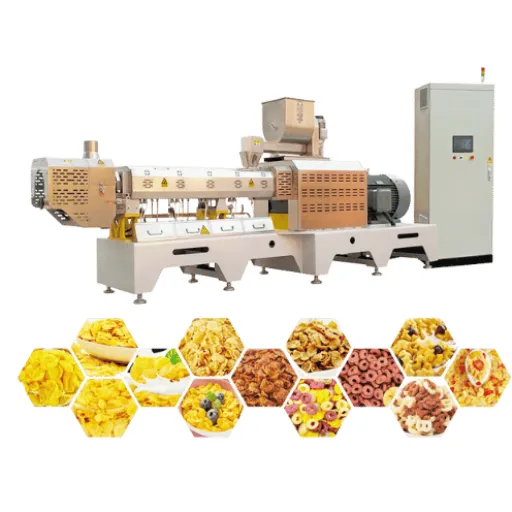
Yes, if the extruder has a modular screw design and interchangeable dies. Many manufacturers use the same twin screw extruder to produce corn flakes, puffed balls, rings, and other extruded snacks by changing screw elements, dies, and cutter configurations.
What L/D ratio is best for corn flakes extrusion?
For corn flakes, an L/D ratio of 12:1 to 20:1 is typical. Lower ratios work for simpler recipes and smaller outputs. Higher ratios provide more cooking and mixing time for complex recipes and high-capacity lines.
How do I prevent die blockage in a corn flakes extruder?
Maintain feed moisture in the 12–18% range, use a consistent particle size for corn flour, install a magnetic separator or sifter to remove foreign material, and keep die temperature within the recommended range. Regular cleaning and sharp cutters also help.
Is a twin screw extruder better than traditional cooking for corn flakes?
For most commercial operations, yes. Twin screw extrusion is continuous, more energy-efficient, and gives better control over texture and consistency than traditional batch pressure cooking. Traditional cook-and-flake methods can still produce excellent texture but require more labor, time, and floor space.
Conclusion
A twin screw extruder corn flakes machine is more than a cooking machine. It is the control point for product quality, throughput, and recipe flexibility. The right corn flakes extruder machine balances screw configuration, barrel temperature, moisture, and die design to produce pellets that flake cleanly, toast evenly, and stay crispy in the bowl.
When you evaluate equipment, focus on the specs that affect daily operation: L/D ratio, modular screws, motor torque, temperature zones, and die quality. Match capacity to your real production goals, and choose a supplier who can support installation, training, and spare parts over the long term.
Shandong Loyal Industrial Co., Ltd. designs food processing machines for manufacturers worldwide, from pilot-scale extruders to full industrial corn flakes lines. Whether you are launching a new cereal brand or scaling an existing operation, our engineering team can help you select the right twin screw extruder configuration for your recipe, capacity, and budget.
Ready to move forward? Contact us today for a customized quote and process consultation.