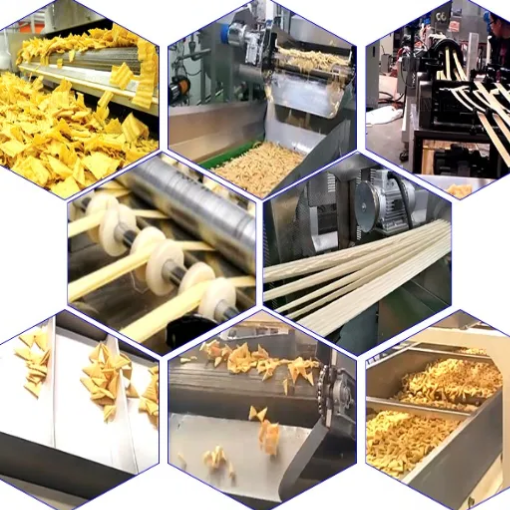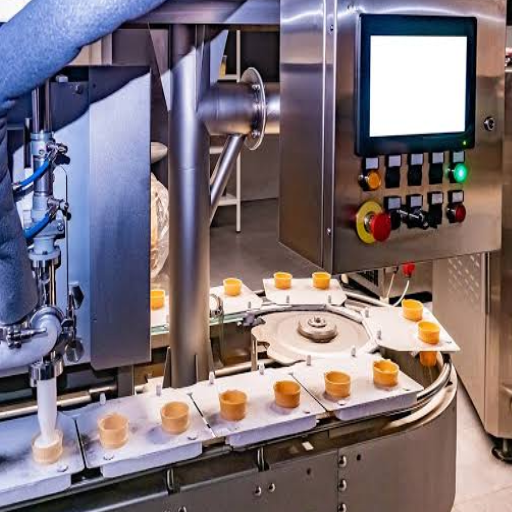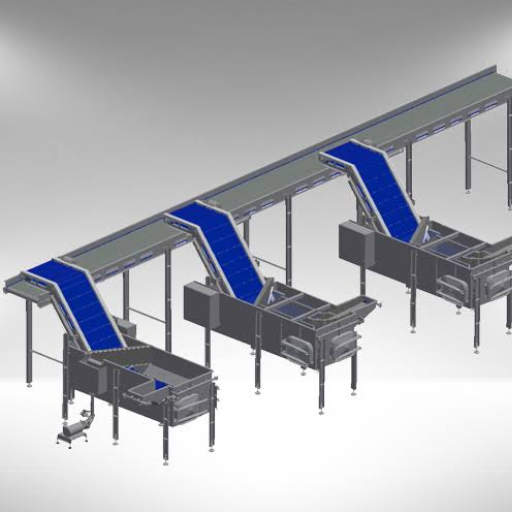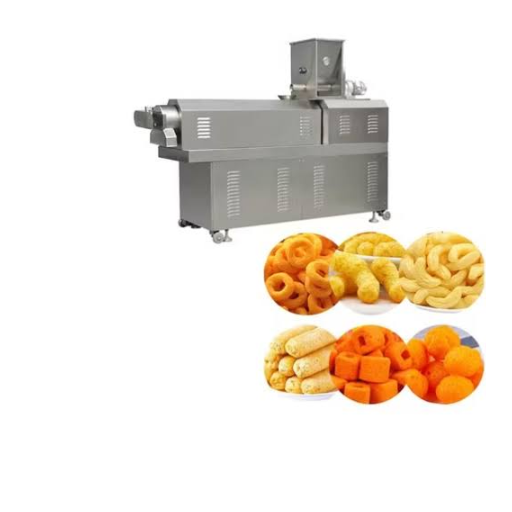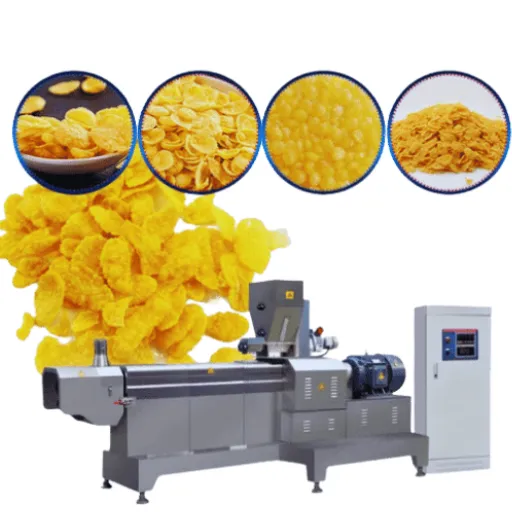
A corn flakes production line is an integrated system of mixers, extruders, flaking machines, dryers, toasters, coating drums, and packaging equipment. It transforms corn flour or grits into ready-to-eat breakfast cereal. The right line can produce 100 kg/h for a small startup or 1,000 kg/h or more for an industrial plant. Prices range from roughly 8,000towellover8,000towellover100,000 depending on capacity and automation.
That crisp, golden flake in your cereal bowl is the result of precise engineering. Choose the wrong equipment and you’ll get uneven flakes, high scrap rates, and expensive retrofits. Choose the right automatic corn flakes production line and you’ll gain consistent quality, lower labor costs, and a platform to scale into new cereal products.
In this guide, you’ll learn exactly what a corn flakes production line includes, how it works, what it costs at each capacity tier, and how to evaluate suppliers before you invest.
Key Takeaways
- A complete corn flakes production line mixes, extrudes, flakes, dries, toasts, cools, and packages corn into breakfast cereal in one continuous flow.
- Capacities typically range from 100 kg/h for small businesses up to 1,000 kg/h for industrial plants, with installed power from 35 kW to 240 kW.
- Entry-level lines start around 8,000–8,000–30,000, mid-size commercial lines run 28,000–28,000–70,000, and large industrial plants exceed $100,000.
- Twin-screw extrusion dominates modern lines because it offers precise cooking control, fast changeovers, and the ability to produce multiple cereal shapes.
- Total cost of ownership matters more than sticker price: factor in shipping, installation, energy, labor, spare parts, and after-sales support.
What Is a Corn Flakes Production Line?
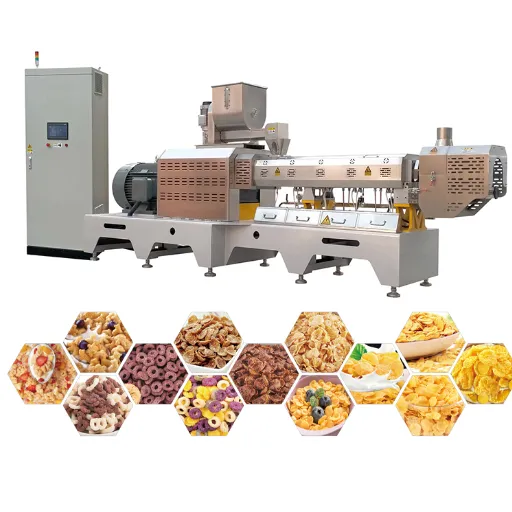
A corn flakes production line is a connected set of food-processing machines. It’s designed to produce ready-to-eat corn flakes continuously. Modern lines are usually built from food-grade SUS304 stainless steel. They’re controlled by a PLC/HMI system that monitors temperature, moisture, screw speed, and conveyor rates.
The line typically includes:
- Raw material mixer
- Screw conveyor or bucket elevator
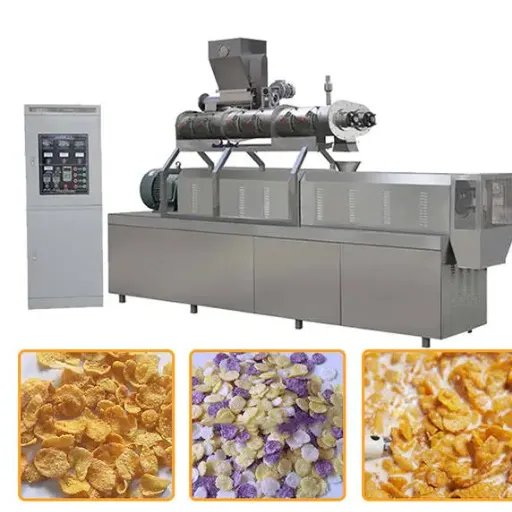
- Twin-screw extruder
- Cooling or vibrating conveyor
- Flaking machine / roller press
- Multi-layer dryer or pre-dryer
- High-temperature toaster or baking oven
- Sugar sprayer or coating drum
- Cooling conveyor
- Automatic packaging machine
Some suppliers also add cleaning/grading equipment at the front end and metal detectors or check-weighers before packaging. The exact configuration depends on whether you start from whole maize grits (traditional cook-and-flake route) or corn flour (modern extrusion route).
How a Corn Flakes Production Line Works
The most common modern process is extrusion cooking. It’s faster, more flexible, and easier to automate than the traditional pressure-cooking method.
Step 1 — Mixing
Corn flour or grits is blended with water, sugar, salt, malt extract, and sometimes vitamins or minerals. The goal is a uniform dough with controlled moisture, usually around 20–25%.
Step 2 — Extrusion Cooking
The dough enters a twin-screw extruder. Inside the barrel, heat, pressure, and mechanical shear cook the starch and form a dense pellet. Temperatures typically range from 90°C to 120°C. This step is what gives extruded corn flakes their light, crispy texture when toasted.
Step 3 — Flaking
The extruded pellets are cooled slightly, then pressed between two large steel rollers into thin flakes. Flake thickness is usually 0.3–1 mm and is controlled by the roller gap and pressure.
Step 4 — Drying and Toasting
Flakes pass through a multi-layer dryer to remove surface moisture, then into a high-temperature toaster or baking oven. Toasting temperatures often reach 200–320°C for 1–2 minutes, creating the golden color and crunch. Final moisture should drop to about 2–3% for shelf stability.
Step 5 — Coating and Flavoring (Optional)
For frosted or flavored cereals, a sugar sprayer or coating drum applies syrup, honey, chocolate, or savory seasonings. Some lines add vitamin coatings here.
Step 6 — Cooling and Packaging
Flakes are cooled to room temperature to prevent moisture condensation, then weighed, nitrogen-flushed, and sealed into pouches, boxes, or bulk bags.
If you want a deeper explanation of the chemistry and quality checkpoints behind these steps, see our companion guide to the corn flakes manufacturing process.
Key Equipment in a Corn Flakes Production Line
Each machine in the line has a specific job. However, skimping on one stage usually shows up later as inconsistent product or downtime.
Mixer and Screw Conveyor
The mixer blends dry and wet ingredients evenly. A screw conveyor then moves the dough into the extruder feeder at a controlled rate. Consistent feeding is critical; uneven flow causes surges that produce misshaped flakes.
Twin-Screw Extruder
The extruder is the heart of the line. Twin-screw designs offer better mixing, higher heat transfer, and more precise control than single-screw extruders. They also handle a wider range of recipes, including multigrain and high-fiber formulations.
Flaking Machine
A flaking machine uses two counter-rotating rollers to press pellets into thin, uniform flakes. Roller surface finish, gap adjustment, and pressure control determine flake thickness and breakage rate.
Dryer and High-Temperature Toaster
Dryers remove moisture gradually to prevent case hardening. The toaster then develops color, flavor, and crunch through Maillard reactions. Gas, electric, steam, or diesel heating options are available depending on local energy costs.
Coating and Flavoring System
A rotating drum or spray system applies coatings evenly. For sugar-coated flakes, a sugar syrup is sprayed while warm air passes through the drum. The excess coating is collected and recycled to cut down on waste.
Cooling Conveyor and Packaging Machine
Flakes are cooled to achieve a uniform temperature before packaging. The packaging machine weighs portions, fills bags, seals them, and prints batch codes. Nitrogen flushing extends shelf life by reducing oxidation.
For a broader view of how these machines fit into snack and cereal manufacturing, explore our snack food production line overview.
Production Capacity, Power, and Specifications
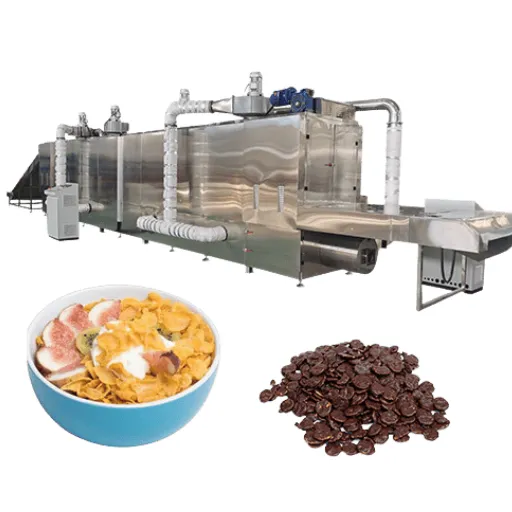
Choosing the right capacity is one of the most important decisions you’ll make. Buy too small and you can’t meet demand. Buy too large and you’ll waste capital, energy, and floor space.
Typical Capacity Ranges
| Capacity | Typical Use Case | Installed Power | Approximate Price Range |
|---|---|---|---|
| 100–150 kg/h | Small business, pilot plant, regional startup | 35–180 kW | 8,000–8,000–30,000 |
| 200–300 kg/h | Growing commercial producer | 120–200 kW | 28,000–28,000–48,000 |
| 300–500 kg/h | Medium commercial / export-oriented plant | 140–240 kW | 48,000–48,000–70,000 |
| 800–1,000 kg/h | Large industrial plant | 180–240 kW | $100,000+ |
Prices are indicative and vary with automation level, material grade, heating method, and supplier services.
Power and Utility Notes
Actual power consumption is usually 50–75% of installed power during normal running. A line heated by electricity will have a higher connected load than one using gas or steam. Therefore, always ask suppliers for real running power, not just installed power, when calculating energy budgets.
Footprint and Layout
A complete 200–300 kg/h line typically needs 20–30 meters of linear space plus room for raw material storage, packaging, and operator access. Larger lines may require 40+ meters. Before ordering, confirm the layout drawing and ceiling height requirements.
Mini-story: The cost of guessing capacity
Maria Lopez, a food entrepreneur in Mexico City, bought a 500 kg/h line for her first cereal launch. The supplier offered a “good deal” on the larger machine, so she took it. For the first 18 months, she ran it at 30% capacity. The oversized dryer consumed more energy than necessary. The loan payment strained cash flow, and she lacked warehouse space to store the output. After selling the line and moving to a 150 kg/h model, her unit costs dropped. Her payback period shortened from five years to under two.
How Much Does a Corn Flakes Production Line Cost?
The equipment price is only part of the investment. When you evaluate a corn flakes production line price, remember that a complete budget should include:
- Equipment purchase price
- Shipping and customs clearance
- Installation and commissioning
- Facility preparation (power, water, compressed air, ventilation)
- Raw material inventory
- Packaging materials
- Operator and maintenance training
- Spare parts inventory
- Working capital
Price Ranges by Capacity
| Capacity | Equipment Price (USD) | Typical Total Project Cost |
|---|---|---|
| 100–150 kg/h | 8,000–8,000–30,000 | 40,000–40,000–80,000 |
| 200–300 kg/h | 28,000–28,000–48,000 | 80,000–80,000–150,000 |
| 300–500 kg/h | 48,000–48,000–70,000 | 150,000–150,000–250,000 |
| 800–1,000 kg/h | $100,000+ | $300,000+ |
At the high end, an industrial corn flakes machine rated for 800–1,000 kg/h can cost $100,000 or more. These lines are built for multinational brands and large co-manufacturers.
Total project cost varies widely by region, building condition, and local labor costs. In India, for example, machinery alone is often quoted from ₹1.5 lakh to ₹50 lakh depending on capacity and configuration.
What Affects the Price
- Capacity — the largest single driver.
- Automation level — fully automatic lines cost more but reduce labor.
- Material quality — SUS304 food-grade stainless steel costs more than lower grades.
- Heating method — electric, gas, diesel, or steam each has different equipment and operating costs.
- Brand of motors and controls — Siemens, ABB, Delta, and Schneider components add reliability.
- Customization — special shapes, coatings, or packaging formats increase cost.
- After-sales services — installation, training, recipe support, and extended warranty.
Ready to compare options? Request a detailed quote for a corn flakes production line and get specifications matched to your target capacity.
How to Choose the Right Corn Flakes Production Line
Buying equipment isn’t just a technical decision. It’s a business decision that affects your product quality, operating costs, and ability to scale.
Match Capacity to Real Demand
Start with your target daily output and work backward. For example, if you plan to sell 2 tons per day and run two 8-hour shifts, you need roughly 125 kg/h of reliable output. In addition, add 15–20% headroom for growth and maintenance downtime.
Decide on Automation Level
- Semi-automatic: Lower upfront cost, more operators, better for low-volume or test markets.
- Fully automatic: Higher investment, fewer operators (often 3–5 per shift), consistent quality, easier to scale.
Choose the Process Route
- Extrusion: Best for most new plants. Fast, flexible, and compact.
- Traditional cook-and-flake: Preferred when texture and “bloom” are critical, but requires more space, longer cooking time, and more labor.
Evaluate Material and Build Quality
Food-contact surfaces should be SUS304 stainless steel or higher. Ask about motor brands, electrical components, bearing quality, and whether the supplier can provide CE, ISO, or HACCP-related documentation.
Check Supplier Support
A low price means little if the supplier can’t commission the line or supply spare parts. Confirm:
- Installation and commissioning support
- Operator and maintenance training
- Recipe and formulation assistance
- Warranty terms
- Spare parts availability and lead times
- Remote diagnostics capability
For more guidance on evaluating industrial machinery, see our overview of industrial food processing equipment.
Advantages of an Automatic Corn Flakes Production Line
Modern automatic lines deliver benefits that are difficult to match with manual or semi-automatic production.
Higher Output and Consistency
PLC-controlled extrusion, flaking, and toasting keep moisture, thickness, and color within tight limits. The result is fewer rejects and a more stable retail product.
Lower Labor Costs
A fully automatic line may need only 3–5 workers per shift, compared with 10–15 for a semi-automatic setup. Over a 5-year period, labor savings often repay a large part of the equipment investment.
Recipe and Shape Flexibility
By changing dies, molds, and parameters, the same line can produce corn flakes, wheat flakes, rice flakes, puffed rings, balls, stars, and other breakfast cereals. This lets you test new products without buying separate equipment.
Energy and Material Savings
High-temperature short-time (HTST) extrusion uses less water and energy than traditional pressure cooking. Insulated dryers, hot-air recirculation, and precise dosing reduce utility bills and ingredient waste.
Food Safety and Compliance
Automatic lines minimize human contact with the product. Stainless steel construction, smooth welds, and clean-in-place designs help meet HACCP, GMP, ISO 22000, and CE requirements.
Mini-story: From family snack plant to cereal exporter
When Raj Patel upgraded his family’s snack plant in Gujarat from a semi-automatic corn puff line to a fully automatic corn flakes production line, output per shift doubled and flake breakage dropped by nearly 40%. The PLC system let his team save recipes for three different products, so they could switch from plain corn flakes to frosted wheat flakes in under an hour. Within two years, the plant began exporting fortified cereal to East Africa.
Maintenance and Troubleshooting Tips
Preventive maintenance is what separates a line that runs 300 days a year from one that breaks down every month.
Daily Maintenance
- Inspect rollers, belts, and conveyors for wear.
- Check for abnormal noise, vibration, or overheating.
- Clean product contact surfaces and remove residue.
- Verify that temperature and moisture sensors read correctly.
Weekly Maintenance
- Lubricate bearings and moving parts per the manufacturer’s schedule.
- Clean the extruder barrel, screws, and dies.
- Inspect electrical connections and control panels.
Monthly Maintenance
- Replace worn belts, seals, bearings, and screw elements before they fail.
- Calibrate sensors and scales.
- Review production logs for trends that signal future problems.
Common Problems and Causes
| Problem | Likely Cause | Corrective Action |
|---|---|---|
| Inconsistent flake thickness | Worn rollers or uneven pressure | Adjust roller gap; replace worn rollers |
| Soggy or soft flakes | Final moisture too high | Increase toaster temperature or drying time |
| Burnt or dark flakes | Excessive toasting temperature | Calibrate oven controls; reduce temperature |
| Broken flakes | Over-drying or rough handling | Adjust moisture and conveyor speeds |
| Uneven coating | Clogged spray nozzles or drum speed | Clean nozzles; adjust drum rotation |
Keeping a stock of critical spare parts — rollers, bearings, seals, belts, and extruder screws — can cut downtime from days to hours.
Corn Flakes Market Outlook
Demand for ready-to-eat breakfast cereals continues to grow. According to market research, the global corn flakes market was valued at approximately USD 2.0 billion in 2025 and is projected to reach USD 4.68 billion by 2032 at a CAGR of 12.9% (Maximize Market Research).
The broader breakfast cereal market is also expanding. Future Market Insights estimates the cereal flakes market at USD 46.42 billion in 2026, with ready-to-eat processing types accounting for 63.4% of share (Future Market Insights).
Growth is strongest in Asia-Pacific, Africa, and Latin America, where urbanization and changing breakfast habits are driving demand. Health-conscious consumers want low-sugar, high-fiber, protein-fortified, and gluten-free options — all of which are easier to produce on a flexible extrusion-based line.
For a deeper technical background on cereal manufacturing, the Cereals & Grains Association provides a detailed PDF on ready-to-eat cereal technology.
Frequently Asked Questions
What is included in a corn flakes production line?
A typical line includes a mixer, screw conveyor, twin-screw extruder, cooling conveyor, flaking machine, dryer, high-temperature toaster, coating drum, cooling conveyor, and packaging machine. OpAdditional features include raw material purification, metal detection, and nitrogen flushing.
How much does a small corn flakes production line cost?
A small corn flakes making machine or entry-level 100–150 kg/h line typically costs between 8,000and8,000and30,000 for the equipment. Total project costs, including installation and working capital, usually run 40,000–40,000–80,000.
What is the difference between extruded and traditional corn flakes?
Extruded corn flakes are made from corn flour cooked under heat and pressure in a twin-screw extruder, then flaked and toasted. Traditional corn flakes start with whole maize grits that are pressure-cooked, dried, tempered, and then flaked. Extrusion is faster and more flexible; traditional flaking can produce a different texture and appearance.
How many workers are needed to run a corn flakes production line?
A fully automatic line typically requires 3–5 workers per shift for monitoring, feeding, packaging, and quality checks. A semi-automatic line may need 10–15 workers.
Can one production line make different cereal products?
Yes. By changing extruder dies, roller settings, and coating recipes, the same line can produce corn flakes, wheat flakes, puffed rings, balls, and other breakfast cereals.
What certifications should a corn flakes production line have?
Look for CE, ISO 22000 or ISO 9001, HACCP, and GMP compliance. Local markets may also require FDA, FSSAI, or EU hygiene registration depending on where you sell.
Conclusion
A corn flakes production line is one of the most important investments a cereal manufacturer can make. The right line gives you consistent product quality, lower labor costs, recipe flexibility, and a clear path to scale.
Before you buy, focus on matching capacity to real demand, choosing the right process route, evaluating total cost of ownership, and selecting a supplier with strong after-sales support. Price matters, but reliability, training, and spare parts availability often determine whether your investment succeeds.
Mini-story: Scaling with the right partner
The team at Sunrise Cereals in Nigeria started with a 150 kg/h automatic corn flakes line in 2023. As demand grew, they added a second line and expanded into honey-coated wheat flakes. Because their original equipment was modular and their supplier provided recipe support, the expansion took months instead of years. Today, Sunrise supplies supermarkets across West Africa.
Ready to find the right corn flakes production line for your business? Contact Shandong Loyal Industrial Co., Ltd. for a customized quote, capacity recommendation, and layout drawing tailored to your production goals.