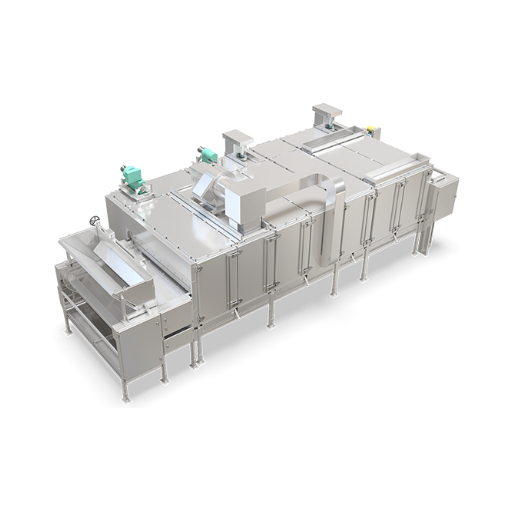
Sanitary design food processing equipment is built to be cleaned to a microbiological level, with no crevices, dead spaces, or rough surfaces where bacteria can survive. When a machine is hygienically designed, the risk of contamination drops before a single cleaning procedure is even written.
That distinction matters more than most buyers realize. A recall rarely starts with a dirty floor or a careless operator. It starts with a weld seam that traps residue, a flat ledge that pools water, or a shaft seal that no one can reach to clean.
Agree. You already know hygiene is non-negotiable. Every food safety plan, from HACCP to FSMA, leans on it.
Promise. By the end of this guide, you’ll know the principles behind sanitary equipment design, which stainless steel to specify, which standards actually matter, and exactly what to demand from any equipment supplier before you sign.
Preview. We’ll cover the 10 principles of sanitary design, material and surface finish choices, 3-A and EHEDG certification, and a practical buyer’s checklist.
Key Takeaways
- Sanitary design is a prevention strategy: equipment should be cleanable to a microbiological level, not just visually clean.
- Food-contact stainless steel should carry a surface finish of Ra 0.8 μm or smoother, with self-draining geometry and no niches or crevices.
- 304 suits most neutral-pH processing; 316 and 316L resist chloride and acid pitting for brines, seafood, and aggressive CIP chemicals.
- 3-A (US) and EHEDG (Europe) are the two certification bodies that prove an equipment design can actually be cleaned and verified.
- A flexible CIP system can cut water use by 30%, chemical use by 25%, and cleaning time by 20% while adding production hours.
What Is Sanitary Design in Food Processing?
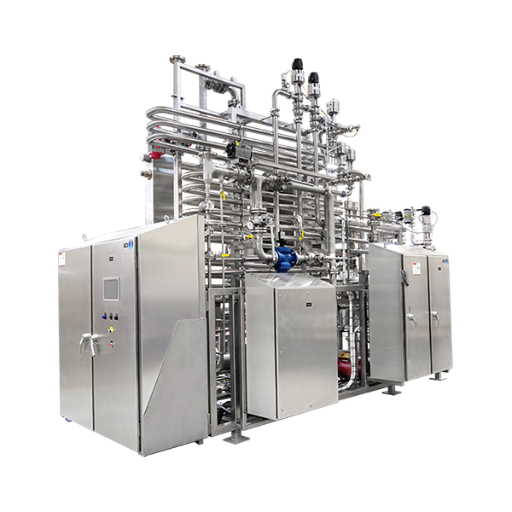
Sanitary design, often called hygienic design in European markets, is an approach to engineering equipment so that every product-contact surface can be cleaned quickly, completely, and repeatedly without deterioration.
Sanitary design is a prevention strategy, not a cleaning strategy. A cleaning program can only be as effective as the equipment it’s applied to. If a frame has an open hollow section, if a corner is a sharp 90-degree angle, if a weld has an undercut, no amount of scrubbing will reliably remove what hides there.
The goal is simple to state and hard to achieve: equipment that is cleanable to a microbiological level, meaning it can be brought to a state where harmful microorganisms are reduced to safe levels, every single cycle, for the life of the machine.
For a food manufacturer, this is not academic. The FDA lists equipment design under 21 CFR 117.40, and it ranked among the top 10 most-cited violations in 2023. Poor design is a compliance problem, not just a quality problem.
The 10 Principles of Sanitary Equipment Design
The North American Meat Institute published what is now the industry’s most widely referenced framework: 10 principles that apply well beyond protein processing. Most equipment buyers recognize these, even if they don’t know them by name.
Cleanable to a Microbiological Level
This is principle one because everything else serves it. Equipment must be built from materials and geometry that allow efficient cleaning throughout its entire service life.
Consider Maria, a QA manager at a cereal manufacturer. Her plant passed three consecutive audits, then failed one after a routine swab found Listeria in a conveyor’s tubular frame. The frame was welded shut, so it was never opened or cleaned internally. Condensation had pooled inside for years. The design itself created the harborage point. Maria’s team spent six figures on remediation and lost two weeks of production, all for a hollow tube that should have been hermetically sealed or eliminated in the first place.
Made of Compatible Materials
Product-contact materials must be inert, non-toxic, corrosion-resistant, and mechanically stable. This almost always means stainless steel. More on grades and finishes below.
Accessible for Inspection, Maintenance, and Cleaning
Every part of the machine should be reachable without extraordinary effort. If a component can’t be seen, it can’t be verified clean. Equipment should sit on legs or frames with clearance underneath, and away from walls and adjacent equipment, so a washdown crew can get to every surface.
No Product or Liquid Collection
Flat horizontal surfaces collect liquid. Sanitary design slopes surfaces, usually at a minimum of 3 degrees, so water and product run off rather than pool. Frames, housings, and control enclosures should be pitched or rounded to shed moisture.
Hollow Areas Hermetically Sealed
Hollow rollers, frames, and shafts are classic harborage points. They should be eliminated where possible or permanently sealed. Where a sealed hollow element heats up, it needs venting so cooling doesn’t pull moisture inside.
No Niches
A niche is any pit, crack, gap, open seam, exposed thread, bolt head, or recess that can trap product. Sharp internal angles, lap joints, and protruding ledges are all niches. Hygienically designed equipment eliminates them or covers them so they can’t harbor bacteria.
Sanitary Operational Performance
The machine must not build up residue during normal operation. Conveyors should not shed product into frames, and bearings should not leak grease onto product zones.
Hygienic Design of Maintenance Enclosures
Control panels, motor housings, and electrical enclosures need sloped tops and sealed edges so they don’t collect dust and moisture. In washdown environments, components should carry an IP69K rating to survive high-pressure, high-temperature cleaning.
Hygienic Compatibility with Other Plant Systems
Equipment has to work with the plant’s drainage, ventilation, and automated cleaning systems. A beautifully cleanable machine installed over a poorly sloped floor is still a risk.
Validated Cleaning and Sanitizing Protocols
Finally, the design must support documented, validated cleaning procedures, whether manual, clean-in-place (CIP), or clean-out-of-place (COP). A design is only as good as the protocol it enables.
Material Selection: Food-Grade Stainless Steel for Processing Equipment
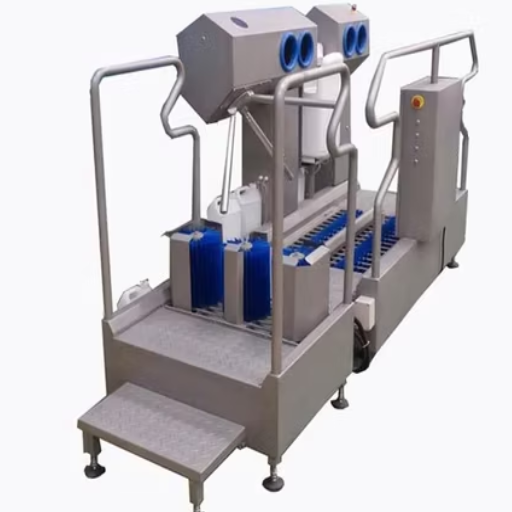
Stainless steel is the default material for sanitary food processing equipment, and for good reason. It is inert, non-toxic, smooth, non-porous, and resistant to both food acids and cleaning chemicals. But “stainless steel” is not one thing.
304 vs 316 Stainless Steel: Which Grade Do You Need?
The single biggest distinction between grades is molybdenum. 316 and 316L contain 2 to 3 percent molybdenum, which is what resists chloride-induced pitting and crevice corrosion. 304 contains none.
| Grade | Composition | Best Use | Key Limitation |
|---|---|---|---|
| 304 | 18% Cr, 8% Ni | Neutral-pH products, dairy, bakery, dry goods, beverages | Pits in high-salt or chloride-heavy conditions |
| 304L | Low carbon | Welded equipment (resists weld sensitization) | Same chloride limits as 304 |
| 316 / 316L | Adds 2–3% Mo | Brine, seafood, acidic foods, chlorine CIP | Costs 20–30% more than 304 |
| 430 | Ferritic, no nickel | Dry, non-critical, decorative only | Poor chloride resistance, not for washdown |
Here is the practical rule: specify 304 for roughly 90 percent of neutral-pH processing. Specify 316 or 316L when your product contains salt, brine, or acid, or when your CIP system uses chlorine-based chemicals. The 20 to 30 percent premium on 316 is cheap insurance against pitting that ruins a surface finish in months.
Surface Finish and Ra Values: Why 0.8 μm Matters
Grade alone is not enough. A rough or scratched 316 surface harbors bacteria just as easily as a rough 304 surface. What matters is the surface roughness, measured as an Ra value in micrometers.
Food-contact surfaces should carry a finish of Ra 0.8 μm or smoother, roughly a No. 4 mechanical finish. Electropolishing goes further for the most demanding applications. After welding or machining, passivation per ASTM A967 restores the protective chromium oxide layer. Without passivation, even the right grade will underperform.
Welds, Seals, and Passivation
Welds on product-contact surfaces must be continuous, smooth, and free of porosity, cracks, or undercut. Spot welding should be avoided in favor of continuous welds that are ground and polished. Direct metal-to-metal connections, other than welds, should be minimized because they corrode and trap residue. Seals and O-rings belong only in static joints and must be easy to remove and replace.
Want to see how these principles translate into a real line? Explore our food processing machines and see where sanitary design shows up in every weld, slope, and seal.
The Standards Landscape: 3-A, EHEDG, NSF, and FSMA
Sanitary design is not a matter of opinion. It is codified in standards you can point to and certify against.
3-A Sanitary Standards (United States)
3-A Sanitary Standards, Inc. is an independent nonprofit with more than 70 standards covering dairy, meat, beverage, and general food equipment. Its recent General Requirements revision (00-02) tightened seal requirements, mandated substantially flush CIP gasket joints, and added visible leak detection for double seals. 3-A certification is the clearest US signal that an equipment design has been independently verified for cleanability.
EHEDG Guidelines (Europe)
The European Hygienic Engineering & Design Group, founded in 1989, publishes roughly 45 guidelines and offers its own testing and certification. EHEDG testing distinguishes components cleanable without disassembly (Class I, typically via CIP) from those requiring dismantling. Its three test methods cover cleanability, sterilisability, and bacteria tightness. EHEDG certification is the European equivalent of 3-A and increasingly recognized worldwide.
What FSMA Means for Equipment Buyers
The Food Safety Modernization Act shifted the US industry from reacting to contamination to preventing it. FSMA does not name specific certifications, but it requires facilities to demonstrate that equipment is designed and maintained to protect against contamination. Third-party certification from 3-A, EHEDG, or NSF is the simplest way to substantiate that claim. If you export to both the US and Europe, buy equipment that aligns with both frameworks from a manufacturer experienced in each market.
Here is where a global manufacturer’s perspective pays off. The 3-A and EHEDG standards share the same core principles, but they differ in detail. A supplier who builds for multiple regions already designs to the stricter common denominator. That is the kind of expertise worth asking about before you buy.
Ready to spec a line that meets both markets? Contact us for a tailored quote and we’ll map the standards that apply to your products and target regions.
Sanitary Design Across Food Production Lines
Principles are universal, but application differs by product. Here is how sanitary design plays out across the lines Loyal builds.
Snack and Extrusion Lines
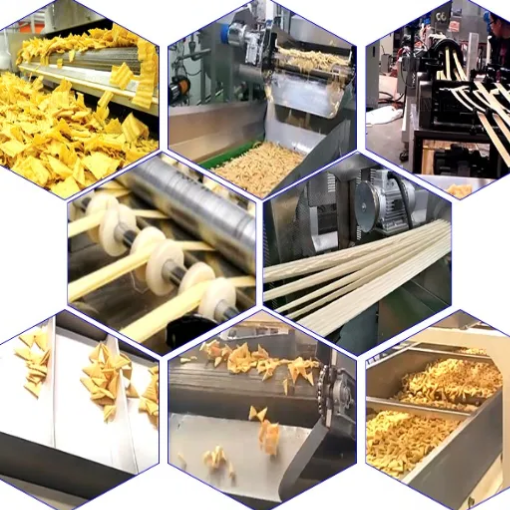
Puffed snacks, cereal bars, and corn flakes run through extruders and dryers that operate warm and wet, then dry. Warm, humid, starch-rich environments are exactly where biofilm forms. Extruder barrels need smooth, polished product-contact surfaces. Conveyors need self-draining frames and sealed bearings so oil and starch dust don’t accumulate.
Microwave Drying and Sterilization Equipment
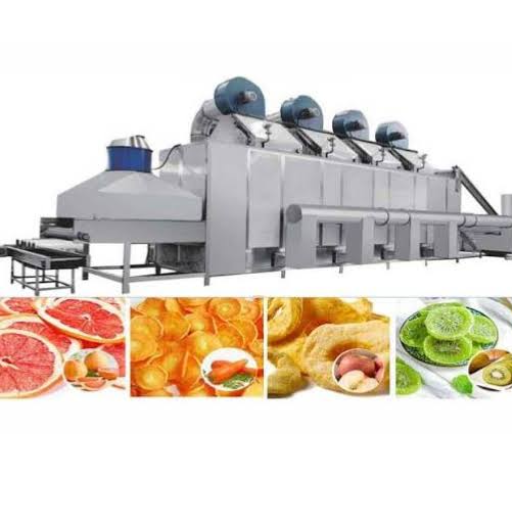
Microwave systems do double duty: they dry and they sterilize. A well-designed microwave drying machine reduces drying time while its thermal effect lowers microbial load. But the benefit is lost if the chamber itself traps moisture. Sanitary microwave equipment uses smooth stainless chambers, rounded internal corners, and drainable geometry so condensation doesn’t linger between cycles.
Baby Food and High-Care Production
Baby food and other high-care products demand cleanroom-compatible equipment. This is the strictest end of the spectrum: electropolished surfaces, hermetic sealing, CIP-ready piping, and components rated for aggressive washdown. If your line can’t meet these standards, it can’t enter this market segment at all.
Across every line, the pattern is the same. Sanitary design is not a premium add-on. It is the difference between a line that passes audit and one that doesn’t. You can explore industrial food processing equipment and food production line equipment to see how these principles carry through a full system.
CIP vs. COP vs. Manual Cleaning: Designing for Cleanability
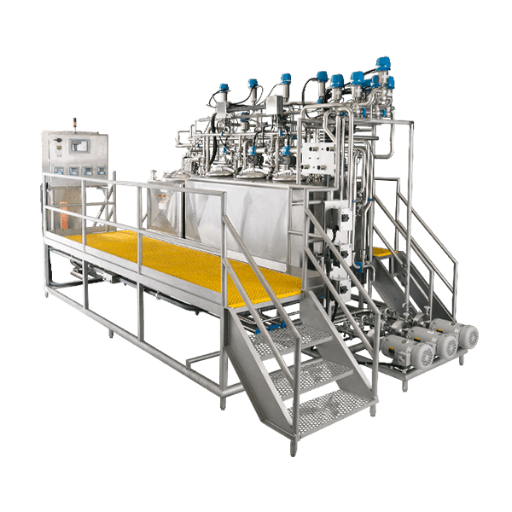
How you clean depends on how the equipment is designed. The three approaches are clean-in-place (CIP), clean-out-of-place (COP), and manual cleaning. Sanitary design should be matched to the method you intend to use.
Clean-in-Place (CIP) Systems and Design Requirements
CIP circulates rinse, wash, acid, and sanitizing solutions through a closed circuit without disassembly. It is rooted in dairy but has spread to beverage, meat, and general food processing. For CIP to work, the equipment must be designed for it: self-draining lines, no dead ends, cleanable welded or clamp joints, and surfaces that let flow reach every product-contact area. 3-A guidance recommends flow velocities around 1.5 meters per second, exposure times of 10 to 60 minutes, and drainage slopes of 5 to 10 millimeters per meter.
The return is significant. A well-designed flexible CIP system delivers at least 30 percent savings on freshwater, 25 percent on chemicals, and 20 percent on cleaning time, while cutting wastewater load. One bakery’s modular CIP spray system dropped conveyor cleaning from six to eight hours of manual work to 30 minutes per conveyor, eliminated a $16,000-per-week outsourced cleaning bill, and added roughly 390 production hours per year.
Consider David, a plant engineer at a South African ice cream producer. His team replaced ten valves with mixproof valves carrying smart positioners. The retrofit saved an estimated 165,000 liters of CIP liquid per year, worth about €70,000 in water, chemicals, and energy, and paid for itself in four months. David’s lesson: the biggest savings in food processing often hide in the cleaning cycle, not the production cycle.
Cost and ROI: What Sanitary Design Saves You
Sanitary design costs more upfront. Electropolished surfaces, continuous polished welds, sealed bearings, and CIP-ready manifolds all add to the purchase price. But the alternative costs more over time: slower changeovers, higher labor, more water and chemicals, higher recall risk, and audit failures that stop production.
A basic CIP system can start around $200,000 for integrated plant-scale installations, with smaller mobile units available for a fraction of that. The payback, as the case studies show, is measured in months, not years. When you evaluate equipment quotes, compare lifecycle cost, not just sticker price. A cheaper line with crevices and dead spaces becomes more expensive the first time you can’t clean it in time for the next run.
How to Choose Sanitary Design Food Processing Equipment
This is the section most guides skip. Here is what to demand from any supplier before you commit.
- Request mill test certificates. Match the material certificate to the machine’s serial number. Ask for the originals, not photocopies.
- Confirm the grade. Verify 304 versus 316 with documentation, and consider an on-site molybdenum spot test if the application is chloride-heavy.
- Ask for surface finish data. Request measured Ra values on product-contact surfaces, not a vague promise of “food safe.”
- Demand welding and passivation records. Ask for welding procedure specifications, welder qualification records, and passivation reports per ASTM A967.
- Check drainability. Walk the line and look for flat ledges, pools, and hollow sections. If water can collect, bacteria will follow.
- Inspect seals and gaskets. Confirm O-rings are static, removable, and replaceable, and that double seals have visible leak detection.
- Match cleaning method to design. If you plan to use CIP, verify the line is CIP-ready with no dead ends and self-draining geometry.
- Ask about certification. Inquire about 3-A, EHEDG, or NSF certification and whether the manufacturer has experience with your target markets.
- Verify washdown ratings. Confirm motors, sensors, and enclosures are IP69K or equivalent if they’ll face high-pressure cleaning.
- Check the track record. Ask for ISO 9001, HACCP alignment, and export experience, plus references in your product category.
Watch for red flags: a supplier substituting grade 201 or 430 for 304 or 316, thin plating over non-food-grade substrate, or a vague “food safe” claim with no standard to back it. These are the shortcuts that show up as a failed audit or a recall down the line.
Loyal has built food processing machines to these principles since 2005, serving more than 650 customers across global markets. That longevity comes from treating sanitary design as a baseline, not an option.
Conclusion
Sanitary design food processing equipment is where food safety either holds or fails. The equipment you buy today determines whether your cleaning program works tomorrow.
Remember the core points. Build to the 10 principles of sanitary design, starting with cleanability to a microbiological level. Specify the right stainless steel, 304 for neutral products and 316 or 316L for salt, acid, and chlorine. Demand a surface finish of Ra 0.8 μm or smoother, and verify it, along with welds, seals, and passivation records. Align your line with 3-A and EHEDG standards and let third-party certification prove it. And match your cleaning method, CIP, COP, or manual, to the design from day one.
Every hour you save in cleaning is an hour of production, and every crevice you eliminate is a recall you never have to manage.
If you’re specifying sanitary design food processing equipment or upgrading an existing line, we can help. Contact Shandong Loyal Industrial Co., Ltd. to talk through the standards that apply to your products and get a line built for cleanability from the first weld.