Energy efficient microwave drying can reduce industrial food processing energy costs by 50% to 70% compared to conventional hot air drying, and by up to 90% compared to freeze drying. For manufacturers spending 50,000annuallyondryingenergy,thistechnologycancutthatbillto50,000annuallyondryingenergy,thistechnologycancutthatbillto15,000 or less — while also speeding up production and improving product quality.
If you run a food processing operation, you already know the pressure. Energy costs keep climbing. Margins stay thin. Customers and regulators demand lower carbon footprints.
And drying — one of the most energy-intensive steps in food manufacturing — accounts for an estimated 20% to 25% of your total energy consumption. That’s according to research from Oak Ridge National Laboratory.
The good news? You don’t need to choose between cutting costs and maintaining quality. Energy efficient microwave drying delivers both. This guide gives you the exact energy consumption data, ROI framework, and equipment selection criteria you need to make an informed decision — with real production numbers, not marketing claims.
By the end, you’ll know how much energy you can realistically save, what the equipment costs, how to calculate your payback period, and which type of system fits your specific product and operation.
Key Takeaways
- Energy efficient microwave drying cuts energy use by 50% to 70% versus hot air drying, with some systems achieving 0.8 to 1.5 kWh per kilogram of water removed compared to 1.5 to 4.0 kWh/kg for conventional methods.
- Drying times drop by 50% to 80%, which means more production cycles per shift and lower labor costs per unit.
- Most mid-to-high-volume operations see an equipment payback period of 18 to 36 months through energy savings alone.
- Hybrid systems that combine microwave with hot air can reduce energy consumption by up to 55% versus hot air alone, often offering the best total cost of ownership.
- Because microwave dryers run on electricity rather than fossil fuels, they support corporate decarbonization goals and make your operation renewable-energy ready.
What Is Energy Efficient Microwave Drying?
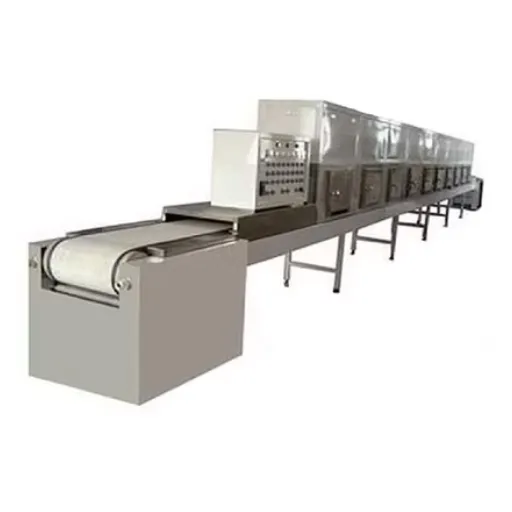
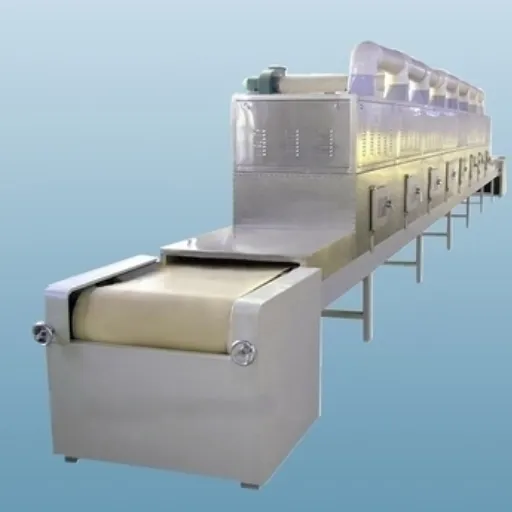
Energy efficient microwave drying uses electromagnetic radiation — typically at 915 MHz or 2.45 GHz — to heat water molecules directly inside food products.
Unlike conventional hot air dryers that heat the surrounding air and rely on surface-to-interior heat conduction, microwave dryers create volumetric heating. The energy couples with polar molecules (primarily water) throughout the material simultaneously. This eliminates wasted energy. Hot air systems lose substantial heat to chamber walls, exhaust gases, and non-aqueous product components.
Think of it this way. A hot air dryer is like heating a room to dry a wet towel. A microwave dryer is like targeting the water inside the towel directly.
The result? Faster drying. Less energy waste. More consistent results.
When Chen Wei took over as plant manager at a mid-sized snack factory in Shandong Province, his first task was cutting the monthly energy bill. The factory’s three hot air drying tunnels were running 16 hours a day. They consumed massive amounts of natural gas and electricity.
After six months of research and a pilot test with a hybrid microwave system, Chen cut his drying energy costs by 58%. The dryers now finish each batch in 45 minutes instead of 2.5 hours.
“I was skeptical at first,” he told his equipment supplier. “But the meter doesn’t lie.” His story isn’t unique. It’s the pattern we see across the industry.
Explore our industrial microwave ovens for energy-efficient drying solutions.
How Volumetric Heating Works
Microwave energy penetrates food materials and causes water molecules to oscillate rapidly. This molecular friction generates heat internally rather than externally. The penetration depth depends on the frequency used and the dielectric properties of the food:
- 915 MHz: Deeper penetration (up to 20 cm in some materials), ideal for large or dense products
- 2.45 GHz: Shallower penetration (approximately 2-4 cm), better for smaller, thinner products
The key microwave drying efficiency advantage comes from where the energy goes. In a hot air system, roughly 35% to 45% of input energy is lost as hot exhaust. Microwave systems direct 65% to 75% of their energy input into the product itself. That difference is where your savings live.
Types of Energy Saving Microwave Drying Machines
Not all microwave drying systems work the same way. The right configuration depends on your product, throughput, and quality requirements:
Atmospheric Microwave Dryers: These operate at standard pressure and work well for high-volume bulk products like grains, seeds, and certain snack materials. They’re the most affordable option but can subject heat-sensitive products to higher temperatures.
Vacuum Microwave Dryers: By reducing chamber pressure, these systems lower water’s boiling point to 30°C to 50°C. This enables gentle drying that preserves heat-sensitive nutrients, colors, and flavors. They’re ideal for premium fruits, vegetables, proteins, and botanical ingredients.
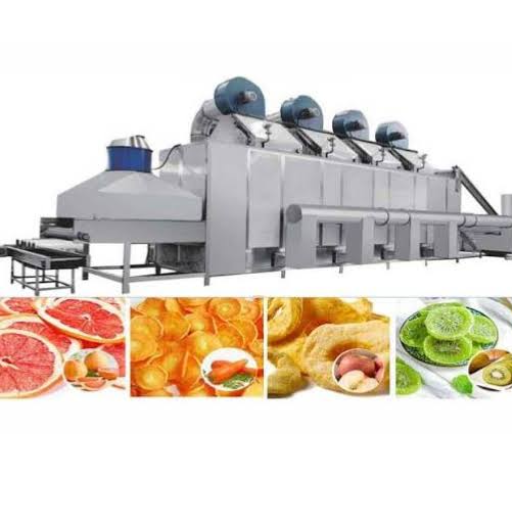
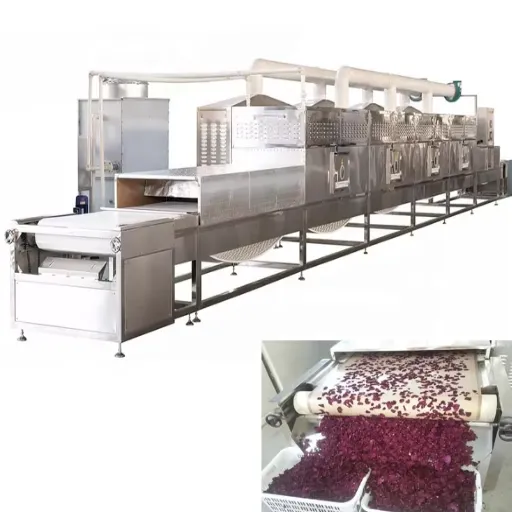
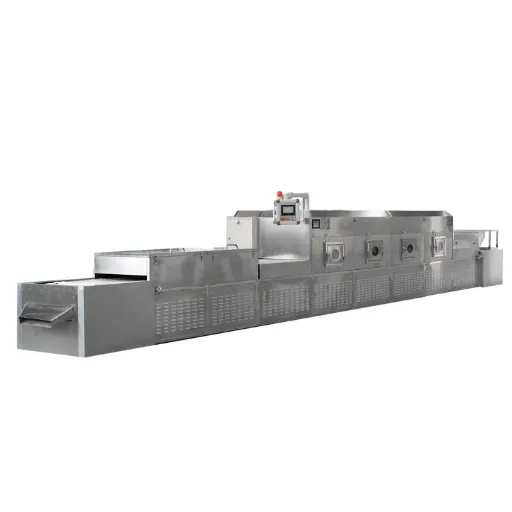
Continuous Belt Systems: Product moves on a conveyor belt through a microwave field. These suit high-throughput operations (tons per hour) with consistent product dimensions. Think large-scale snack production or grain processing.
Batch Tray Systems: Product sits on trays inside a sealed chamber. Better for R&D, smaller production runs, or products that need precise process control. Many manufacturers start here for pilot testing.
Hybrid Systems: Combine microwave energy with hot air, infrared, or vacuum. Hot air handles initial surface moisture efficiently, while microwaves tackle the slower internal drying phase. As we’ll see later, hybrid configurations often deliver the best total cost of ownership.
Microwave Drying Energy Savings: The Data That Matters
Let’s get specific. Here’s how energy efficient microwave drying stacks up against the two most common conventional methods. Understanding these differences is key to projecting your actual microwave drying energy savings.
Microwave Drying vs Hot Air Drying: Energy Comparison
| Metric | Hot Air Drying | Microwave Drying | Savings |
|---|---|---|---|
| Specific energy consumption | 1.5 to 4.0 kWh/kg water removed | 0.8 to 1.5 kWh/kg water removed | 50% to 70% |
| Thermal efficiency | 15% to 25% | 30% to 50% | 2x improvement |
| Drying time | Baseline | 50% to 80% faster | Hours saved |
| Floor space | Baseline | 20% to 35% less | Compact layout |
| Vitamin C retention | 30% to 40% (60-70% loss) | 70% to 85% | 2x better |
The numbers tell a clear story. One manufacturer dropped from 4.2 kWh/kg to 0.9 kWh/kg after switching to a continuous microwave system.
That’s a 79% reduction.
But here’s what many guides miss: your actual savings depend heavily on what you dry and how you currently do it. Industrial microwave dryer energy consumption varies significantly by product type, moisture content, and system design. A facility already running efficient hot air at 1.5 kWh/kg will see smaller gains than one running outdated equipment at 4.0 kWh/kg. The comparison table above shows the range — your results will fall somewhere inside it.
Microwave Drying vs Freeze Drying
Freeze drying is the gold standard for product quality. It’s also an energy hog. Freeze dryers consume 10 to 15 kWh per kilogram of water removed — roughly 10 times what an efficient microwave system uses. Drying cycles stretch to 24 to 48 hours versus 30 to 90 minutes for vacuum microwave.
For premium products where quality justifies the cost, freeze drying still has its place.
But for most food manufacturers, the quality gap has narrowed dramatically. The energy savings? Impossible to ignore.
Real-World Production Examples
Maria Gonzalez runs quality assurance at a pet food production facility in Mexico. Her company switched from hot air to vacuum microwave drying for their high-moisture meat-based products in 2024.
“We went from 8-hour drying cycles to 45 minutes,” she explains. “Energy costs dropped 62% in the first year.”
But honestly, the bigger win was product quality. Her team’s protein retention improved. Customer complaints about off-flavors stopped entirely.
Her facility processes roughly 2 metric tons per day. At local electricity rates, the energy savings alone cover the equipment lease payment with margin to spare.
How Energy Efficiency Translates to Cost Savings
Energy savings are only part of the financial picture. To build a solid business case, you need to model the full impact on your operation.
Calculating Your Potential Savings
Here’s a simple framework you can adapt with your own numbers:
Step 1: Calculate current annual drying energy cost
- Current kWh/kg × daily throughput (kg) × operating days per year × electricity rate ($/kWh)
Step 2: Estimate microwave drying energy cost
- Microwave kWh/kg × same throughput × same operating days × same rate
Step 3: Add hidden savings
- Faster cycles = more throughput per shift (capacity gain)
- Reduced rejection rates = less waste
- Lower labor per unit = production efficiency gain
- Less floor space = potential facility cost reduction
Example: A snack manufacturer processes 1,000 kg daily, 250 days per year. Their hot air system uses 3.5 kWh/kg at $0.12/kWh.
Annual drying energy cost: 105,000.Switchingtoamicrowavesystemat1.2kWh/kgdropsthatto105,000.Switchingtoamicrowavesystemat1.2kWh/kgdropsthatto36,000. That’s $69,000 in annual energy savings alone.
Payback Period Reality
Equipment investment for industrial microwave dryers typically ranges from 150,000forpilot−scalesystemsto150,000forpilot−scalesystemsto500,000 to 1.5millionformid−rangeproductionunits.Largecontinuouslinescanexceed1.5millionformid−rangeproductionunits.Largecontinuouslinescanexceed3 million, with installation and utilities adding 15% to 25% on top.
For mid-to-high-volume operations, the payback period usually falls between 18 and 36 months when counting energy savings alone. Add in throughput gains and reduced waste, and that timeline often shortens to 12 to 24 months.
Factors that shorten payback:
- High current energy costs (expensive electricity or gas)
- Long current drying cycles (lots of room for improvement)
- High daily throughput (savings scale with volume)
- Government energy-efficiency incentives or tax credits
Factors that extend payback:
- Low current energy costs
- Small daily volumes
- Need for extensive facility upgrades
- Products requiring complex custom configurations
Hidden Cost Benefits
The energy savings get the headlines, but three secondary benefits often matter just as much:
Reduced rejection rates: Better temperature control and more uniform drying mean fewer burnt, under-dried, or case-hardened products. Some manufacturers report rejection rate drops of 30% to 50%.
Labor efficiency: Automated continuous systems reduce manual loading, monitoring, and unloading. One operator can often manage what previously required two or three.
Space savings: Microwave systems typically need 20% to 35% less floor space than equivalent hot air setups. In facilities where space is tight, this can eliminate the need for costly expansion.
Product Quality: The Efficiency Bonus
Here’s the counterintuitive truth that surprises many manufacturers: energy efficient microwave drying doesn’t just save money. It often produces a better product. This is one reason adoption of energy efficient microwave drying technology is accelerating across the food industry.
Nutrient Retention Advantages
Because microwave drying is faster and can operate at lower temperatures (especially in vacuum configurations), heat-sensitive nutrients survive better. Research published in the Journal of Food Science and compiled by the Institute of Food Technologists shows that hot air drying can destroy 60% to 70% of Vitamin C in some fruits and vegetables. Microwave drying — particularly vacuum microwave — typically retains 70% to 85%.
The same pattern holds for antioxidants, volatile aroma compounds, and natural colors.
Your dried mango looks more like mango. Your herb powders smell more like fresh herbs. Your protein ingredients retain more of their nutritional value.
Drying Speed and Throughput
Speed isn’t just about convenience. It’s about capacity. Energy efficient microwave drying transforms your production schedule. When your drying cycle drops from 4 hours to 1 hour, you can run 3 to 4 batches in the same shift that previously handled 1. That means you either produce more with the same equipment footprint, or you meet demand with fewer shifts and less overtime.
For seasonal products or demand spikes, this flexibility is invaluable. You’re no longer locked into long drying cycles that dictate your entire production schedule.
Consistency and Safety
Volumetric heating reduces the wet-core problem that plagues hot air systems. In conventional drying, the surface dries faster than the interior, creating a hard outer shell that traps moisture inside. This case hardening leads to inconsistent final moisture content, storage instability, and potential microbial growth.
Microwave heating penetrates throughout the product, drying more uniformly. Some systems achieve microbial safety in as little as 10 minutes — compared to 1.5 days for certain conventional processes. That’s not just a quality improvement. It’s a food safety advantage.
Choosing the Right Energy Efficient System
With multiple energy efficient microwave drying configurations available, how do you pick the right one? The decision comes down to three factors: your product, your volume, and your infrastructure.
Key Selection Criteria
Throughput requirements: Continuous belt systems handle high volumes (tons per hour). Batch systems suit smaller runs or product variety. Match the system to your peak demand, not your average.
Product characteristics: High-moisture, heat-sensitive, or premium products typically need vacuum microwave. Dense or large products may need 915 MHz systems for deeper penetration. Thin, uniform products work well with 2.45 GHz.
Available power infrastructure: Industrial microwave dryers need significant electrical capacity. A mid-range system might require 100 kW to 300 kW of dedicated power. Verify your facility can support this before specifying equipment.
Explore our microwave drying machines to find the right system for your operation.
Atmospheric vs Vacuum: Which Saves More Energy?
Atmospheric systems use less energy overall because they don’t need vacuum pumps. But they operate at higher temperatures, which can damage sensitive products and may require longer cycle times for certain materials.
Vacuum systems use more energy per cycle due to vacuum pump load, but they enable much lower drying temperatures. For premium products where quality commands a price premium, the trade-off usually favors vacuum.
Here’s a simple decision framework:
- Choose atmospheric if: You process grains, seeds, or robust low-value products in high volumes. Upfront cost is your primary constraint.
- Choose vacuum if: You process fruits, vegetables, proteins, herbs, or other heat-sensitive materials. Product quality directly affects pricing.
When Hybrid Systems Make Sense
Here’s a contrarian point that many equipment vendors won’t emphasize: pure microwave isn’t always the best answer. Hybrid configurations that combine hot air with microwave energy often deliver the best total cost of ownership.
Here’s why. Hot air is actually very efficient at removing surface moisture during the initial “constant-rate” drying phase. It’s only during the later “falling-rate” phase — when moisture must migrate from the interior to the surface — that hot air becomes slow and inefficient. Microwaves excel at exactly this internal moisture movement.
A well-designed hybrid system uses hot air for the first phase and microwave energy for the second. Research shows these configurations can reduce total energy consumption by up to 55% compared to hot air alone. The capital cost is lower than a pure microwave system of equivalent capacity. And you get the best of both technologies.
For many small-to-mid-sized manufacturers, a hybrid retrofit of an existing hot air line — adding microwave modules to the falling-rate zone — offers the fastest payback with the lowest disruption.
Implementation: From Pilot to Production
Switching drying technology isn’t a light switch. It’s a journey. The manufacturers who get the best results follow a structured path.
Start with a Pilot
Never buy energy efficient microwave drying equipment based on brochure claims alone. Reputable suppliers offer pilot testing facilities where you can run your actual product through their equipment. This step is non-negotiable.
During pilot testing, measure:
- Actual energy consumption (kWh/kg water removed) for your specific product
- Final moisture content and uniformity
- Product quality attributes (color, texture, flavor, nutrient retention)
- Cycle time from load to unload
- Any unexpected behaviors (sparking, overheating, uneven drying)
Bring your own energy meter if possible. Verify the supplier’s claims with independent measurement. A few days of pilot testing can save months of regret.
Scaling Considerations
Industrial-scale continuous microwave systems operate at higher power densities than lab units. While laboratory batch units typically run at 0.5 to 4.5 W/g, optimal industrial continuous power densities center around 7.3 W/g. Your supplier should help you navigate this scale-up based on your pilot results.
Integration with existing production lines matters too. Will the microwave dryer feed directly from your forming or extrusion equipment? Where does dried product go next? Map the full material flow before finalizing layout.
Maintenance for Sustained Efficiency
The magnetron — the component that generates microwave energy — is your primary maintenance item. Industrial magnetrons typically last 4,000 to 6,000 operating hours. At 16 hours per day, that’s roughly 8 to 12 months of continuous use.
Replacement magnetrons cost several thousand dollars each, depending on power rating. Budget for this as a scheduled maintenance item, not an unexpected failure. Regular inspection of waveguides, seals, and safety interlocks prevents more expensive problems.
Keep your system clean. Product residue absorbs microwave energy unpredictably, reducing efficiency and creating hot spots. Most food-grade systems use stainless steel interiors that clean easily, but establish a regular cleaning protocol and stick to it.
Sustainability and ESG: Beyond Cost Savings
The business case for energy efficient microwave drying isn’t just about your P&L. It’s increasingly about your sustainability reporting, customer relationships, and regulatory compliance. Companies that invest in energy efficient microwave drying position themselves ahead of tightening environmental regulations.
Decarbonizing Your Drying Process
Most hot air dryers run on natural gas or steam generated from fossil fuels. Microwave dryers run on electricity. That difference matters more every year.
Electricity can come from renewable sources. Natural gas cannot. As more manufacturers commit to net-zero targets and Scope 2 emissions reductions, electrifying thermal processes like drying becomes a strategic priority. Microwave drying makes your operation renewable-energy ready.
If your facility has access to solar, wind, or hydro power — or if you’re planning to install on-site generation — switching to electric drying captures the full carbon benefit. With fossil-fuel drying, you’re locked into emissions no matter how green your electricity becomes.
Meeting Corporate Sustainability Goals
Food manufacturers face pressure from every direction. Retailers ask for sustainability data. Investors review ESG metrics. Regulators worldwide tighten emissions reporting requirements. Switching to energy efficient microwave drying helps you stay ahead of these demands.
Energy efficient microwave drying gives you a concrete, measurable sustainability story. You can report specific kWh savings, carbon reductions, and efficiency improvements. These aren’t vague commitments — they’re verified operational metrics.
Some manufacturers are already using their drying technology upgrades as marketing points. “Produced with 65% less drying energy” resonates with environmentally conscious consumers and B2B buyers alike.
Conclusion
Energy efficient microwave drying is no longer an experimental technology. It’s a proven, production-ready solution that thousands of food manufacturers worldwide have already adopted. The global market for energy efficient microwave drying equipment reflects this reality: growing from 4.27billionin2025toaprojected4.27billionin2025toaprojected7.79 billion by 2034.
Let’s recap what matters most:
- Energy savings are substantial: 50% to 70% versus hot air, 70% to 90% versus freeze drying, with specific energy consumption as low as 0.8 to 1.5 kWh/kg.
- Speed drives capacity: 50% to 80% faster cycles mean more throughput without more equipment.
- Payback is achievable: Most mid-to-high-volume operations recover their investment in 18 to 36 months through energy savings alone.
- Quality improves, not suffers: Better nutrient retention, more uniform drying, and reduced case hardening.
- Hybrid may beat pure: Combining hot air with microwave often delivers the best total cost of ownership.
- Sustainability counts: Electric drying supports decarbonization goals and renewable energy strategies.
The manufacturers who win in the next decade won’t be the ones with the biggest facilities. They’ll be the ones who produce the highest quality at the lowest energy cost per unit. Energy efficient microwave drying is a core part of that equation.
Ready to explore energy efficient microwave drying for your operation? Contact Shandong Loyal Industrial Co., Ltd. for a customized energy assessment and pilot testing program.
FAQ: Energy Efficient Microwave Drying
How much energy does microwave drying save compared to hot air drying?
Energy efficient microwave drying typically saves 50% to 70% compared to conventional hot air drying. Specific energy consumption ranges from 0.8 to 1.5 kWh per kilogram of water removed for microwave systems, versus 1.5 to 4.0 kWh/kg for hot air. One documented production case showed a drop from 4.2 kWh/kg to 0.9 kWh/kg — a 79% reduction.
What is the typical payback period for a microwave drying system?
Most mid-to-high-volume food processing operations see a payback period of 18 to 36 months when counting energy savings alone. When you factor in increased throughput, reduced waste, and lower labor costs, payback often shortens to 12 to 24 months. Pilot-scale systems start around 150,000,withmid−rangeproductionunitsat150,000,withmid−rangeproductionunitsat500,000 to $1.5 million.
Does microwave drying affect food quality?
Microwave drying often improves product quality compared to hot air methods. The shorter drying cycles and lower operating temperatures (especially in vacuum systems) better preserve heat-sensitive nutrients like Vitamin C, antioxidants, and volatile aroma compounds. Volumetric heating also reduces case hardening and produces more uniform moisture content.
Are hybrid microwave-hot air systems better than pure microwave?
For many applications, yes. Hybrid systems use hot air for efficient surface moisture removal during the initial constant-rate phase, then apply microwave energy to accelerate the slower falling-rate internal drying phase. Research shows hybrid configurations can reduce total energy use by up to 55% versus hot air alone, often at lower capital cost than pure microwave systems.
What maintenance does a microwave dryer require?
The primary maintenance item is the magnetron, which typically lasts 4,000 to 6,000 operating hours (roughly 8 to 12 months at 16 hours per day). Regular inspection of waveguides, door seals, and safety interlocks is also essential. Keeping the interior clean prevents energy-absorbing residue buildup that reduces efficiency.
Can small manufacturers benefit from microwave drying?
Absolutely. While large continuous systems grab attention, batch microwave dryers and smaller hybrid units make the technology accessible to small and medium operations. In fact, smaller manufacturers sometimes see faster proportional payback because their existing hot air systems tend to be older and less efficient.