Microwave drying outperforms traditional hot air drying on almost every metric that matters to food processors: it dries 10 to 15 times faster, uses 30 to 50 percent less energy per kilogram of water removed, and preserves up to 90 percent more heat-sensitive nutrients. The catch? It requires a higher upfront investment. That trade-off is why the global microwave drying machine market, already worth roughly $1.2 billion in 2025, is projected to double by 2034.
But “better” is not the same as “right for everyone.” Hot air drying still has its place. Freeze drying still sets the quality benchmark. Many processors now find the smartest path is a hybrid approach, not a full replacement.
In this guide, we will walk you through exactly how each technology works, where each one wins, and how to make a decision your finance team and your production team will both support. At Shandong Loyal Industrial, we have helped food manufacturers across six continents evaluate, install, and optimize industrial microwave drying machines for everything from dried fruit and spices to pet food and nutraceuticals. What follows is the same framework we use in those conversations.
Key Takeaways
- Microwave drying cuts processing time by 25 to 95 percent compared with hot air drying, with some applications seeing a 90 percent reduction.
- Energy efficiency ranges from 30 to 50 percent for microwave systems versus 15 to 25 percent for conventional hot air dryers.
- Nutrient retention is dramatically higher: microwave systems preserve up to 90 percent of Vitamin C, while hot air drying can destroy 60 to 70 percent.
- The typical payback period for a microwave investment is 18 to 36 months at commercial volume.
- Hybrid microwave-assisted hot air drying (MAHD) is emerging as the practical sweet spot for many processors.
What Is Traditional Drying?
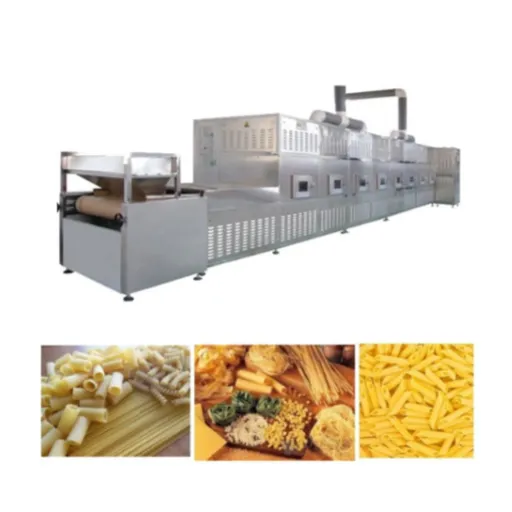
Traditional drying is any method that removes moisture from food using externally applied heat and air movement. In the food industry, the dominant form is hot air drying, but freeze drying also falls under this umbrella. Understanding the physics behind each is essential because it explains why their limitations are so stubborn.
How Hot Air Drying Works
Hot air drying forces heated air across the surface of a food product. Heat moves from the air to the surface by convection. Then it moves from the surface to the interior by conduction. Moisture evaporates at the surface and the moving air carries it away.
This sounds straightforward, but it creates a fundamental problem. The surface dries out first. As the exterior loses moisture, it hardens and shrinks. That crust traps remaining water inside the product. This phenomenon is known as case hardening. It forces operators to either accept uneven drying or raise the temperature. Raising the temperature degrades color, flavor, and nutrients.
The most frustrating phase is the falling-rate period. This is when the last pockets of moisture are trapped inside. Industry estimates suggest that two-thirds of the total energy in a hot air drying cycle is spent on this final, inefficient phase.
How Freeze Drying Works
Freeze drying, or lyophilization, takes a completely different approach. The product is frozen, then placed under a deep vacuum. Because pressure is extremely low, ice sublimates directly into water vapor without passing through a liquid phase.
TThis leads to a very high quality; freeze-drying allows foods to retain all of their original qualities in terms of shape, appearance, taste, and nutrition. Reconstitution takes place instantly. The downside is that freeze-drying is a highly energy-consuming process which may require several days to be completed for each batch. It was shown that freeze-drying took up 15.09 kWh compared to 1.27 kWh in vacuum microwave drying.
Where Traditional Methods Fall Short
For most industrial food processors, the weaknesses of traditional drying boil down to three things:
- Energy waste: Hot air systems lose 35 to 45 percent of their energy through exhaust gas.
- Quality compromise: Prolonged heat exposure destroys vitamins, antioxidants, and natural pigments.
- Speed bottlenecks: The falling-rate period creates hard ceilings on throughput.
In 2022, Priya Sharma took over her family’s spice processing plant in Gujarat, India. She inherited three tunnel dryers running 18 hours a day. “We were spending more on natural gas than on raw materials,” she told us. “And our turmeric was coming out dull brown instead of the vibrant orange our buyers expected.” Her case hardening problem was severe. She had to re-process 15 percent of each batch. That waste alone cost her $8,000 per month.
What Is Microwave Drying?
Microwave drying is a form of volumetric heating. Instead of transferring heat from the outside in, microwave energy penetrates the material and excites polar molecules, primarily water, causing them to vibrate and generate heat from the inside out.
The Science Behind Volumetric Heating
Industrial microwave drying systems typically operate at one of two frequencies: 915 MHz or 2450 MHz. The lower frequency penetrates deeper into dense materials, which is why most large-scale industrial systems use 915 MHz generators.
When microwave energy enters a food product, it creates an oscillating electromagnetic field. Water molecules are polar, meaning they have a positive and negative end. They try to align themselves with this field. The field reverses billions of times per second. The molecules rotate back and forth. That friction generates heat throughout the entire volume at once.
This inside-out heating is the key to microwave drying’s advantages. No surface crust forms early in the cycle. The falling-rate period never takes over. Moisture moves toward the surface and escapes freely.
Types of Microwave Drying Systems
Food processors today have several configurations to choose from:
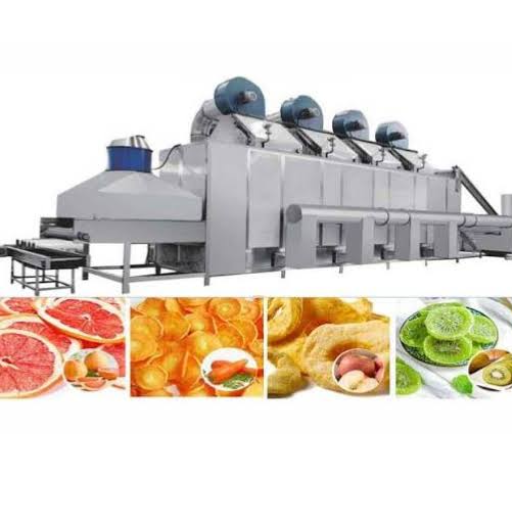
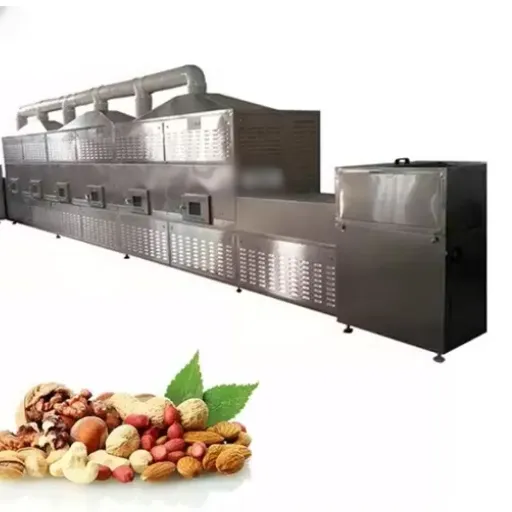
- Continuous tunnel microwave dryers: Products travel on a conveyor belt through a microwave chamber. Ideal for high-volume operations with consistent product sizes.
- Batch microwave dryers: Smaller chambers for R&D, pilot-scale production, or processors handling multiple SKUs with changeovers.
- Vacuum microwave dryers: Combine microwave energy with reduced pressure, enabling drying at temperatures as low as 30 to 50 degrees Celsius. Delivers near-freeze-drying quality in a fraction of the time.
- Microwave-assisted hot air drying (MAHD): Hybrid systems that use hot air for the efficient initial phase and microwave energy to blast through the falling-rate period.
At Shandong Loyal Industrial, our microwave drying equipment lineup spans all four configurations, with power ratings from 20 kW pilot units to 200 kW continuous production systems.
Why the Falling-Rate Period Disappears
In hot air drying, the falling-rate period exists because heat must slowly travel from the dry outer shell to the wet interior. In microwave drying, energy reaches the interior directly. Water molecules absorb microwave energy and generate heat. The drier the surface becomes, the less energy it absorbs. Meanwhile, the wetter interior continues to heat efficiently. This natural balance keeps the drying front moving steadily outward.
Want to see how this translates to real production numbers? Contact our engineering team for a free drying process assessment tailored to your product and capacity targets.
Head-to-Head Comparison: Microwave Drying vs Traditional Drying
The best way to evaluate these technologies is across the dimensions that actually drive purchasing decisions: speed, energy, quality, cost, and flexibility.
| Factor | Hot Air Drying | Microwave Drying | Freeze Drying |
|---|---|---|---|
| Drying speed | Baseline (hours to days) | 10-15x faster (minutes to hours) | 3-5x slower than hot air (days) |
| Thermal efficiency | 15-25% | 30-50% | 10-15% |
| Specific energy use | 1.5-4.0 kWh/kg water removed | 0.56-1.2 kWh/kg water removed | Very high (10-15x microwave) |
| Vitamin C retention | 30-40% remaining | 90%+ remaining | 95%+ remaining |
| Capital cost | Low | Medium-high | Very high |
| Operating cost per kg | High | Low-medium | Very high |
| Footprint | Large | Compact | Very large |
| Case hardening risk | High | Minimal | None |
| Best for | Bulk, low-value commodities | Quality-sensitive, medium-high volume | Ultra-premium, low volume |
Speed and Throughput
A 2025 study published in Food Processing compared intermittent microwave convective drying (IMCD) with conventional hot air drying for fish. The result: microwave reduced drying time by 90 percent — 12 minutes versus 300 minutes. The microwave-dried fish also showed superior rehydration capacity, less shrinkage, and better color uniformity.
In practical terms, this means a processor can run three to five times more product through the same floor space. For operations where real estate is limited or demand is growing, that throughput advantage alone can justify the investment.
Energy Consumption
Energy is where the numbers get especially compelling. A 2025 study in Applied Thermal Engineering compared microwave and convective drying systems for industrial applications. Microwave systems achieved 56 percent thermal efficiency versus roughly 30 percent for convective systems.
The reason is simple. Hot air dryers heat the air, the chamber, the belts, and the product. Much of that energy escapes through the exhaust stack. Microwave energy couples directly with water molecules inside the product itself. Very little is lost.
For a mid-sized processor drying 10 metric tons of product per day, the difference between 1.5 kWh/kg and 0.8 kWh/kg adds up to thousands of dollars per month in energy savings alone.
Product Quality Impact
Quality is not subjective here. It is measurable:
- Nutrient retention: Washington State University research confirms that microwave drying preserves significantly more Vitamin C, antioxidants, and phenolic compounds than hot air drying.
- Color and appearance: Because microwave drying operates at lower overall temperatures for shorter durations, Maillard browning and pigment degradation are minimized. Dried strawberries stay bright red. Turmeric stays vivid orange.
- Texture and rehydration: Without case hardening, the cellular structure of the food remains more intact. That translates to faster, more complete rehydration — a critical quality metric for many end users.
- Microbial safety: Microwave energy kills microorganisms as it dries. One study documented bacterial counts up to 15 times lower in microwave-dried products compared with conventionally dried equivalents.
Capital Cost vs Operating Cost
There is no avoiding it: microwave drying equipment costs more upfront than a comparable hot air system — typically 30 to 50 percent more. But the operational savings accumulate quickly.
| Cost Category | Hot Air (5-Year) | Microwave (5-Year) |
|---|---|---|
| Initial equipment | $120,000 | $170,000 |
| Energy (5 years) | $185,000 | $95,000 |
| Maintenance (5 years) | $45,000 | $35,000 |
| Labor (5 years) | $75,000 | $55,000 |
| Re-processing/waste | $48,000 | $8,000 |
| Total 5-Year Cost | $473,000 | $363,000 |
| Savings with microwave | — | $110,000 |
Note: Figures are illustrative based on mid-scale fruit/vegetable drying operation. Actual costs vary by region, product, and capacity.
The typical payback period for the incremental capital investment is 18 to 36 months at commercial production volumes.
Safety, Compliance, and Maintenance
No technology evaluation is complete without looking at the operational realities: safety standards, regulatory compliance, and maintenance schedules.
Microwave Safety Standards
Industrial microwave systems are governed by strict international standards. The IEC 60335-2-25 standard governs household and commercial microwave appliances, while industrial systems must comply with additional electromagnetic compatibility (EMC) and workplace safety regulations.
Modern industrial microwave dryers incorporate multiple safety layers:
- Leakage monitoring: Continuous sensors detect any microwave leakage beyond safe thresholds and shut down the system automatically.
- Arcing detection: Metal contaminants or sharp edges can cause arcing. Advanced systems detect these events in milliseconds and cut power before damage occurs.
- Interlocked doors and panels: Access doors cannot be opened while the magnetrons are energized.
- Shielding: All chambers are fully enclosed with RF-reflective steel that contains 99.9+ percent of emitted energy.
Regulatory Compliance
For food contact applications, microwave drying systems must meet:
- FDA 21 CFR: Materials used in food contact surfaces must be approved.
- USDA acceptance: Equipment used in meat and poultry processing must meet USDA sanitary design standards.
- EU Machinery Directive 2006/42/EC: Systems sold in Europe must carry CE marking and meet safety requirements.
- HACCP compatibility: Microwave drying can be integrated into HACCP plans as a critical control point for both moisture reduction and microbial kill.
At Shandong Loyal Industrial, all our microwave drying equipment is manufactured to FDA, USDA, and CE standards, with full documentation for regulatory audits.
Maintenance Requirements
Every drying technology requires maintenance, but the schedules differ:
- Magnetrons: The microwave generators that produce the RF energy have a typical lifespan of 4,000 to 6,000 operating hours. Replacement is straightforward — usually a 30-minute procedure — and costs roughly 800to800to1,500 per unit depending on power rating.
- Waveguides: The channels that direct microwave energy into the drying chamber should be inspected quarterly for contamination or damage.
- Conveyor belts: In continuous systems, belts require the same tension and tracking maintenance as any industrial conveyor.
- Air handling: Even microwave systems need some air movement to remove humidity from the chamber. Filters should be changed monthly.
Compared with hot air systems, which require burner maintenance, heat exchanger cleaning, ductwork inspection, and combustion safety checks, microwave systems generally have lower ongoing maintenance complexity.
The Hybrid Solution: Microwave-Assisted Hot Air Drying
Not every processor needs to choose one technology or the other. In fact, the fastest-growing segment in industrial drying is hybrid systems that combine the strengths of both approaches.
How MAHD Works
Microwave-assisted hot air drying (MAHD) uses hot air at the start. The product surface is wet and evaporation is rapid during this phase. Once the surface begins to dry, the falling-rate period starts. That is when microwave energy kicks in. It drives moisture from the interior.
This staged approach delivers the best of both worlds:
- 40 to 60 percent reduction in total drying time compared with hot air alone
- 30 to 60 percent reduction in energy consumption
- Lower capital cost than a pure microwave system of the same capacity
- Familiar operation for teams already trained on hot air equipment
A 2026 review in the Biochemical Engineering Journal ranked MAHD as the optimal configuration for most medium-to-large scale food processing operations, noting that it balances capital cost, operational efficiency, and product quality better than any standalone system.
When MAHD Is the Right Choice
MAHD makes the most sense when:
- You have existing hot air infrastructure that is not fully depreciated.
- Your product mix includes both high-moisture and low-moisture items.
- You want to reduce energy costs without a complete line replacement.
- Your team is comfortable with hot air operation and wants to add capability incrementally.
Shandong Loyal Industrial offers MAHD retrofit kits that integrate microwave modules into existing tunnel and tray dryer lines, as well as turnkey hybrid systems for new installations.
When to Choose Which Technology
After walking hundreds of processors through this decision, we have found that the right choice depends on four factors: product value, production volume, energy costs, and quality requirements.
Choose Microwave Drying When:
- You process high-value, heat-sensitive products where nutrient retention, color, and flavor command premium pricing.
- Energy costs are significant in your region and represent a major line item.
- Floor space is limited and you need maximum throughput per square meter.
- Your customers or regulatory environment demand low microbial counts without additional processing steps.
- You are scaling up and need a system that will not become a bottleneck as volume grows.
Choose Hot Air Drying When:
- You process bulk, low-value commodities like grains or feed where some quality loss is acceptable.
- Minimizing upfront capital expenditure is the primary constraint.
- You have existing depreciated equipment with adequate remaining capacity.
- Your product is not heat-sensitive and case hardening is not a concern.
Choose Freeze Drying When:
- You produce ultra-premium products like gourmet ingredients, pharmaceuticals, or specialty nutraceuticals.
- Budget is not the primary constraint and you can absorb the highest production costs in your pricing.
- Perfect rehydration and original structure preservation are non-negotiable.
Choose MAHD When:
- You want meaningful efficiency gains without replacing an entire production line.
- Your product range is diverse and you need flexibility.
- You are risk-averse about new technology and want a transitional step.
When Priya Sharma upgraded her Gujarat spice plant in 2023, she took a gradual approach. She retrofitted one tunnel dryer with a microwave-assisted module. The other two stayed as-is. Within eight months, the retrofitted line handled 40 percent of her total volume. It consumed 35 percent less energy per kilogram. The hybrid approach gave her proof of concept. She committed to a full upgrade once she saw the numbers. By 2025, all three lines ran MAHD configurations. Her energy costs had dropped by $12,000 per month.
Curious whether MAHD or pure microwave makes sense for your operation? Request a free process assessment and our engineers will model your exact product, throughput, and energy costs.
2026 Technology Trends Shaping the Drying Landscape
The industrial drying market is not standing still. Three technology trends are reshaping what is possible and what is economical.
Solid-State RF Generators
Traditional microwave systems use magnetron tubes — the same technology found in household microwave ovens, just scaled up. Magnetrons are effective but have fixed frequency output and limited lifespan.
Solid-state RF amplifiers are replacing magnetrons in next-generation systems. They offer:
- Instant power control: Adjust output in milliseconds instead of seconds.
- Frequency agility: Optimize the RF frequency for your specific product’s dielectric properties.
- Longer lifespan: 50,000+ hours versus 4,000 to 6,000 for magnetrons.
- Better energy conversion: Up to 85 percent electrical-to-RF efficiency versus 65 to 75 percent for magnetrons.
IoT and AI-Driven Process Control
Smart drying systems now incorporate sensors that monitor moisture content, product temperature, and chamber humidity in real time. Machine learning algorithms adjust power levels, belt speed, and air flow on the fly to optimize each batch.
The result is more consistent product quality, reduced energy waste, and predictive maintenance alerts that prevent unplanned downtime.
Sustainability and Carbon Footprint Reduction
Food drying generates an estimated 6.7 million metric tons of CO₂ equivalent annually in the United States alone — roughly 15 percent of total food-sector emissions. As carbon pricing and emissions reporting requirements expand globally, processors are under pressure to reduce their footprint.
Microwave and hybrid systems offer a direct path. The combination of higher energy efficiency and faster processing means less total energy consumed per kilogram of finished product. For processors selling into sustainability-conscious markets, that is becoming a competitive advantage, not just a cost saving.
Conclusion
Microwave drying vs traditional drying is not a simple either-or question. Hot air drying has been the workhorse of the food industry for decades because it is affordable, familiar, and adequate for many applications. Freeze drying still produces the highest quality output for the most demanding markets. But for a growing swath of food processors — those who need speed, efficiency, and quality without freeze-drying’s astronomical costs — microwave drying has become the clear choice.
The data supports it: 10 to 15 times faster processing, 30 to 50 percent better energy efficiency, dramatically higher nutrient retention, and payback periods under three years. The hybrid MAHD approach makes the transition even more accessible for processors who want to upgrade incrementally.
Here are the five takeaways to bring back to your team:
- Speed: Microwave drying eliminates the falling-rate bottleneck that plagues hot air systems.
- Efficiency: You will use roughly half the energy per kilogram of water removed.
- Quality: Better color, flavor, texture, and nutrient profiles mean higher selling prices or happier customers.
- ROI: Most processors see full payback in 18 to 36 months through energy and labor savings alone.
- Flexibility: Hybrid MAHD systems let you upgrade without ripping out existing infrastructure.
At Shandong Loyal Industrial, we have been designing and manufacturing food processing machines since 2005. Our industrial microwave drying machines power production lines in over 80 countries, from small specialty processors to multinational brands. Whether you are ready to invest in a full microwave line or want to explore a hybrid retrofit, our engineering team can model your specific product and capacity to give you exact numbers.
Ready to see what microwave drying can do for your operation? Contact us today for a free drying process assessment and customized equipment recommendation.