What if the biggest bottleneck in your food production line could be eliminated overnight? For food manufacturers still relying on conventional hot air or freeze drying, that bottleneck is real — and costly. Microwave drying for food reduces processing time by up to 90% while cutting energy consumption by 30-50%, all while preserving the color, flavor, and nutrients that define product quality.
If you have ever watched a batch of herbs lose their vibrant color in a conventional dryer, or struggled with case-hardened fruit that looks perfect on the outside but remains moist inside, you already understand the problem. Traditional drying methods were designed for an era when speed and efficiency mattered less than they do today. Modern food manufacturers face tighter margins, stricter quality standards, and consumers who demand clean-label products with minimal processing.
This guide covers everything food manufacturers need to know about microwave drying technology. You will learn how it works, which food products benefit most, how it compares to traditional methods, and what the transition looks like in practice. Whether you run a small specialty food business or manage a large-scale production facility, the insights here will help you make an informed decision about upgrading your drying process.
Key Takeaways
- Microwave drying for food reduces processing time by 50-90% compared to hot air drying, enabling higher throughput without expanding facility footprint.
- Energy consumption drops by 30-50% because microwave systems heat water molecules directly rather than warming the surrounding air or chamber walls.
- Product quality improves significantly: better color retention, no case hardening, higher nutrient preservation, and superior rehydration properties.
- The technology applies across nearly every food category, from delicate herbs and berries to dense meat products and grain-based snacks.
- Typical return on investment ranges from 18 to 36 months, driven primarily by energy savings and increased production capacity.
What Is Microwave Drying for Food?
Microwave drying for food removes moisture by heating from the inside out. It uses electromagnetic waves to create heat directly within the product. This is the opposite of conventional methods, which heat the surface first. That single difference changes everything about the drying process.
How Microwave Drying Works
Conventional dryers heat the food surface first. Heat then moves slowly toward the center. Moisture moves because of this temperature difference and evaporates once it reaches the cooler exterior. While this method works, it’s pretty slow and gives uneven results.
Microwave drying is different; it uses electromagnetic waves at 915 MHz or 2.45 GHz that travel through the food. They excite water molecules, causing rapid vibration. This friction creates heat throughout the entire product at once. The food heats from the inside out. Moisture then moves to the surface and evaporates into the air or vacuum chamber.
The result is faster, more uniform drying with less surface degradation. Because the energy targets water molecules selectively, heat-sensitive compounds like vitamins, antioxidants, and essential oils remain largely intact.
Types of Microwave Drying Systems
Food manufacturers can choose from several system configurations depending on their product type, production volume, and quality requirements:
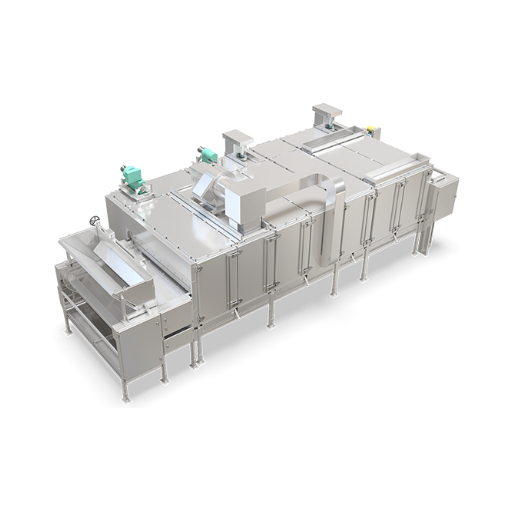
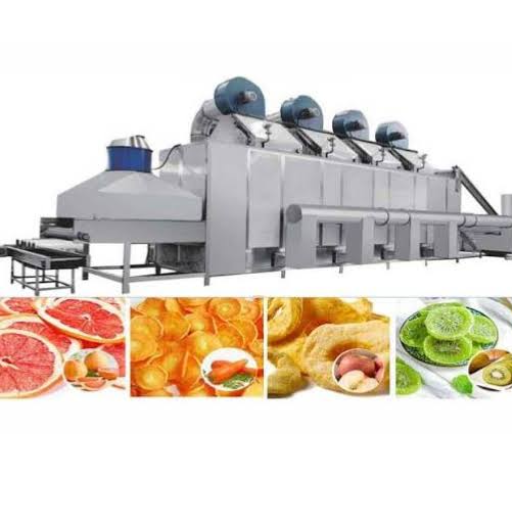
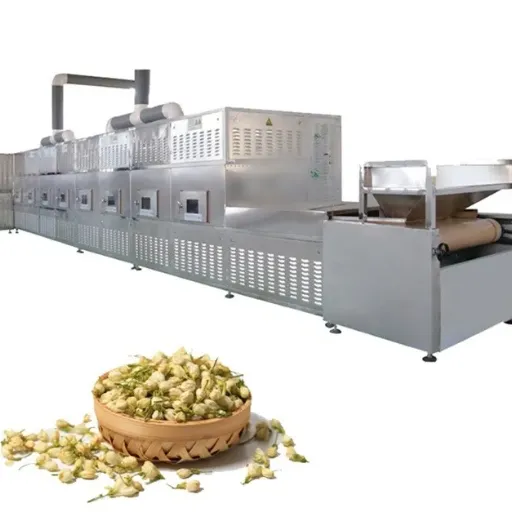
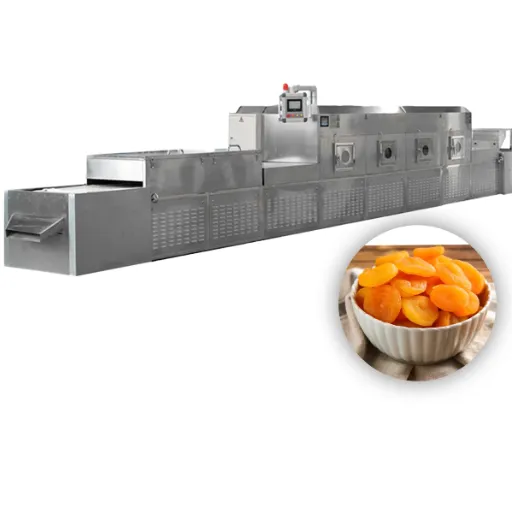
Continuous Tunnel Systems. These conveyor-based units move product through multiple microwave zones on a belt, enabling high-volume production of 500 to 2,000 kg per hour. They are ideal for snack foods, grains, pasta, and other products with steady demand. The instant on/off capability means no warm-up time between shifts.
Batch Tray Systems. Smaller units with stacked trays allow flexible processing of multiple product types in sequence. These suit R&D facilities, pilot testing, and specialty producers who run smaller batches of high-value products like artisanal herbs or medicinal foods.
Vacuum Microwave Dryers. By reducing chamber pressure, these systems lower the boiling point of water to 30-50 degrees Celsius. This makes them perfect for heat-sensitive products like probiotics, certain fruits, and functional ingredients where even moderate temperatures could degrade bioactive compounds.
Hybrid Systems. The fastest-growing segment in 2026, hybrid configurations combine microwave energy with hot air, infrared, or steam to optimize both speed and quality. One 2025 launch from SAIREM claimed 40% energy savings by integrating microwave internal heating with convection surface evaporation.
Five Key Benefits of Microwave Drying for Food Manufacturers
When Maria Chen expanded her dried fruit operation in Fujian Province, she faced a familiar dilemma. Her hot air dryers could not keep up with rising orders. Expanding the drying facility would cost nearly $400,000. Instead, she installed a continuous microwave tunnel system. Processing time for her mango slices dropped from eight hours to forty-five minutes. Energy costs fell by 35% in the first quarter. Her customers noticed the difference immediately. The mango chips retained a brighter color and fresher aroma that commanded a 12% price premium in export markets.
Maria’s story illustrates the transformative impact of microwave drying for food across multiple dimensions.
1. Dramatic Time Savings
The most immediate benefit is speed. Because heat generates throughout the product simultaneously rather than transferring from the surface inward, drying cycles that once took hours or even days now complete in minutes. Hot air drying of vegetables typically requires eight to twelve hours. Microwave drying accomplishes the same result in two to four hours. For certain products, the reduction reaches 90%.
This speed translates directly into throughput. A manufacturer using continuous tunnel microwave systems can process multiple batches per shift without expanding the physical drying footprint. The instant start/stop capability eliminates warm-up and cool-down periods, adding productive hours to every workday.
2. Superior Energy Efficiency
Traditional dryers waste enormous amounts of energy heating the air, the chamber walls, and the surrounding environment before the product itself reaches drying temperature. Microwave systems bypass this inefficiency entirely by delivering energy directly to the water molecules within the food.
Microwave drying uses 1.0 to 1.5 kWh per kilogram of water removed. Hot air dryers use 1.5 to 4.0 kWh per kilogram. Freeze drying requires 10 to 15 kWh per kilogram. For a mid-scale processor running daily operations, switching to microwave can save 50,000to50,000to200,000 per year.
The U.S. Department of Energy, in a 2025 report from Oak Ridge National Laboratory, noted that innovative low-temperature drying technologies including microwave can achieve energy savings of up to 83% compared to conventional methods in the food sector.
3. Enhanced Product Quality
Quality preservation matters more to food manufacturers than almost any other factor. Traditional hot air drying creates a hard outer shell called case hardening. This traps moisture inside. The surface looks dry while the interior stays wet. The result is inconsistent texture, shorter shelf life, and potential microbial growth.
Microwave drying prevents case hardening. Moisture moves from the interior toward the surface through pressure-driven flow. The result is uniform moisture distribution and better structural integrity.
Color retention improves dramatically. Berries keep their anthocyanins. Green vegetables preserve chlorophyll. Carrots maintain carotenoids. All of these degrade less under microwave drying than under prolonged hot air exposure. Vitamin C retention in fruits increases by 20-30%. Essential oils in herbs and spices stay intact. These aromatic compounds define product value in the marketplace.
Rehydration also improves. Microwave-dried products absorb water faster. They return to a texture closer to their fresh state. This matters greatly for instant foods, soup ingredients, and ready-to-eat meals.
4. Food Safety and Shelf Life Extension
Microwave drying offers a secondary benefit that many manufacturers overlook: microbial reduction. The rapid heating and electromagnetic effects work together to reduce bacterial loads. One study documented complete microbial elimination in a fermented product within ten minutes of microwave processing, compared to 1.5 days with hot air drying.
This antimicrobial action means manufacturers can achieve extended shelf life with reduced reliance on chemical preservatives. In an era when consumers increasingly scrutinize ingredient lists, the ability to offer clean-label products with natural shelf stability represents a significant competitive advantage.
5. Sustainability and ESG Alignment
Food manufacturers worldwide face pressure to reduce their environmental footprint. Microwave drying supports this goal directly. It uses less energy, which means fewer greenhouse gas emissions. Precise temperature control reduces waste from overheating. Clean-label products need no artificial preservatives.
The European Union’s Green Deal rewards energy-efficient upgrades. Similar programs exist across Asia and North America. Microwave drying helps manufacturers qualify for these incentives. It also protects against future energy price increases.
Microwave Drying vs. Traditional Methods: A Food Processor’s Comparison
Choosing the right drying technology requires understanding how each method performs across the metrics that matter most to food manufacturers. The table below provides a clear comparison.
| Factor | Microwave Drying | Hot Air Drying | Freeze Drying |
|---|---|---|---|
| Processing Speed | 10-15x faster | Slow baseline | Very slow (24-48 hours) |
| Energy Use | 1.0-1.5 kWh/kg water | 1.5-4.0 kWh/kg water | 10-15 kWh/kg water |
| Quality Retention | High | Moderate (heat degradation) | Very high |
| Case Hardening Risk | Minimal | High | None |
| Capital Cost | 150K−150K−3M+ | Lower initial investment | Very high |
| Operating Cost | Low | Moderate | Very high |
| Best Applications | Most food products | Bulk grains, non-premium | Ultra-premium, structural products |
When to Choose Each Method
Microwave drying suits the vast majority of food applications. It excels with heat-sensitive products like herbs, fruits, and proteins. It delivers the best cost-to-quality ratio for most manufacturers. If you produce dried snacks, dehydrated vegetables, meat products, or functional ingredients, microwave drying should be your default consideration.
Hot air drying still has its place for very large-scale bulk grain operations where capital constraints are severe and processing speed is not critical. It also works for products where surface texture matters less than cost minimization.
Freeze drying remains the top choice for ultra-premium products where structural integrity is paramount — think gourmet freeze-dried ice cream or delicate floral ingredients for high-end culinary applications. The quality is unmatched, but so is the cost.
For most food manufacturers, the decision comes down to microwave versus hot air. The quality gap is substantial. The energy savings are proven. The only remaining question is timing.
Food Products That Thrive with Microwave Drying
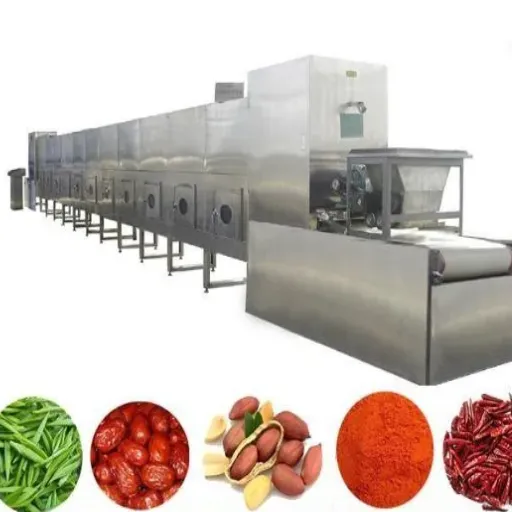
One of the most compelling aspects of microwave drying for food is its versatility. The technology adapts to virtually every category of edible product, with specific advantages for each.
Fruits and Vegetables
Dried fruits and vegetable powders represent some of the largest and fastest-growing segments in the global food market. Microwave drying preserves the natural colors and flavors that consumers expect while significantly reducing processing time.
Apple slices, banana chips, strawberry halves, and blueberry pieces all benefit from rapid moisture removal that prevents enzymatic browning. Vegetable powders for ingredient applications — spinach, beetroot, pumpkin, tomato — retain higher concentrations of vitamins and minerals. Vacuum microwave drying creates a natural puffing effect for crispy fruit chips without frying, addressing the booming demand for healthy, low-oil snack alternatives.
Research shows that microwave-dried shiitake mushrooms and black fungus retain 20-30% more umami compounds and B vitamins than their hot air-dried counterparts. For ingredient suppliers, this nutritional advantage translates directly into premium pricing.
Herbs and Spices
The herb and spice industry depends on rapid, gentle drying. Prolonged heat exposure destroys the volatile essential oils that give basil, oregano, rosemary, and turmeric their commercial value.
Microwave drying completes the process in minutes rather than hours, preserving the aromatic compounds that conventional methods degrade. Chili powder maintains its heat intensity. Turmeric retains its curcumin content. The result is a fresher, more potent product that commands higher prices in both retail and foodservice markets.
Meat and Seafood
Dense protein products present unique drying challenges. The exterior can burn while the interior remains moist — a problem that microwave’s volumetric heating solves elegantly.
Beef jerky, dried pork slices, and poultry strips dry uniformly without the surface charring common in conventional ovens. The non-thermal electromagnetic effects help inhibit pathogens like E. coli, adding a food safety dimension that traditional dryers cannot match.
Seafood applications are equally impressive. Shrimp that requires two to three days of sun-drying can be processed in two to three hours with microwave technology. The finished product displays brighter color, eliminates fishy odors, and shows 40% lower peroxide values — indicating significantly less fat oxidation and longer shelf stability.
Snacks and Ready-to-Eat Foods
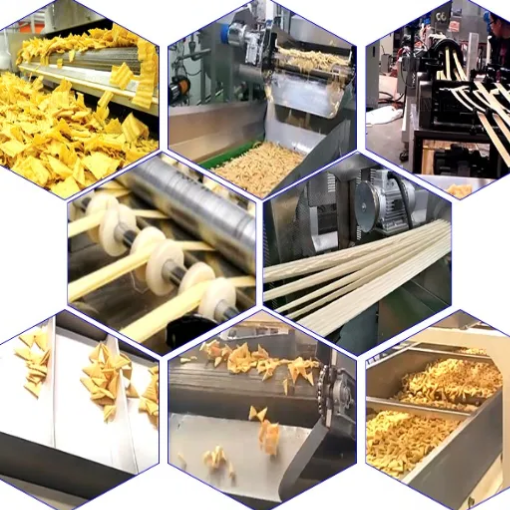
The snack industry has embraced microwave drying more aggressively than perhaps any other food sector. Puffed fruit and vegetable chips, protein crisps, and instant noodle toppings all benefit from the rapid, controlled dehydration that microwave provides.
Vacuum microwave drying creates the light, porous textures that consumers associate with premium snacking experiences. The low-oil or no-oil processing capability aligns perfectly with the health-conscious snacking trend that dominates consumer purchasing decisions in 2026.
Convenience foods also gain from microwave drying. Dehydrated soup mixes, instant grain products, and ready-meal vegetable medleys rehydrate more effectively when processed with microwave technology. The improved water absorption means faster preparation times and better eating quality for end consumers.
Grains, Nuts, and Seeds
Cereal products, pasta, and rice noodles traditionally require lengthy drying cycles in large hot air tunnels. Hybrid microwave-hot air systems cut these cycles from approximately eight hours to under ninety minutes while preserving the al dente quality that defines premium pasta.
Nut processing benefits from precise temperature control that prevents the oil oxidation and rancidity that can ruin a batch of almonds or walnuts. Seed drying for ingredient applications achieves more consistent moisture content, improving downstream processing reliability.
Specialty and Functional Foods
The fastest-growing applications for microwave drying may be in the functional food and novel ingredient categories. Probiotic powders dried at 35-40 degrees Celsius under vacuum maintain over 90% bacterial survival while reaching moisture levels below 3%.
Medicinal foods like goji berries and red dates retain their bioactive polysaccharides. Green tea undergoes enzyme fixation in 30 to 60 seconds, preserving chlorophyll and aromatic compounds that slower methods destroy. Novel protein sources including insect-based ingredients for human and animal consumption dry in under ten minutes with approximately 85% nutritional retention.
Addressing Common Myths About Microwave Drying for Food
Despite decades of industrial use, misconceptions about microwave drying persist among food manufacturers. Let us address the most common myths with facts.
Myth: Microwave Drying Destroys Nutrients
This misconception likely stems from consumer experiences with household microwave ovens, where uneven heating and overcooking can degrade food quality. Industrial microwave drying operates under precisely controlled conditions with calibrated power levels, controlled atmosphere, and real-time monitoring.
Properly calibrated systems actually retain or enhance nutrient profiles compared to hot air drying. Vacuum microwave models operate at 30 to 50 degrees Celsius — temperatures low enough to preserve heat-sensitive vitamins, antioxidants, and polyphenols that prolonged thermal exposure would degrade. A 2025 comprehensive review published in the Institute of Food Technologists’ journal confirmed that microwave drying achieves superior retention of bioactive compounds across multiple food categories.
Myth: Microwave Drying Is Less Efficient Than Freeze Drying
Freeze drying produces exceptional quality, but at tremendous cost in both time and energy. A typical freeze drying cycle requires 24 to 48 hours and consumes 10 to 15 kWh per kilogram of water removed.
Vacuum microwave drying produces comparable sensory quality — color, flavor, texture, and aroma — in a fraction of the time at roughly one-third the energy cost. For most food applications, the slight quality trade-off is imperceptible to consumers while the operational savings are transformative for manufacturers.
Myth: Microwave Drying Is Not Safe for Food Production
Industrial microwave systems are engineered with multiple safety layers. Magnetron emissions are tightly controlled and shielded. Vacuum components enable gentle, low-temperature processing. Temperature and moisture sensors provide real-time feedback that prevents overheating.
Food-grade systems use stainless steel construction that meets HACCP and GMP standards. The technology has been used in commercial food production for decades with an excellent safety record.
Myth: Microwave Drying Only Works for Small Batches
This may have been true in the early days of the technology, but modern continuous tunnel systems process 500 to 2,000 kilograms per hour. Major snack food manufacturers worldwide operate microwave drying lines that run 24 hours a day, seven days a week. The scale limitations of decades past have been thoroughly solved.
How to Transition Your Food Production to Microwave Drying
Making the switch from conventional to microwave drying requires careful planning, but the process follows a logical sequence that any food manufacturer can execute.
Step 1: Audit Your Current Drying Process
Start by documenting your current drying operation. Record energy use per batch. Track processing time from load to unload. Note moisture content differences between batches. Count product losses from overheating or uneven drying. Log labor hours spent on drying. These numbers become your benchmark.
Next, identify your pain points. Is throughput your main bottleneck? Are energy costs eating into margins? Do quality issues trigger customer complaints? Pinpointing your primary constraint tells you which microwave configuration will help most.
Step 2: Determine the Right System Type
Match the technology to your product and volume. Continuous tunnel systems suit high-volume producers with consistent product lines. Batch systems offer flexibility for multi-product operations or seasonal variations. Vacuum configurations address heat-sensitive ingredients. Hybrid systems optimize complex products that benefit from combined drying mechanisms.
Consider your facility constraints. Microwave systems typically require less floor space than equivalent-capacity hot air dryers, but electrical infrastructure needs assessment. Most industrial microwave dryers require three-phase power at appropriate amperage.
Step 3: Calculate Return on Investment
The business case for microwave drying is strong. Still, do your own calculations. Count energy savings of 30-50%. Add labor reductions from shorter cycles. Include quality premiums of 5-15%. Factor in less waste from consistent drying. Account for lower maintenance on simpler mechanical systems.
A mid-scale operation processing 500 kg daily can save 30,000to30,000to80,000 per year on energy alone. Add throughput gains and quality premiums. The typical payback period becomes 18 to 36 months. Larger systems often pay back even faster.
Step 4: Plan Implementation
Successful transitions almost always start with pilot testing. Run your actual products through a test system to validate drying parameters, quality outcomes, and throughput rates. Adjust power levels, belt speeds, and vacuum settings until you achieve optimal results.
Train your operations team on the new equipment. Microwave dryers require different operational knowledge than conventional systems, but the learning curve is manageable. Most manufacturers find that operators adapt within a few weeks.
Integrate the new system with your existing production line. Continuous tunnel dryers typically feed directly from upstream processing equipment and discharge to packaging or storage. The seamless flow minimizes handling and reduces contamination risk.
2025-2026 Technology Trends in Food Microwave Drying
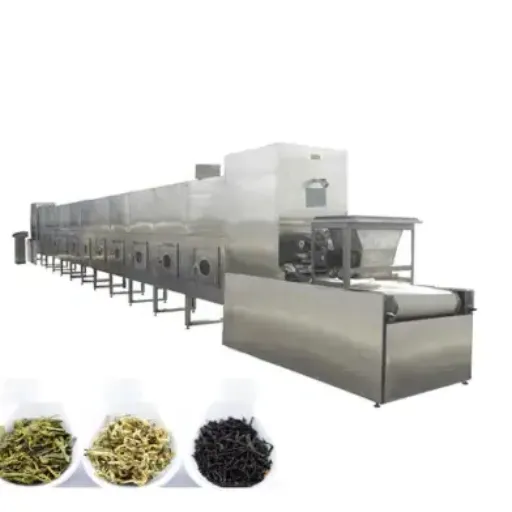
The microwave drying landscape is evolving rapidly. Three trends in particular are reshaping how food manufacturers approach dehydration.
Artificial Intelligence and IoT Integration. Modern systems now deploy moisture sensors, thermal cameras, and machine learning algorithms that autonomously adjust magnetron power in real time. Predictive maintenance monitors component performance and alerts operators before failures occur. These smart systems reduce waste, improve batch consistency, and minimize unplanned downtime.
Hybrid System Dominance. The fastest-growing segment combines microwave internal heating with hot air, infrared, or steam for surface evaporation. This approach leverages the strengths of multiple technologies while compensating for individual weaknesses. Growth in this segment exceeds 10% annually, well above the industry average.
Solid-State Microwave Technology. Traditional magnetron-based systems are giving way to solid-state generators that offer more precise frequency control, longer lifespan, and improved energy efficiency. Though still emerging in food applications, solid-state technology promises to further reduce operating costs and improve product consistency.
Conclusion
Microwave drying for food is more than an equipment upgrade. It is a strategic shift. It changes how manufacturers approach dehydration, quality, and efficiency. The math shows the truth. Processing times drop by half or more. Energy costs fall by a third. Product quality improves measurably. Shelf life extends without chemical additives.
For food manufacturers facing tighter margins, the key question has changed. It is no longer whether microwave drying delivers value. The data proves it does. The question now is how fast you can capture that value.
The five benefits we covered are not theories. They are daily realities. The California fruit-chip producer cut energy costs by 30% in her first quarter. The seafood processor reduced shrimp drying from days to hours. These results are available now.
If you are ready to explore how microwave drying technology could transform your food production, Shandong Loyal Industrial Co., Ltd. offers tailored solutions for every scale of operation. From batch systems for specialty producers to continuous tunnel lines for high-volume manufacturers, our team designs equipment that matches your product, your volume, and your quality standards.
Contact us today for a consultation and discover how our microwave drying machines can help you produce better food, faster, at lower cost.
Frequently Asked Questions
What types of food products work best with microwave drying?
Microwave drying works effectively across nearly every food category. It excels with fruits, vegetables, herbs, spices, meat, seafood, grains, nuts, and snack foods. Heat-sensitive products like probiotics and medicinal ingredients benefit most from vacuum microwave configurations that dry at temperatures as low as 30 degrees Celsius.
How much energy does microwave drying actually save?
Food manufacturers typically see energy reductions of 30-50% compared to hot air drying. Specific energy consumption ranges from 1.0 to 1.5 kWh per kilogram of water removed, versus 1.5 to 4.0 kWh for conventional methods and 10 to 15 kWh for freeze drying.
Is microwave drying safe for food production?
Yes. Industrial microwave systems are engineered with tight electromagnetic shielding, precise temperature control, and food-grade stainless steel construction that meets HACCP and GMP standards. The technology has been used commercially for decades with an excellent safety record.
What is the typical payback period for a microwave drying system?
Most food manufacturers achieve return on investment within 18 to 36 months. Payback is driven primarily by energy savings, increased throughput, reduced waste, and potential quality premiums. Larger continuous systems with high utilization often achieve faster payback.
Can microwave drying replace freeze drying completely?
For most applications, yes. Vacuum microwave drying produces sensory quality comparable to freeze drying at roughly one-third the energy cost. However, certain ultra-premium products where structural integrity is paramount may still benefit from freeze drying. Many manufacturers now use a hybrid approach or microwave as a finish-drying step.