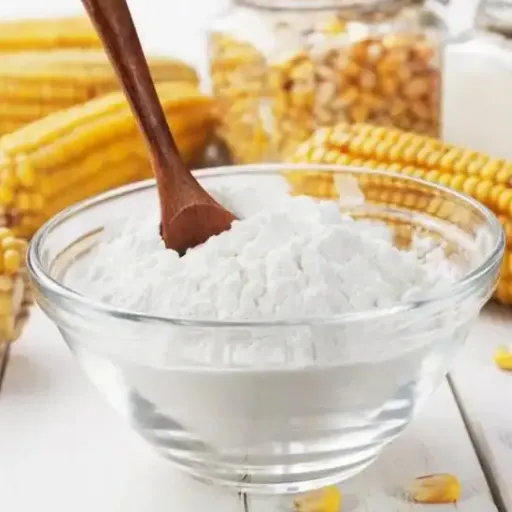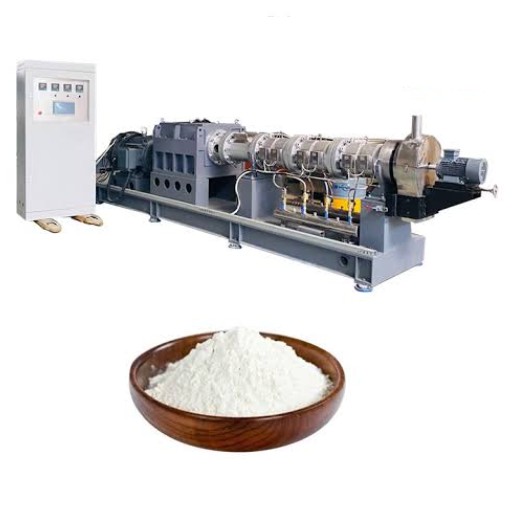
A small scale modified starch production line typically handles 100–250 kg/hour and costs between 15,000and15,000and60,000, depending on capacity, automation, and modification method. These compact systems let startups, R&D labs, and growing manufacturers enter the modified starch market without the multi-million-dollar investment of a full industrial plant.
What if you could test a new pregelatinized starch recipe, win your first commercial customer, and scale production, all with the same equipment train? That is exactly what the right small scale line makes possible.
We agree that buying food processing machinery feels overwhelming. Capacity numbers, voltage options, and stainless-steel grades all start to blur together. In this guide, you will learn what a small scale modified starch production line includes, how the process works, what it costs, and how to choose a configuration that grows with your business.
Key Takeaways
- A small scale modified starch production line usually runs at 100–250 kg/h and costs 15,000–15,000–60,000, with pilot units starting near $8,500.
- Twin-screw extrusion is the most common small-scale method for producing physically modified starches like pregelatinized starch.
- The seven-step process covers mixing, extrusion/reaction, cooling, drying, grinding, screening, and packaging.
- Chemical modification requires extra reactors and raises capital cost by 30–60%, while physical modification stays simpler and more compact.
- Most well-run small lines achieve payback in 18–36 months.
What Is a Small Scale Modified Starch Production Line?
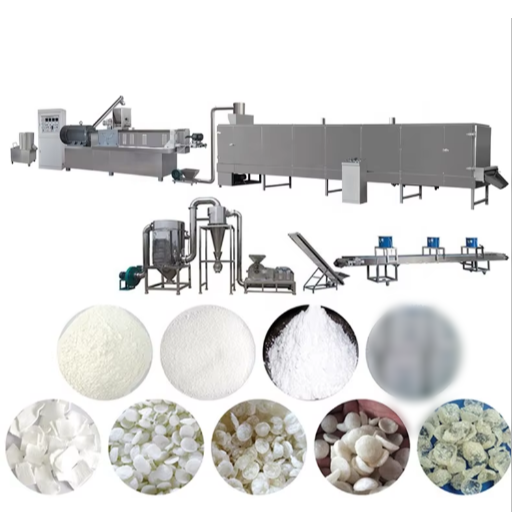
A modified starch production line converts native starch into a product with improved functional properties. These improvements can include better solubility, stronger thickening, improved freeze-thaw stability, or resistance to high heat and shear. A small scale modified starch production line simply performs this work at a lower throughput, using more compact and affordable small scale starch processing equipment than industrial plants.
At this scale, the system usually focuses on physical modification. The most common product is pregelatinized starch, which swells and dissolves in cold water. This makes it valuable for instant foods, sauces, oil drilling fluids, construction adhesives, and pharmaceutical binders. Chemical modifications such as cross-linked, oxidized, or cationic starches are possible at small scale, but they require extra reaction tanks, washing steps, and process controls.
Typical capacity tiers look like this:
| Scale | Capacity | Typical Investment | Best For |
|---|---|---|---|
| Lab/pilot | 10–50 kg/h | 8,500–8,500–20,000 | Recipe development, trials |
| Small commercial | 100–250 kg/h | 15,000–15,000–60,000 | Startups, niche markets |
| Small-to-medium | 250–500 kg/h | 60,000–60,000–120,000 | Growing regional producers |
These compact lines appeal to businesses that want to prove a product, serve a local market, or add a new revenue stream without committing to a full turnkey plant.
Why Small Scale Production Makes Sense
Modified starch demand is growing across food, pharmaceuticals, paper, textiles, oil drilling, and construction. According to industry research, the global modified starch processing line equipment market reached 625.4millionin2025∗∗andisprojectedtogrowto∗∗625.4millionin2025∗∗andisprojectedtogrowto∗∗668.65 million in 2026
Large industrial plants handle bulk commodity starch. Small scale lines serve a different purpose. They let you:
- Test recipes quickly before committing to large capital expense
- Serve niche or local customers who need specialized products
- Add value to native starch produced on-site or sourced locally
- Reduce risk by starting small and scaling as demand grows
When Maria Santos launched her food ingredient business in Brazil, she did not want to gamble on a 500,000plant.Sheboughta150kg/hextrusionlinefor500,000plant.Sheboughta150kg/hextrusionlinefor32,000, developed three pregelatinized starch recipes for instant soup manufacturers, and landed her first long-term contract within eight months. Two years later, she added a second line to reach 400 kg/h. Starting small gave her the cash flow and confidence to scale.
Small Scale Modified Starch Production Process
Most small scale lines follow a seven-step workflow. The exact equipment and conditions depend on whether you choose physical, chemical, or enzymatic modification.
Step 1: Raw Material Selection
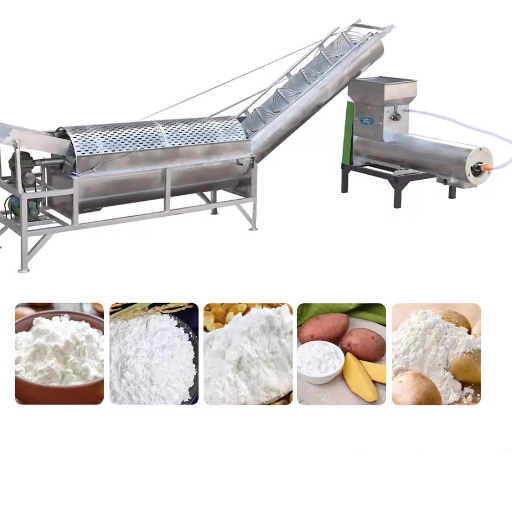
Native starch forms the base. Common sources include:
- Corn starch
- Cassava or tapioca starch
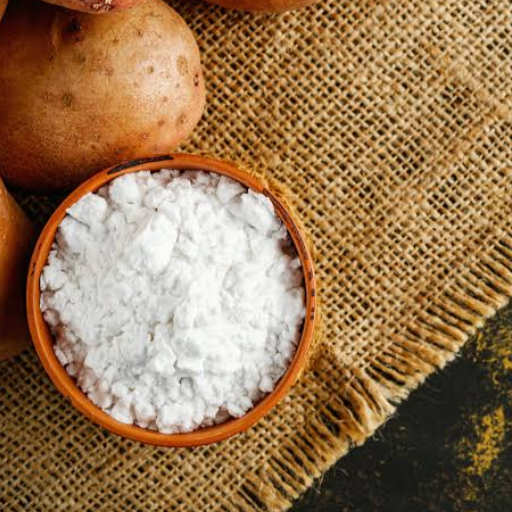
- Potato starch
- Wheat starch
- Rice starch
Each raw material behaves differently during gelatinization. Cassava starch produces clear pastes and works well for food thickeners. Corn starch is economical and widely available. Potato starch creates strong gels and is popular in processed meat and noodle applications.
Step 2: Mixing and Pre-conditioning
The starch is mixed with water, sometimes with additives or modifiers. In extrusion-based physical modification, a pre-conditioner hydrates the starch before it enters the extruder. Target moisture content usually falls between 20% and 35%, depending on the product.
Step 3: Modification
This is the core transformation step.
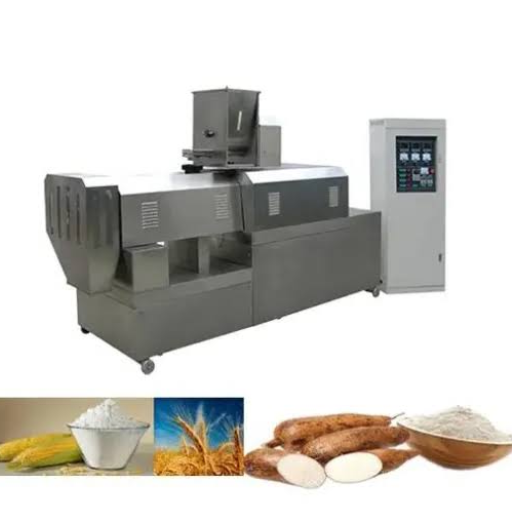
- Physical modification (extrusion): A twin-screw extruder applies heat, pressure, and shear. Temperatures typically reach 120–180°C with pressures around 0.5–2 MPa. The starch granules gelatinize instantly, creating pregelatinized starch.
- Chemical modification: Starch reacts with reagents such as sodium hypochlorite for oxidation, sodium trimetaphosphate for cross-linking, or propylene oxide for hydroxypropyl substitution. This requires a controlled reactor, pH adjustment, and washing.
- Enzymatic modification: Alpha-amylase breaks starch chains under controlled temperature and pH to produce dextrins or maltodextrins.
Step 4: Cooling or Neutralization
Extruded starch passes through a cooling conveyor to set its structure. Chemically modified starch may need neutralization and washing to remove residual reagents and salts.
Step 5: Drying
The product is dried to a stable moisture content, usually below 10–12%. Small lines may use a multi-layer oven, flash dryer, or drum dryer. Energy choice (electric, gas, or steam) affects operating cost and product quality.
Step 6: Grinding and Screening
Dried material is ground into the desired particle size and screened. Common final products range from coarse powders to fine flours passing 80–200 mesh.
Step 7: Packaging
The finished modified starch is packed in bags, big bags, or custom containers. Dust collection systems protect both product quality and worker safety.
For a more detailed look at the chemistry and reactions, see our modified starch manufacturing process guide.
Equipment Needed for a Small Scale Line
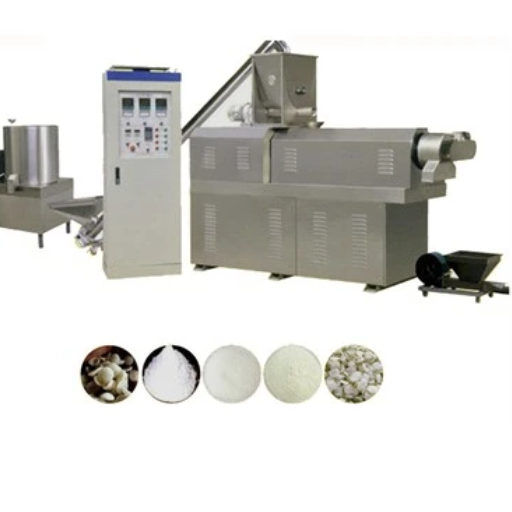
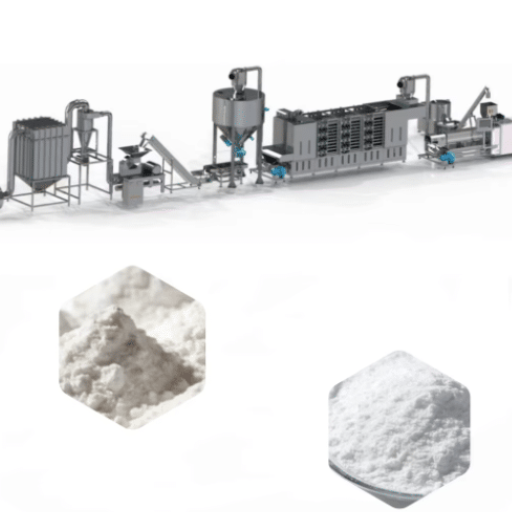
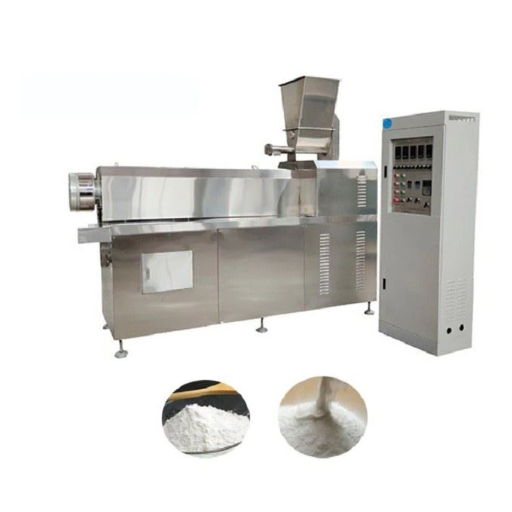
A typical extrusion-based small scale modified starch production line includes:
- Screw elevator or vacuum feeder for moving raw starch
- Mixer or pre-conditioner for water and additive blending
- Twin-screw extruder as the core modification unit
- Cooling conveyor to bring product temperature down
- Wet mill or crusher for initial particle reduction
- Air conveyor for material transfer
- Dryer such as a multi-layer oven or belt dryer
- Ultrafine pulverizer or grinder for final powder sizing
- Vibrating sieve for quality control
- Packaging machine with dust collection
- PLC control cabinet for temperature, speed, and moisture automation
If you plan chemical modification, you will also need reaction tanks, pH control systems, washing and dewatering equipment, and wastewater handling.
Most small lines use food-grade SUS 304 or 316 stainless steel for contact surfaces. Siemens motors, ABB relays, and Delta inverters are common in reliable systems. Look for CE, ISO 9001, and HACCP-aligned design. For food exports, FDA 21 CFR and EU 1935/2004 compliance may also matter.
Want to see how the equipment fits together? Explore our complete modified starch production line configurations, from pilot units to full industrial systems.
Small Scale Modified Starch Production Line Cost
Cost is usually the first question buyers ask. The table below gives realistic 2026 ranges for extrusion-based physical modification lines.
| Capacity | Investment Range | Best Fit |
|---|---|---|
| 10–50 kg/h (pilot/lab) | 8,500–8,500–20,000 | Recipe development, universities, R&D |
| 100–150 kg/h | 15,000–15,000–35,000 | Startups, first commercial production |
| 200–400 kg/h | 30,000–30,000–60,000 | Small-to-medium producers |
| 500–800 kg/h | 50,000–50,000–100,000 | Growing regional operations |
Several factors push prices up or down:
- Capacity: Larger extruders and dryers cost more but lower cost per kilogram.
- Automation level: Manual controls save money upfront. Full PLC automation adds 20,000–20,000–80,000 but reduces labor and improves consistency.
- Modification method: Chemical modification can add 30–60% to equipment cost because of reactors, washing, and wastewater systems.
- Materials and certifications: Food-grade SUS 316, CE marking, and ISO certification increase price but improve export eligibility and food safety.
- Supplier location: Chinese manufacturers typically quote 30–50% less than Western suppliers for comparable equipment.
Operating costs also matter. Energy for a 200–400 kg/h line often runs 60–120 kW installed power. Maintenance usually costs 3–5% of equipment price per year. Raw starch accounts for the largest share of variable cost.
For a deeper cost breakdown, see our modified starch production line cost guide.
Need a quote for your project? Tell us your target product, capacity, and raw material, and our engineers will recommend the right small scale modified starch production line configuration and pricing.
Choosing the Right Line for Your Business
Buying equipment without a clear product strategy is risky. Start by answering these questions.
What type of modified starch will you produce?
If your target is pregelatinized starch for instant foods or adhesives, a twin-screw extrusion line is usually enough. If you need chemically modified starch, budget for reactors, washing, and environmental controls.
What is your realistic capacity need?
Do not buy for peak demand on day one. A 150 kg/h line running two shifts produces 2,400 kg per day. That is plenty for most startup and niche applications.
Will you scale later?
Choose a supplier that offers modular scaling. Some manufacturers design screw profiles, barrel segments, and dies that transfer to larger models. This protects your recipe development investment.
What support does the supplier provide?
A machine alone does not guarantee success. Look for:
- Recipe development and trial runs
- Installation and commissioning
- Operator training
- Spare parts availability
- Remote troubleshooting support
What are common red flags?
- Prices far below market without clear specifications
- No reference installations in your region
- Missing certifications for your target market
- Limited after-sales support or spare parts
- No recipe or process guidance
Raj Patel, a food ingredient distributor in Mumbai, learned this lesson the hard way. He bought the cheapest 100 kg/h line he could find, saving $8,000 upfront. Within six months, the extruder barrel wore out, spare parts took five weeks to arrive, and he had no recipe support. Downtime cost him more than the original savings. His second purchase was a slightly higher-priced line from a supplier that offered recipe trials and local spare-parts support. That line has run reliably for three years.
Common Applications of Small Scale Modified Starch
Small scale lines can serve many markets. The right application depends on your local demand and technical capabilities.
Food and Beverage
Pregelatinized starch thickens instant soups, sauces, puddings, and baby foods. It dissolves in cold water, which simplifies manufacturing and improves texture.
Oil Drilling
Modified starch controls fluid loss in drilling mud. Small producers can serve regional drilling contractors with consistent, customized products.
Construction
Pregelatinized starch works as a binder in gypsum board and tile adhesives. This market values low cost and reliable supply over premium food-grade specs.
Paper and Textiles
Modified starch improves paper surface strength and textile sizing. These applications often need specific viscosity and bonding properties.
Pharmaceuticals and Cosmetics
Pharma-grade modified starch acts as a tablet binder and disintegrant. This market demands strict hygiene, traceability, and regulatory documentation.
Loyal’s Small Scale Modified Starch Solutions
At Shandong Loyal Industrial Co., Ltd., we design small scale modified starch production lines that help businesses start smart and scale with confidence. Our approach combines engineering quality with practical support.
Flexible Configurations
We offer modular lines from pilot scale through 1,500 kg/h. You can start with a 100–150 kg/h extrusion system and expand capacity without replacing your entire process.
Multiple Modification Methods
Our extruders handle physical modification for pregelatinized starch. For customers needing chemical or enzymatic modification, we design integrated reaction, washing, and drying systems.
Quality and Compliance
Contact surfaces use food-grade SUS 304 or 316 stainless steel. We support CE, ISO 9001, HACCP, FDA 21 CFR, and EU 1935/2004 compliance to meet export requirements.
Recipe and Trial Support
We help customers develop recipes, run trials, and refine screw profiles and process parameters before full production begins. This reduces startup risk and shortens time to market.
Global Service Network
From installation and training to spare parts and remote support, we serve customers across Asia, Africa, Europe, the Middle East, and the Americas. Our goal is to be a long-term partner, not just an equipment supplier.
If you are comparing physical modification options, our pregelatinized starch production line page covers the most common small-scale entry point in detail.
Frequently Asked Questions
How much does a small scale modified starch production line cost?
A 100–150 kg/h line typically costs 15,000–15,000–35,000. Pilot units start near 8,500 ,while reliable daily − production systems usually begin around 8,500 , while reliable daily − production systems usually begin around 30,000. Chemical modification lines cost 30–60% more.
What capacity is considered small scale?
Small scale generally means 100–250 kg/h for commercial production. Lab and pilot units may run as low as 10–50 kg/h.
What raw materials can I use?
Corn, cassava, tapioca, potato, wheat, and rice starches all work. Choose based on local availability, cost, and the functional properties your end product needs.
Can one line produce different types of modified starch?
A twin-screw extrusion line can produce several physically modified starches by changing screw profile, temperature, moisture, and die configuration. Chemical modifications require additional reactors and washing equipment.
What certifications should the line have?
For food-grade production, look for CE, ISO 9001, food-grade SUS 304/316 construction, and HACCP-aligned design. Export markets may require FDA 21 CFR or EU 1935/2004 compliance.
What is the payback period?
Most well-run small scale lines pay back in 18–36 months. Payback depends on capacity utilization, product margin, energy cost, and local market pricing.
Do I need a chemical reactor for chemical modification?
Yes. Chemical modification such as oxidation, cross-linking, or hydroxypropylation requires controlled reaction tanks, pH adjustment, washing, and often wastewater handling.
Conclusion
A small scale modified starch production line is one of the most practical ways to enter the growing modified starch market. With capacities from 100–250 kg/h and investments starting around $15,000, these systems let startups, R&D teams, and regional producers test products, serve niche customers, and scale without massive capital risk.
The key is choosing the right configuration for your product, capacity, and growth plan. Focus on physical modification with twin-screw extrusion if you want the simplest and most affordable entry point. Plan for chemical reactors and washing systems only if your end product demands it. And always choose a supplier that offers recipe support, training, spare parts, and proven after-sales service.
The modified starch equipment market is expanding steadily. Businesses that start small, prove their process, and scale smartly will be best positioned to capture this demand.
Ready to find the right small scale modified starch production line for your business? Contact our engineering team today for a customized quote, recipe consultation, or trial-run arrangement.