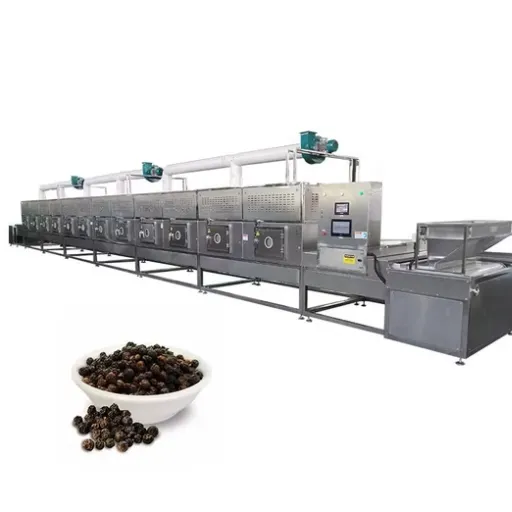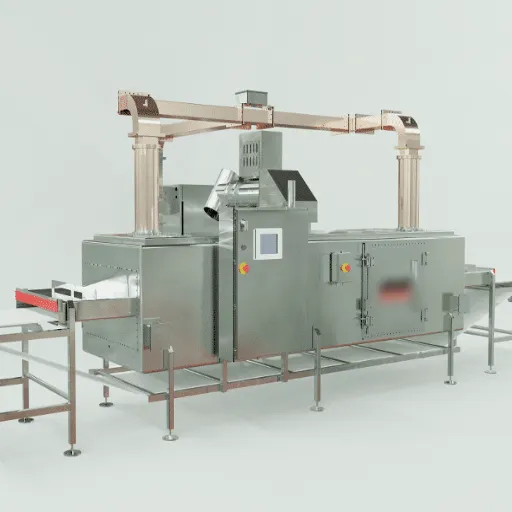
A microwave drying machine removes moisture by using electromagnetic energy to heat water molecules directly inside a product, rather than warming the air or surface first. This inside-out heating method, called dielectric heating, dries food faster and more uniformly than conventional hot-air systems.
If you have ever pulled herbs from a hot-air dryer only to find crisp edges and a damp center, you already understand the problem microwave drying solves. Food manufacturers face the same issue at industrial scale: uneven drying wastes energy, degrades quality, and slows production. In this guide, we explain exactly how a microwave drying machine works, what happens inside the chamber, and why it matters for your operation.
At Shandong Loyal Industrial, we have designed and installed industrial microwave drying machines for food processors worldwide since 2005. We will walk you through the science, the components, and the process step by step.
Key Takeaways
- A microwave drying machine uses 2.45 GHz or 915 MHz electromagnetic waves to excite polar water molecules inside food, creating heat from the inside out.
- The four main parts are the magnetron, waveguide, drying chamber, and PLC control system with moisture sensors.
- Volumetric heating eliminates case hardening and wet cores common in hot-air drying.
- Vacuum microwave dryers can dry heat-sensitive foods at 30–50°C, preserving color, flavor, and nutrients.
- Industrial microwave drying can reduce drying time by 50–95% and energy use by 30–50% compared with conventional methods.
What Is a Microwave Drying Machine?
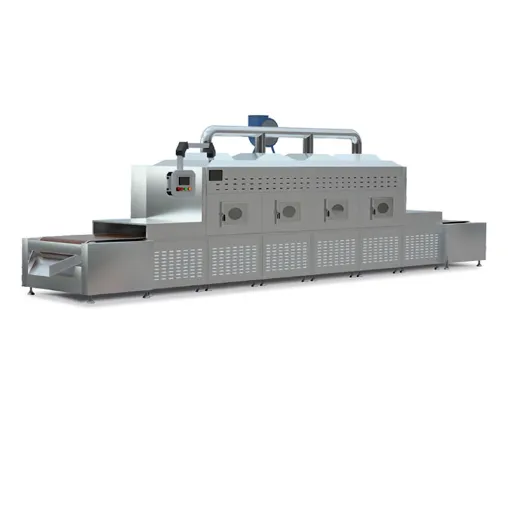
A microwave drying machine is industrial equipment that uses microwave radiation to remove moisture from food, powders, herbs, grains, and other materials. Unlike a home microwave, these systems run continuously. They control power and belt speed precisely, and they are built from food-grade stainless steel for commercial production. They are a core part of modern food processing machines designed for efficient, large-scale operations.
The core idea is simple. Water molecules are polar, meaning they have a positive and negative end. When microwaves pass through a product, these molecules rotate rapidly to align with the oscillating electric field. That molecular movement creates friction, which generates heat throughout the material. Because the energy goes straight to the water, the product heats from the inside out.
Want to see how this technology fits your production line? Explore our microwave drying machine solutions →
The Science Behind Microwave Drying
Dielectric Heating Explained
Dielectric heating is the scientific term for what happens when microwave energy interacts with polar molecules, especially water. Industrial microwave dryers typically use 2.45 GHz, the same frequency as consumer microwaves, because it balances penetration depth with energy absorption. For thicker or bulkier products, 915 MHz is sometimes used because it penetrates deeper.
As the electric field alternates billions of times per second, water molecules twist back and forth. This movement does not just warm the surface. It warms the entire volume of the product at once. The result is volumetric heating, the opposite of hot-air drying, which must conduct heat from the outside in. Therefore, microwave drying technology can cut processing time by half or more while improving moisture uniformity.
Mini-story: Maria runs a spice processing facility in Gujarat. Her hot-air dryers took four hours to reduce chili powder to the target moisture level, and the outer layer often overheated while the center stayed damp. After switching to a continuous microwave drying machine, the same batch finished in 35 minutes. More importantly, the moisture content was uniform from edge to center, and the bright red color she sold at a premium was preserved.
From Moisture to Vapor
Once water molecules inside the product begin to heat, they turn into vapor. This vapor creates internal pressure that pushes additional moisture toward the surface. An exhaust fan or vacuum pump then removes the humid air, keeping the drying process moving. Because heat is generated throughout the material, the drying speed stays high even as moisture content drops.
In hot-air drying, by contrast, a dry outer crust can form and trap moisture inside. That problem is called case hardening, and microwave drying largely avoids it.
How Does a Microwave Drying Machine Work? Key Components Inside
Understanding how a microwave drying machine works means knowing what each part does. Here are the main components you will find in a typical industrial system.
Microwave Generator / Magnetron
The magnetron converts electrical energy into microwave radiation. This is where the heart of the machine operates. Most food-grade dryers use multiple magnetrons to distribute energy evenly across the drying chamber. Magnetrons typically last 4,000 to 6,000 hours of operation, though lifespan depends on power settings, cooling quality, and maintenance.
Waveguide
The waveguide is a metal channel that directs microwaves from the magnetron into the drying chamber. It ensures energy reaches the product efficiently and safely, with minimal loss.
Drying Chamber / Cavity
This is where the product travels while being dried. In continuous systems, it is a long tunnel. In batch systems, it is a sealed cabinet. Chambers are usually made from 304 or 316L stainless steel to meet food safety standards. Multiple heating zones allow operators to fine-tune energy delivery along the length of the tunnel.
Conveyor or Tray System
Continuous microwave dryers use a food-grade conveyor belt to move product through the chamber. Belt speed is adjustable and controlled by the PLC. Batch dryers use stacked trays instead. The choice between continuous and batch depends on production volume and product type.
PLC Control System and Sensors
A programmable logic controller, or PLC, manages power output, belt speed, temperature, and moisture levels. Modern systems include infrared or microwave moisture sensors that measure product moisture in real time. Operators can store recipes for different products and switch between them with a touchscreen.
Cooling and Exhaust Systems
Magnetrons generate heat and need cooling, usually through air or water. Exhaust fans remove humid air from the chamber so vapor does not condense back onto the product. In vacuum microwave dryers, a vacuum pump lowers chamber pressure instead.
Safety Features
Industrial microwave dryers include metal shielding around the chamber, door interlocks, and leakage detectors. International standards typically limit microwave leakage to 5 mW per square centimeter or less. These features protect operators and ensure compliance with workplace safety regulations.
How Does a Microwave Drying Machine Work? The 8-Step Process
Here is how a typical continuous microwave drying machine processes food from start to finish.
- Product is introduced into the feeder. Raw or partially dried product is loaded onto the conveyor belt at a controlled thickness.
- The operator selects a recipe. The PLC sets the microwave power, belt speed, temperature limit, and target moisture.
- Magnetrons generate microwaves. Electricity is converted to electromagnetic energy at 2.45 GHz or 915 MHz.
- Waveguides distribute energy. Microwaves enter the drying chamber and penetrate the product.
- Water molecules heat the product. Polar molecules rotate and create friction, raising the internal temperature.
- Moisture vaporizes and migrates. Internal vapor pressure pushes water toward the surface.
- Exhaust removes humid air. Fans or vacuum pumps carry moisture out of the chamber.
- Dried product exits for cooling or packaging. The final moisture content is checked, and the product moves to the next stage.
This entire cycle can take minutes rather than hours. For example, a 2025 study on intermittent microwave convective drying of fish found drying time dropped from 300 minutes to 12 minutes, a 90% reduction, while improving rehydration capacity and color uniformity. You can read more about the underlying science in this microwave drying overview from ScienceDirect.
Types of Microwave Drying Machines
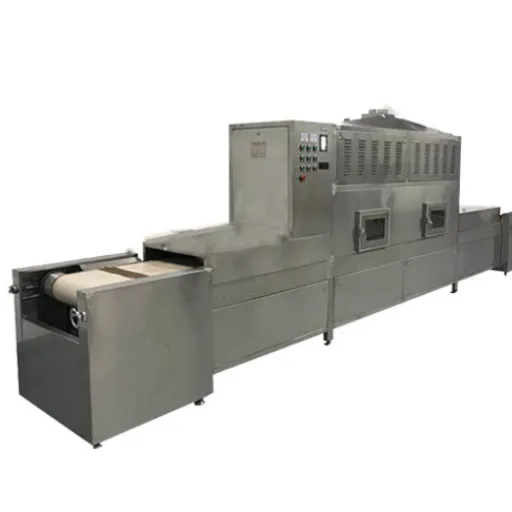
Not every microwave drying machine works the same way. The right configuration depends on your product, throughput, and quality goals. Below are the four main types of microwave drying equipment used in food production today.
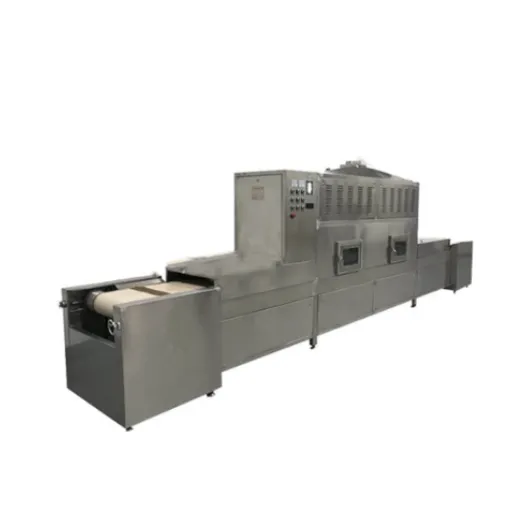
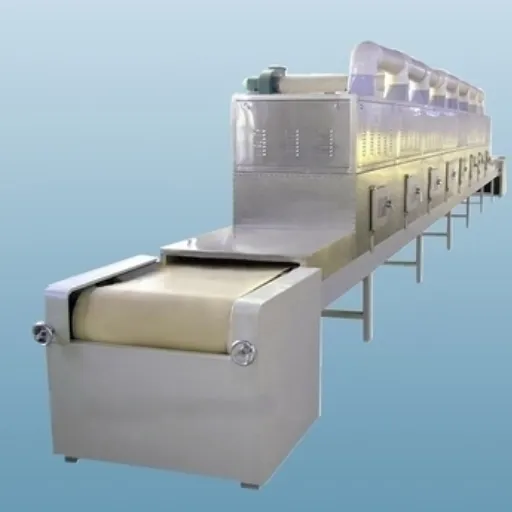
Continuous Tunnel Microwave Dryers
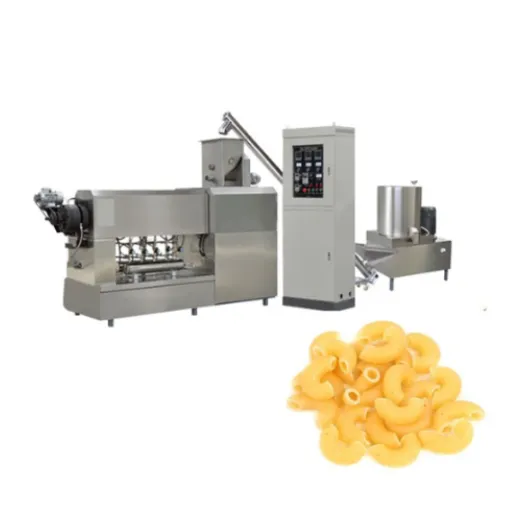
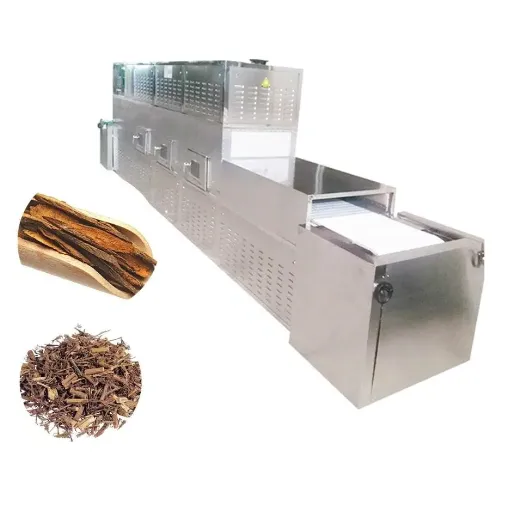
These are the workhorses of large-scale food production. Product moves on a conveyor belt through a long tunnel with multiple microwave zones. They are ideal for snacks, grains, tea, spices, and pet food. Shandong Loyal Industrial designs continuous tunnel dryers for operations that need high throughput and consistent results. Many customers integrate them into a complete snack food production line for puffed snacks, chips, and extruded products.
Batch Cabinet Dryers
Batch systems work like industrial cabinets with trays. They are used for R&D, small production runs, and high-value products. A food company might use a batch dryer to test a new recipe before investing in a full continuous line.
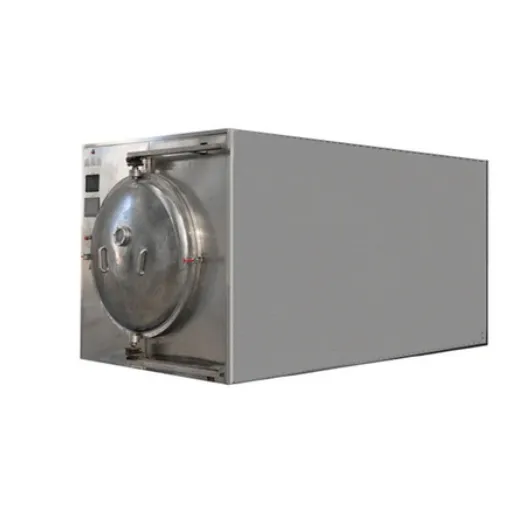
Vacuum Microwave Dryers
Vacuum microwave dryers remove air from the chamber, which lowers water’s boiling point. This allows drying at 30–50°C, making it ideal for heat-sensitive foods like fruits, vegetables, herbs, and proteins. The low temperature preserves vitamins, natural color, and volatile flavor compounds that hot air can destroy. For manufacturers focused on premium quality, industrial microwave oven vacuum systems offer an attractive middle ground between speed and gentleness.
Mini-story: James operates a small dried-fruit business in California. His hot-air dryer had to run at 70°C for eight hours to remove moisture from strawberry slices. The result was often leathery, darkened fruit. After testing a vacuum microwave dryer, he dried the same strawberries at 40°C in under two hours. The slices kept their bright red color and sold for 30% more at farmers markets.
Hybrid Microwave–Hot Air Dryers
Hybrid systems combine microwave energy with conventional hot air. Hot air handles the initial constant-rate drying phase, while microwave energy takes over during the slower falling-rate phase. This combination can reduce drying time by 40–60% and energy use by 30–60% compared with hot air alone, while improving uniformity.
What Actually Happens to Your Food?
Microwave drying changes more than just moisture content. It affects texture, color, flavor, nutrition, and microbial safety.
Faster, More Uniform Drying
Because microwaves heat water throughout the product, drying happens evenly. There are no wet cores and no hard outer shells trapping moisture inside. This uniformity is especially valuable for powders, spices, and sliced products where consistency determines price.
Better Quality Preservation
Hot-air drying can degrade heat-sensitive vitamins and cause browning or flavor loss. Microwave drying runs at lower overall temperatures, especially in vacuum systems. Research shows microwave drying can retain 82–94% of Vitamin C in some products, compared with 45–65% for hot-air drying. These figures are supported by industrial data on microwave drying equipment for food processing.
Built-In Sterilization
Microwave energy does more than remove water. It also reduces microbial loads. The combination of heat and microwave-specific biological effects can kill bacteria, molds, and yeast during the drying cycle. This means some products can be dried and pasteurized in a single step, reducing processing time and improving food safety.
When Microwave Drying Works Best
Microwave drying is not the right choice for every product. It works best when:
- The product has moderate to high moisture content.
- Uniform drying is critical for quality or pricing.
- Heat-sensitive ingredients need gentle handling.
- Energy costs or throughput constraints are pressing.
- Floor space is limited.
It is less ideal for very dense products with low water content, or for materials that do not absorb microwaves well. Some products also benefit from a hybrid approach rather than pure microwave drying. If you are still asking how does a microwave drying machine work for your specific product, a pilot test is the most reliable way to find out.
Not sure which drying technology fits your product? Contact our engineering team for a free process assessment →
Microwave Drying vs. Hot-Air Drying: A Quick Comparison
| Factor | Microwave Drying | Hot-Air Drying |
|---|---|---|
| Heating method | Volumetric, inside-out | Surface-to-core conduction |
| Typical drying speed | 50–95% faster | Baseline |
| Energy efficiency | 30–50% thermal efficiency | 15–25% thermal efficiency |
| Energy use | 0.56–1.2 kWh/kg water removed | 1.5–4.0 kWh/kg water removed |
| Moisture uniformity | High, avoids case hardening | Can create wet cores and dry crusts |
| Temperature control | Precise, especially vacuum systems | Broader temperature ranges |
| Footprint | 20–35% smaller | Larger for equivalent throughput |
| Capital cost | Higher | Lower |
This comparison explains why manufacturers often view microwave drying as a long-term investment rather than just equipment. Lower energy bills, higher throughput, and better product quality can deliver payback in 18 to 36 months for medium-to-high-volume operations. The global market for industrial microwave dryer technology was valued at roughly USD 1.0–1.2 billion in 2025 and is projected to grow at 4–8% CAGR as more food processors switch to energy-efficient drying.
Frequently Asked Questions
What is a microwave drying machine?
A microwave drying machine is industrial equipment that uses electromagnetic energy to heat water molecules inside a product and remove moisture. Unlike home microwaves, industrial units run continuously and include precise controls, food-grade stainless steel construction, and safety shielding.
How does microwave drying work?
Microwave drying works through dielectric heating. Microwaves penetrate the product and cause polar water molecules to rotate rapidly. The resulting friction generates heat throughout the material, turning moisture into vapor that is removed by exhaust or vacuum systems.
What are the main parts of a microwave dryer?
The main components are the magnetron (microwave generator), waveguide, drying chamber or cavity, conveyor or tray system, PLC control system with sensors, cooling system, exhaust system, and safety shielding with interlocks.
Is microwave drying better than hot-air drying?
For many food applications, yes. Microwave drying is typically 50–95% faster, uses 30–50% less energy, and produces more uniform moisture content. However, it requires a higher capital investment and may not suit every product density or moisture level.
What foods can be dried with microwave drying equipment?
Common applications include spices, herbs, tea, grains, nuts, snacks, fruits, vegetables, proteins, pet food, and powders. Vacuum microwave dryers are especially useful for heat-sensitive products like berries and leafy herbs.
How much does a microwave drying machine cost?
Entry-level batch systems can start around 150,000,mid−rangecontinuoussystemsrangefrom150,000,mid−rangecontinuoussystemsrangefrom500,000 to 1.5million,andlargecustomproductionlinescanexceed1.5million,andlargecustomproductionlinescanexceed3 million. Payback periods typically fall between 18 and 36 months for medium-to-high-volume operations.
Conclusion
A microwave drying machine works by sending electromagnetic energy through food. It excites water molecules and generates heat throughout the product from the inside out. The magnetron, waveguide, drying chamber, and PLC control system work together to remove moisture quickly, evenly, and with minimal quality loss.
For food manufacturers, the benefits go beyond speed. Microwave drying reduces energy use, preserves color and nutrients, prevents case hardening, and can even sterilize products during the same cycle. Whether you run a spice line, a snack plant, or a fruit processing facility, understanding how a microwave drying machine works is the first step toward evaluating this microwave drying equipment for your operation.
Ready to see what microwave drying can do for your product? Request a customized drying assessment from Shandong Loyal Industrial → Our engineers will help you choose the right system, test your product, and build a drying line that fits your production goals.