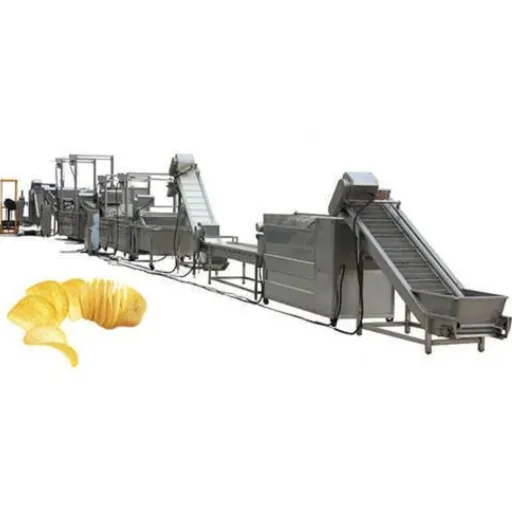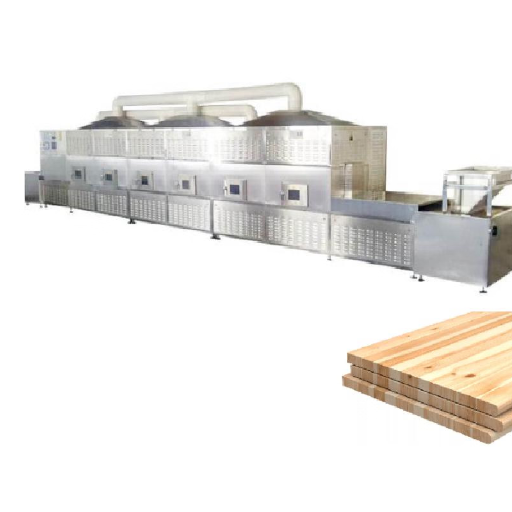
An industrial microwave dryer uses electromagnetic energy at 915 MHz or 2.45 GHz to heat water molecules directly inside materials. This volumetric heating approach dries products 50% to 90% faster than conventional hot air methods while cutting energy consumption by 30% to 60%. Food manufacturers, pharmaceutical producers, and chemical processors worldwide are replacing traditional conveyor ovens and tray dryers with microwave systems to boost throughput, reduce operating costs, and improve product quality.
Here is the challenge most buyers face. The market is crowded with options ranging from 8,000batchunitsto8,000batchunitsto3 million continuous systems. European brands promise precision but charge premium prices. Chinese manufacturers offer competitive rates, yet quality varies dramatically between suppliers. Picking the wrong machine can lock you into years of downtime, inconsistent results, and hidden maintenance costs.
When Marcus Oliveira upgraded his fruit chip facility in Sao Paulo last year, he spent six weeks comparing quotes from five suppliers. His existing hot air dryer took eight hours per batch and consumed 45 kWh. The microwave system he eventually installed from a Tier 2 Chinese manufacturer cut that to ninety minutes at 18 kWh per batch. His energy bill dropped 30% in the first quarter alone. More importantly, his vitamin C retention test results jumped from 60% to over 90%. The machine paid for itself in fourteen months.
This guide will walk you through everything you need to make a confident buying decision. You will learn how microwave drying works, how it compares to traditional methods, which applications benefit most, what technology trends matter in 2026, and how to evaluate suppliers. By the end, you will have a clear framework for calculating total cost of ownership and selecting the right system for your production line.
Key Takeaways
- Industrial microwave dryers cut drying time by 50% to 90% and energy use by 30% to 60% compared to hot air systems.
- The global market is growing at 7.6% CAGR, driven by hybrid systems, AI controls, and solid-state generator technology.
- Food processing dominates at 38% to 40% of demand, but pharmaceutical and chemical applications are expanding rapidly.
- Chinese Tier 2 manufacturers now compete seriously with European brands in the 25,000to25,000to120,000 segment.
- Total cost of ownership typically delivers payback in 12 to 24 months through energy savings and throughput gains.
- Vacuum microwave drying at 30 to 50 degrees Celsius rivals freeze-dried quality at one-third the energy cost.
What Is an Industrial Microwave Dryer?
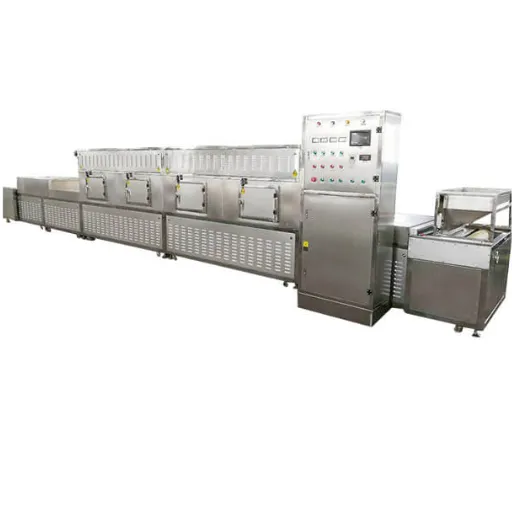
An industrial microwave dryer is a production-scale drying system that uses microwave radiation to remove moisture from materials. Unlike conventional dryers that heat air and blow it across product surfaces, microwave dryers generate heat inside the material itself. Water molecules are polar. They rotate rapidly when exposed to alternating electromagnetic fields. This molecular friction creates heat throughout the entire volume of the product simultaneously.
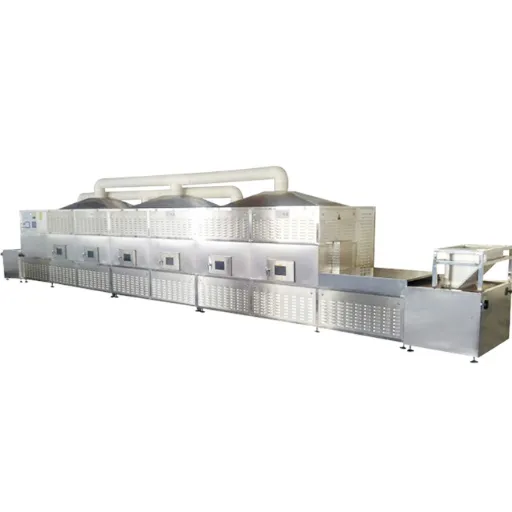
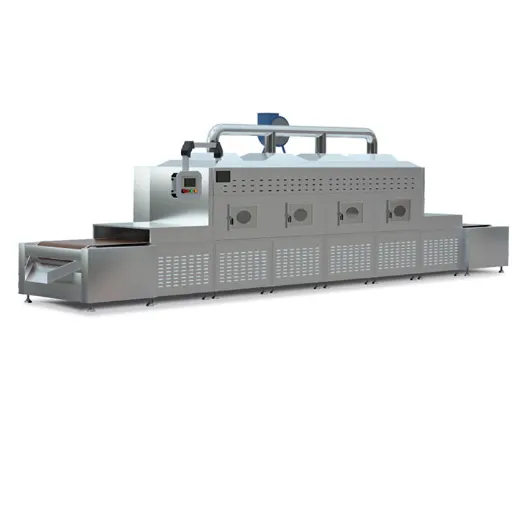
The core components include a microwave generator (magnetron or solid-state), a waveguide to direct energy, a processing cavity or tunnel where product moves through the field, a conveyor system for continuous operation, and a control unit that manages power output, temperature, and timing. Most food-grade systems use 2.45 GHz frequency because it offers good penetration depth for typical product thicknesses. For bulkier materials, 915 MHz provides deeper penetration with higher power capacity.
Three main configurations dominate the market. Batch tray dryers work like oversized microwave ovens. You load trays of product, set the program, and unload when complete. These suit small producers, R&D labs, and multi-product operations. Continuous tunnel dryers move product on a conveyor belt through a long microwave field. These handle high volumes and integrate easily into existing production lines. Vacuum microwave dryers combine low-pressure chambers with microwave heating. They dry heat-sensitive products at 30 to 50 degrees Celsius, preserving colors, flavors, and active compounds that would degrade at higher temperatures.
Want to see how these systems compare for your specific application? Explore our microwave drying machine range and request a free technical consultation.
How Microwave Drying Works: The Science Made Simple
Traditional drying methods rely on conduction, convection, or radiation to transfer heat from the outside in. Hot air blows across product surfaces. The outer layer dries first. Moisture must then migrate from the interior to the surface through diffusion. This process is slow. It creates temperature gradients that cause uneven drying, case-hardening, and quality loss.
Microwave drying flips this model. Electromagnetic waves penetrate the material and interact directly with water molecules. Because water has a high dielectric loss factor compared to most dry solids, it absorbs microwave energy selectively. The wetter regions heat faster. This creates an internal vapor pressure gradient that actively pumps moisture toward the surface. Drying becomes faster, more uniform, and more controllable.
The frequency choice matters. At 2.45 GHz, penetration depth in water-rich foods is roughly 2 to 3 centimeters. This works well for most food products. At 915 MHz, penetration extends to 10 centimeters or more. This makes it ideal for bulky materials, dense pharmaceutical powders, or thick wood panels. However, 915 MHz systems require more complex waveguide designs and typically cost more upfront.
Temperature control is precise. PLC systems paired with infrared moisture sensors can adjust power output in real time. If the sensor detects that moisture content is dropping faster than target, the system reduces power automatically. This prevents overheating and scorching. Modern systems achieve temperature accuracy within one degree Celsius. That level of control is nearly impossible with conventional hot air systems.
Industrial Microwave Dryer vs Traditional Methods
Choosing a drying technology is a strategic decision that affects your operational costs, product quality, and production capacity for years. Here is how industrial microwave dryers stack up against the three most common alternatives.
| Factor | Microwave Drying | Hot Air Drying | Freeze Drying |
|---|---|---|---|
| Drying Time | 50% to 90% faster | Hours to days | Days |
| Energy per kg Water | 1 to 1.5 kWh | 2.5 to 4.5 kWh | 10 to 15 kWh |
| Product Quality | Excellent (uniform) | Good (case-hardening risk) | Excellent |
| Capital Cost | Medium | Low | Very High |
| Operating Cost | Low | Medium | Very High |
| Space Required | Compact | Large | Very Large |
| Sterilization | Built-in during drying | Requires separate step | Limited |
Speed Advantage. The most immediate benefit is time. A Spanish tomato powder producer reported reducing their drying cycle from six hours to forty-five minutes after switching to microwave. That throughput increase allowed them to fulfill orders they previously had to turn down during peak season.
Energy Efficiency. Microwave systems target water molecules specifically. They do not waste energy heating air, conveyor belts, or oven walls. Industry data shows energy savings of 30% to 60% versus hot air drying. Compared to freeze drying, the gap is dramatic. Freeze dryers use 10 to 15 kWh per kilogram of water removed. Microwave systems use 1 to 1.5 kWh for the same result.
Quality Preservation. Because microwave heating is volumetric and controllable, products dry evenly without surface hardening. A study on basil leaf drying found that microwave-preserved samples retained 261% more essential oils than hot air-dried equivalents. Vitamin C retention in fruit products improved from 60% to over 90%.
Total Cost of Ownership. Hot air dryers have lower upfront costs. But the operating cost gap widens every month. A medium-sized food processor running two shifts will typically recover the higher microwave system investment within 18 to 24 months through energy savings alone. Factor in increased throughput and reduced waste, and payback often drops below 12 months.
Environmental Impact. Microwave dryers produce no combustion gases. They can run on renewable electricity. Their compact footprint reduces factory space requirements. For companies pursuing ESG targets or operating under strict EU energy regulations, microwave drying offers a measurable path to lower carbon emissions.
Ready to calculate the ROI for your facility? Contact our engineering team for a free energy savings analysis based on your current drying costs.
Key Applications by Industry
Food Processing
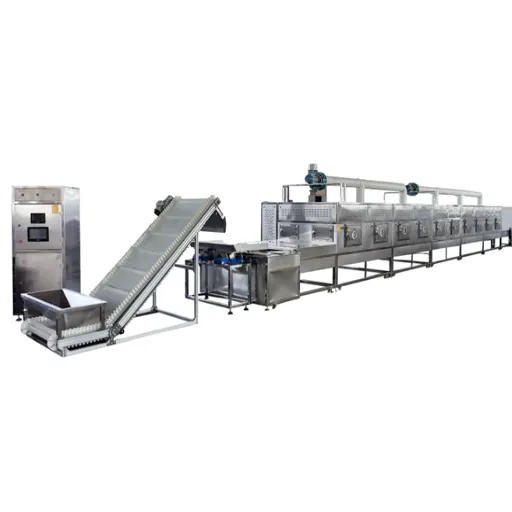
Food processing accounts for 38% to 40% of all industrial microwave drying installations. Fruits and vegetables dry faster while maintaining color, texture, and nutritional value. Herbs and spices retain volatile oils that give them their aroma and flavor. Meat and seafood products achieve consistent moisture levels without surface hardening. Grain and snack producers use microwave systems for everything from puffing to final moisture adjustment.
Insect protein is an emerging application. With the global edible insect market projected to grow at 25% CAGR, microwave drying offers a fast, sanitary way to process cricket and mealworm powders for human and animal consumption.
Pharmaceuticals
Pharmaceutical manufacturers use microwave dryers for active pharmaceutical ingredients (APIs), granules, and biochemical products. The precise temperature control prevents degradation of heat-sensitive compounds. Vacuum microwave variants are particularly valuable for high-value products where even slight quality loss translates to significant financial impact.
Chemicals and Specialty Materials
Chemical processors dry powders, ceramics, catalysts, and coating materials. Textile manufacturers use microwave systems for yarn and fabric drying with minimal fiber damage. Wood processors achieve faster seasoning with reduced cracking. Battery material producers are increasingly adopting microwave drying for electrode coatings and ceramic separators.
Emerging Applications
The newest frontier includes carbon products, graphene oxide, and nanomaterials. These applications demand extreme precision and clean processing environments. Solid-state microwave generators with programmable frequency sweeps are opening markets that magnetron-based systems could never serve.
2026 Technology Trends Shaping the Industry
The industrial microwave dryer market is evolving rapidly. Five technology trends are reshaping what buyers should expect from modern systems.
Hybrid Drying Systems
The fastest-growing product category is hybrid systems that combine microwave energy with hot air, infrared, or steam. These systems grow at 10.2% CAGR, faster than the overall market. In August 2025, SAIREM launched a hybrid microwave-convection system claiming 40% additional energy savings over microwave-only designs. The logic is simple. Microwave energy removes free moisture quickly. Supplemental hot air handles surface evaporation in the final drying stage. The combination is faster and more efficient than either technology alone.
AI and IoT Integration
Smart manufacturing is reaching drying equipment. Modern systems integrate near-infrared (NIR) moisture sensors, thermal cameras, and machine learning algorithms. The AI monitors moisture content, surface temperature, and product density in real time. It adjusts magnetron power, conveyor speed, and airflow automatically. Early adopters report 30% reductions in product reject rates, 15% throughput increases, and 18% less unplanned downtime through predictive maintenance alerts.
By 2030, equipment with AI-based controls and solid-state generators could capture 35% of new installations. Buyers should consider future-proofing their investment by selecting systems with upgradeable control architectures.
Solid-State Microwave Generators
Traditional magnetrons have a finite lifespan of 4,000 to 8,000 operating hours. They degrade gradually, causing power drift and inconsistent results. Solid-state generators use semiconductor technology instead. They offer several advantages. Frequency control is precise and adjustable. Power output can be modulated instantaneously. Electrical-to-microwave conversion efficiency is up to 22% better. Most importantly, lifespan extends to 50,000+ hours.
The downside is cost. Solid-state units currently cost 40% to 80% more than equivalent magnetron systems. However, for high-volume operations running two or three shifts, the longer lifespan and reduced downtime usually justify the premium within three to five years.
Vacuum Microwave Drying
Vacuum microwave drying operates at reduced pressure, allowing water to evaporate at 30 to 50 degrees Celsius. This is game-changing for premium food products, delicate herbs, and heat-sensitive pharmaceuticals. The quality rivals freeze drying. The energy cost is roughly one-third. The process time is hours instead of days.
Asia-Pacific markets are driving adoption at 9.4% CAGR. European producers are following suit, particularly for organic and premium product lines where quality differentiation commands price premiums.
Modular and Compact Designs
Factory space is expensive. Modular microwave dryers can be configured in sections that fit existing production layouts. Need to double capacity next year? Add another microwave module rather than replacing the entire system. This flexibility appeals particularly to small and mid-sized producers who need to scale without massive capital outlays.
Learn more about our continuous microwave dryer systems designed for seamless integration into existing production lines.
How to Choose the Right Industrial Microwave Dryer
Selecting the right system requires more than comparing spec sheets. Here is a practical framework based on what successful buyers actually evaluate.
Step 1: Define Your Production Requirements
Start with numbers. What is your target throughput in kilograms per hour? What is your incoming moisture content, and what is your target final moisture? How many hours per day will the system operate? What is your available floor space and ceiling height? Do you need batch flexibility or continuous throughput?
A snack producer in Gujarat, India, named Priya Patel faced exactly these questions last year. Her family business dried 200 kilograms of spice blends daily using four large hot air ovens. She needed a system that could handle 500 kilograms daily within the same footprint. After evaluating batch and continuous options, she chose a medium tunnel dryer with 40 kW output. Her new system fits in the space of two old ovens. It handles her current volume with capacity to spare.
Step 2: Match Equipment Type to Product Characteristics
Not every product suits microwave drying. Products with very low initial moisture, extremely high fat content, or metallic components may require hybrid approaches. Conduct a pilot test with your actual product before committing. Reputable manufacturers offer pilot testing at their facilities or will loan demonstration units.
Batch Tray Dryers: Best for R&D, small volumes, multiple product types, or operations requiring frequent changeovers. Price range: 8,000to8,000to20,000.
Continuous Tunnel Dryers: Best for high-volume, single-product operations. Price range: 25,000to25,000to120,000 depending on power and length.
Vacuum Microwave Dryers: Best for heat-sensitive, high-value products where quality is paramount. Price range: 30,000to30,000to80,000.
Step 3: Evaluate Supplier Capabilities
The supplier matters as much as the machine. Ask these questions.
Can they customize the system for your specific product? Do they provide installation, training, and commissioning support? What is their spare parts availability and lead time? Do they offer remote diagnostics and technical support? What certifications does their equipment carry? CE marking is essential for EU markets. HACCP and GMP compliance matter for food and pharmaceutical applications.
Step 4: Calculate Total Cost of Ownership
Upfront price is just one factor. Build a five-year TCO model that includes purchase price, installation, energy consumption, maintenance, spare parts, and expected downtime. A 60,000machinewithlowenergycostsandminimaldowntimeoftenbeatsa60,000machinewithlowenergycostsandminimaldowntimeoftenbeatsa40,000 machine that consumes more power and breaks down twice a year.
Here is a simplified comparison for a medium food processor running two shifts, 250 days per year.
| Cost Factor | Hot Air Dryer (5-Year) | Microwave Dryer (5-Year) |
|---|---|---|
| Purchase Price | $25,000 | $55,000 |
| Installation | $3,000 | $5,000 |
| Annual Energy | $18,000 | $7,200 |
| Annual Maintenance | $2,500 | $3,000 |
| Downtime Cost | $4,000 | $1,000 |
| 5-Year Total | $132,500 | $96,000 |
| Savings | Baseline | $36,500 |
Step 5: Request Quotes and Pilot Testing
Get quotes from at least three suppliers. Include one European brand, one established Chinese exporter, and one local option if available. Ask each supplier to provide a written performance guarantee based on pilot testing with your product. Never buy based on promises alone.
Maintenance and Long-Term Care
A well-maintained industrial microwave dryer will run reliably for 15 to 20 years. Neglect it, and you will face expensive repairs within two years.
Magnetron Replacement. The magnetron is the heart of the system. Traditional magnetrons last 4,000 to 8,000 hours. At two-shift operation, that means replacement every 18 to 24 months. Budget 800to800to1,500 per magnetron. Solid-state generators eliminate this concern entirely.
Waveguide Inspection. Inspect waveguides quarterly for carbon buildup, corrosion, or physical damage. Clean according to manufacturer specifications. Damaged waveguides cause uneven energy distribution and can create safety hazards.
Door Seals and Safety Interlocks. Microwave leakage must stay below regulatory limits. Test door seals every six months. Replace worn gaskets immediately. Verify that safety interlocks prevent operation when doors are open.
Conveyor and Belt Systems. For continuous dryers, check belt tension and tracking weekly. Lubricate bearings per schedule. Replace worn belts before they fail mid-production.
Preventive Maintenance Schedule.
- Daily: Clean processing cavity, check for unusual noises or odors.
- Weekly: Inspect conveyor belts, verify temperature readings against calibration standard.
- Monthly: Check waveguide connections, clean air filters, review energy consumption trends.
- Quarterly: Professional magnetron performance test, door seal leakage test.
- Annually: Full system calibration, PLC software update, structural inspection.
Why Choose Shandong Loyal Industrial Co., Ltd.
Shandong Loyal Industrial Co., Ltd. has manufactured industrial food processing equipment since 2005. We serve over 650 customers across 80 countries. Our annual sales exceed $90 million. We are a standing director of the China Food and Drying Equipment Industry Association.
Custom Engineering. Every production line is different. We do not sell off-the-shelf solutions and hope they fit. Our engineers design microwave drying systems around your product, your facility, and your throughput targets. Tunnel length, power density, conveyor speed, and control parameters are all adjustable.
Global Quality Standards. Our equipment carries CE certification, ISO 9001 quality management certification, and meets HACCP requirements for food contact surfaces. We use 304 or 316 stainless steel for all food-contact components. Control systems support multiple languages and voltage configurations.
Competitive Total Cost of Ownership. Our pricing sits in the sweet spot between premium European brands and commodity Tier 3 manufacturers. A medium tunnel dryer from Shandong Loyal typically costs 30% to 50% less than an equivalent European system. Our quality and support standards meet or exceed most competitors in our tier.
Comprehensive Support. We provide on-site installation, operator training, and commissioning support. Our technical team offers remote diagnostics via secure internet connection. Spare parts ship from our Shandong facility within 48 hours. Custom engineering lead times range from 70 to 100 days.
Proven Results. Our customers report typical energy savings of 35% to 60%, throughput increases of 200% to 400%, and payback periods of 12 to 24 months. We will share specific case studies relevant to your industry during our consultation.
Conclusion
Industrial microwave dryers represent one of the most impactful equipment upgrades a food, pharmaceutical, or chemical processor can make. The technology is proven. The economics are compelling. The quality improvements are measurable. Market data projects 7.6% annual growth through 2035, driven by hybrid systems, AI integration, and solid-state generator advances.
The key to success is choosing the right system from the right supplier. Define your requirements clearly. Test your actual product. Calculate total cost of ownership over five years. Demand performance guarantees. Ask about support, spare parts, and upgrade paths.
Shandong Loyal Industrial Co., Ltd. has helped hundreds of manufacturers make this transition successfully. Our team understands that buying industrial equipment is not just a purchase. It is a partnership that will shape your production capacity for the next decade or more.
Ready to explore what microwave drying can do for your operation? Contact us today for a free technical consultation, pilot testing arrangement, and customized quote based on your specific product and production goals.