Last Tuesday, the production manager at a mid-sized spice plant in Kerala checked his drying logs and did a double-take. A batch of turmeric that used to tie up his tray dryer for eight hours was now finished in fifty minutes. Better yet, his quality team reported shelf life had doubled and moisture variance had dropped to plus or minus 0.3 percent. The only thing that changed? He had switched to a microwave drying machine.
The operational expenses of food manufacturing businesses experience two main challenges because of rising energy expenses and customer requirements for superior products that contain fewer artificial additives and their current hot-air drying methods which consume excessive operational space and employee time and production profits.
You are not alone in this. Food and beverage processors now drive roughly 40 to 45 percent of global demand for industrial microwave drying equipment. The market itself is valued between 1.2billionand1.2billionand2.5 billion and is growing at 4 to 6 percent annually. The growth demonstrates actual progress because manufacturers make purchasing decisions. The technology delivers real, measurable returns.
This guide will demonstrate the complete work process of a microwave drying machine while explaining its advantages over traditional drying methods and its application in your production system and the essential purchase criteria. The factory floor maintenance best practices we share will help your equipment maintain strong performance for eight to ten years.
Want to see how microwave drying could fit your operation? Explore our microwave drying solutions and request a tailored quote.
What Is a Microwave Drying Machine?
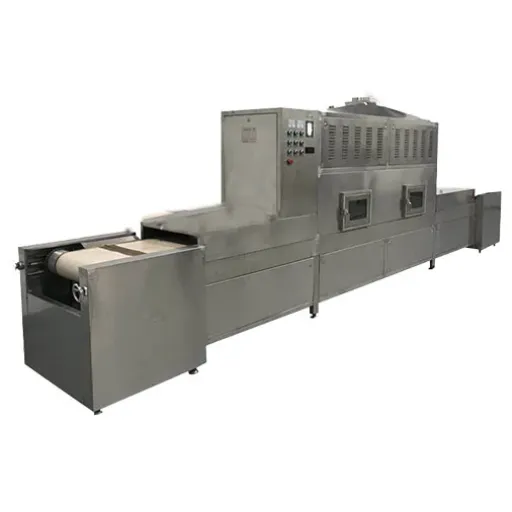
The microwave drying machine operates through its industrial thermal processing system to extract moisture from food by producing heat that penetrates the food product. The microwave dryer system uses electromagnetic waves to create 2450 megahertz or 915 megahertz that excite water molecules which possess polar characteristics. The rapid oscillation creates friction, which produces heat volumetrically. The product achieves accelerated water evaporation through its enhanced moisture removal process which lowers microbial levels.
The Science Behind Dielectric Heating
Think of it this way. The hot-air oven requires heat to move from its chamber walls until it reaches the food surface before proceeding to travel into the food. The outer-to-inner heating method produces a temperature distribution through the material. The surface dries first, sometimes forming a hard shell that traps moisture inside. Food scientists refer to this phenomenon as case-hardening. The process damages texture and color and rehydration characteristics.
Microwave drying flips that script. The material generates heat because its water molecules vibrate throughout the entire structure. The product’s internal vapor pressure forces the moisture to exit. The drying process occurs at the same speed for both the center and the surface. For many grains, what used to take hours in a hot-air dryer now takes five to ten minutes. Speed like that changes everything.
The electromagnetic field provides a second hidden benefit. The combination of thermal and biological effects causes proteins to denature while bacterial DNA experiences disruption. Drying leads to both pasteurization and sterilization processes. The process operates without any need for chemical additives.
Key Components of a Modern System
To understand what you are buying, it helps to know the main parts:
- Magnetron. This is the engine. It generates the high-power microwaves that drive the process. Industrial magnetrons are rated from a few kilowatts up to hundreds of kilowatts.
- Waveguide and cavity. The waveguide directs microwave energy into a multi-mode cavity where the food passes through. Reflective walls and mode stirrers help distribute energy evenly.
- Conveyor system. A belt moves product through the drying chamber at controlled speeds, often adjustable from zero to ten meters per minute.
- Sensors. Infrared temperature sensors and inline moisture analyzers feed real-time data back to the controller.
- PLC control panel. A touchscreen interface lets operators set power levels, belt speed, and temperature profiles. Advanced systems integrate with IoT for remote monitoring.
- Cooling system. Magnetrons generate heat, so air-cooling or water-cooling circuits protect the core components and extend service life.
Types of Industrial Microwave Dryers
Not every food processor needs the same setup. The right microwave drying equipment depends on your product, volume, and available floor space.
Tunnel and Conveyor Dryers
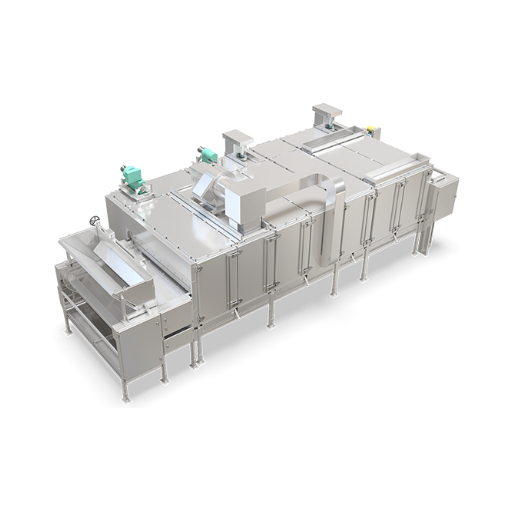
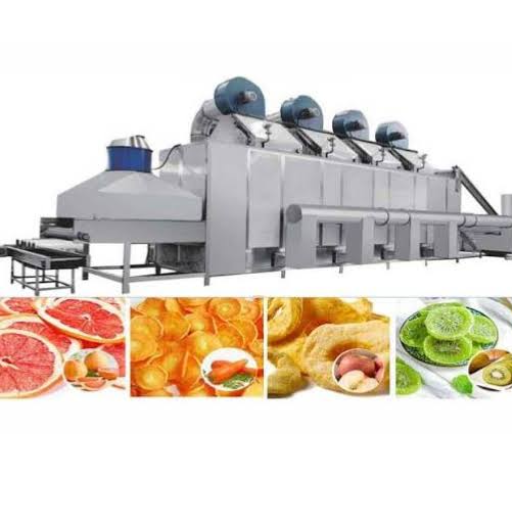
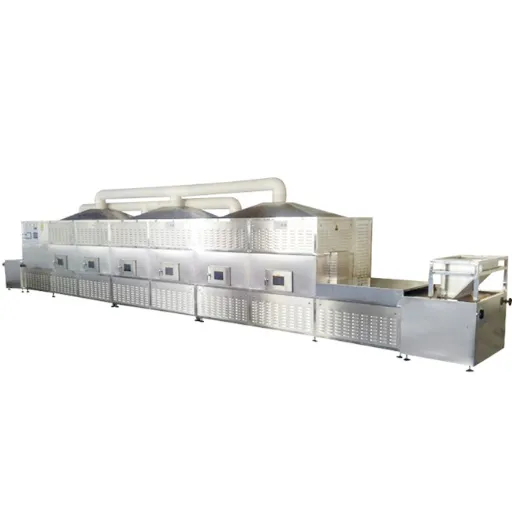
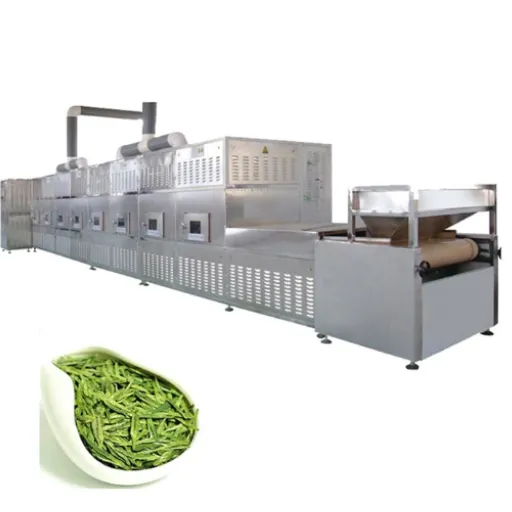
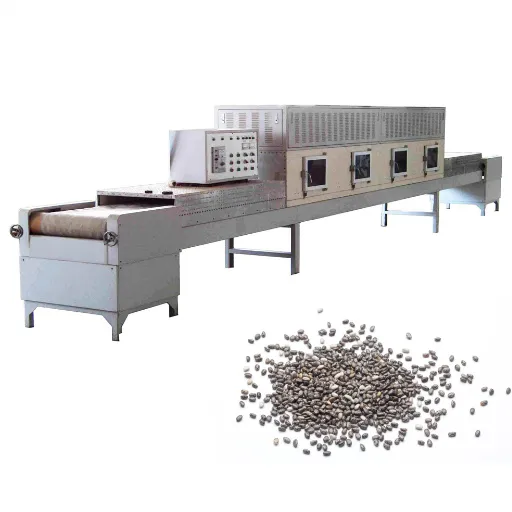
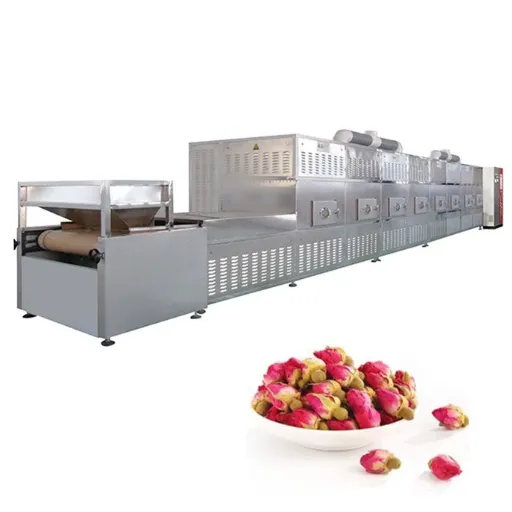
Tunnel dryers function as the essential equipment which enables food processing operations that require high output to work efficiently. The system operates by distributing the product across a conveyor belt which carries the product through an extended microwave tunnel. The system can process materials at a rate which starts from ten kilograms per hour and reaches a maximum capacity of over two thousand kilograms per hour.
The systems maintain a smooth connection with current manufacturing processes. A tunnel dryer installation can occur between an extruder and a washer or a slicer and the subsequent packaging process. This location serves as the primary entry point into production for snack manufacturers and pasta producers and spice processors.
Vacuum Microwave Dryers
Some products cannot handle high temperatures. The heat causes fresh herbs and berries and nutraceuticals and specific pharmaceuticals to lose their effectiveness. The microwave vacuum dryer technology enables water to boil at its boiling point under reduced pressure conditions.
The process enables quick drying from low-temperature conditions. The process produces an additional effect which creates a puffing effect. The process enables water to vaporize through vacuum conditions which produces a sudden explosion that results in a crispy and porous texture that avoids using oil frying. The process of vacuum microwave drying produces optimal results for creating healthy fruit and vegetable chips.
Batch and Cabinet Dryers
A cabinet dryer functions as the ideal solution to support R&D labs and pilot trials and organizations that require high-value small batch operations. The box-type units operate by loading product onto their rotating trays or discs. The operators use the equipment for testing recipes while they establish process parameters until they achieve successful validation of their process. A batch unit exists in every large processing facility to support development of new products.
Benefits of Microwave Drying for Food Processing
Let us look at the business case. Why are so many manufacturers replacing or supplementing their conventional dryers with microwave technology?
Dramatically Faster Drying Times
Speed is the headline benefit. Depending on the product, microwave drying can cut processing time by 50 to 80 percent. Remember the Kerala spice plant? Their turmeric batch went from eight hours to fifty minutes. That is not a marginal improvement. It is a fundamental shift.
Faster cycles mean fewer bottlenecks, lower work-in-progress inventory, and the ability to fulfill rush orders without adding a second or third shift.
Superior Energy Efficiency
The numerical data begins to show its fascinating aspects. A study published in 2025 in International Communications in Heat and Mass Transfer demonstrated that intermittent microwave drying with hot-air drying achieved energy savings of 58.97 percent compared to hot-air drying as the only method. Research studies published in peer-reviewed journals demonstrate that microwave drying systems operating in isolation provide energy savings ranging from 25 percent to 60 percent.
The reason for this effect exists because microwave energy directs its energy toward water molecules. The system uses energy to create microwave energy which directly heats water content while keeping all other components at their actual temperature. The system uses your money to remove extra water content from materials instead of creating additional heat for the space.
The process achieves carbon reduction benefits through its efficient operation. The implementation of microwave drying technology enables manufacturers to achieve sustainable production methods which comply with both environmental regulations and their own corporate ESG objectives.
Better Product Quality and Shelf Life
The results showed a major difference between two drying methods when Maria who works as a quality manager at a basil processing cooperative in Southern Europe switched from conventional oven drying to microwave-assisted drying. Her business achieved a 46.92 percent return on investment through microwave operation, which the peer-reviewed techno-economic study showed, whereas oven drying operations produced a 30.60 percent return on investment. The basil maintained superior color, aroma, and essential oil content.
The explanation for this phenomenon exists in its elementary form. The process of maintaining lower effective temperatures through brief stays results in nutrient and flavor and natural pigment preservation. The method achieves simultaneous sterilization while minimizing microbial contamination through its ability to eliminate microorganisms. For clean-label products, that is a major competitive advantage.
Space and Labor Efficiency
The floor area required for microwave systems equals 20 to 35 percent of the space needed by comparable hot-air tunnel dryers. Facilities that require space optimization can use the released area for either packaging operations or storage functions or extra processing equipment.
The system achieves lower labor expenses. The system uses automated PLCs to cut down on the necessity of workers to observe operations at all times. A single operator frequently operates several systems through a unified touchscreen interface.
Microwave Drying vs. Traditional Drying: A Data-Driven Comparison
Choosing the right drying method is not about picking the newest technology. It is about matching the method to your product, volume, and budget.
| Factor | Hot-Air Drying | Microwave Drying | Hybrid (Microwave + Hot Air) |
|---|---|---|---|
| Drying Speed | Slow (hours) | Fast (minutes) | Fastest |
| Energy Use | High | Low to medium | Lowest |
| Capital Cost | Low | Medium to high | Medium to high |
| Product Quality | Moderate (risk of case-hardening) | High (uniform, less degradation) | Very high |
| Footprint | Large | Compact | Moderate |
| Best For | Low-budget, simple products | Quality-sensitive, high-volume items | Maximum efficiency and quality |
Hot-air drying still has its place. The upfront equipment cost is lower, and the technology is familiar. The system works effectively for basic commodities which do not need precise timing or high-quality standards.
Microwave drying provides fast returns on investment for businesses which produce premium foods and sell them in export markets while operating with energy and labor as their main expense drivers. A ginger processor in Southeast Asia, for example, upgraded from selling fresh ginger to dried ginger slices. The equipment cost 28,000. Hisprofitpertonjumpedfrom28,000. Hisprofitpertonjumpedfrom200 to $900. At twenty tons per month, the payback period was just two months.
Not sure which approach fits your product line? Contact our team at Shandong Loyal Industrial Co., Ltd. and we will help you run the numbers.
Applications Across the Food Industry
Microwave drying is not a niche technology. It spans a wide range of food categories, each with its own process requirements.
Grains and Cereals
Corn, wheat, and rice dry rapidly in tunnel microwave systems. The uniform heating prevents over-drying of the outer layer while the interior still holds moisture. That reduces breakage and improves milling yields.
Tea, Herbs, and Spices
These products are highly value-sensitive. A few degrees too hot or a few minutes too long, and the essential oils vanish. Industrial microwave dryers for food lock in aroma and color while achieving the low moisture content needed for long shelf life.
Fruits and Vegetables
Standard tunnel systems work well for diced or sliced produce. For premium applications like freeze-dried-quality fruit chips, vacuum microwave dryers create the crispy, oil-free texture health-conscious consumers want.
Meat, Seafood, and Jerky
Microwave drying pasteurizes as it dehydrates. That makes it ideal for meat floss, seafood products, and jerky where food safety standards are strict. The rapid process also limits protein denaturation that can create off-flavors.
Snacks and Extruded Products
After extrusion, snacks need precise moisture reduction to achieve the right crunch. Microwave tunnels integrate cleanly after the extruder and before seasoning and packaging. The speed helps maintain line efficiency.
Powders and Flours
Chili powder, garlic powder, onion powder, and wheat flour all benefit from the gentle, uniform heating of microwave drying. Because there is no scorching at hot spots, the risk of clumping or burning is minimized.
What Food Manufacturers Should Consider Before Buying

Investing in microwave drying technology is a strategic decision. Here is how to approach it methodically.
Calculate the Total Cost of Ownership
Do not stop at the purchase price. A proper ROI analysis includes:
- Energy cost per unit. At 25 to 60 percent energy savings, this is often the largest ongoing benefit.
- Labor reduction. Faster, automated cycles mean fewer operator hours per batch.
- Throughput increase. Shorter drying times let you produce more with the same footprint.
- Waste and rework. Uniform heating reduces off-spec batches.
- Quality premium. Better color, flavor, and shelf life can command higher prices.
When Marcus, a production director at a small herb cooperative, ran his numbers, he found that the quality premium alone justified the investment. His dried basil could now be certified for the premium export market, adding roughly 15 percent to his selling price.
Match Production Volume and Space
Tunnel dryers operate between their smallest units which dry ten kilograms per hour and their largest industrial drying systems. You need to determine both your existing production capacity and your three-year growth projection. When equipment becomes smaller than necessary its performance speed becomes restricted. The process of oversizing equipment leads to unnecessary expenses for both financial resources and energy consumption.
You must check that your facility has appropriate electrical power sources and adequate airflow systems and sufficient weight capacity on floors. Most industrial microwave ovens require dedicated high-voltage lines and stable voltage.
Understand Your Product Characteristics
Different food matrices respond to microwave treatment in distinct ways. Products with very high sugar or fat content can develop localized hot spots if power settings are too aggressive. The processing of heat-sensitive materials requires either a vacuum system or a hybrid equipment line which starts with hot air and ends with microwave treatment.
A reliable supplier will conduct pilot tests on your actual product before providing a system price estimate. At Shandong Loyal we conduct customer sample tests in our R&D lab to determine product specifications and expected production capacity.
Evaluate the Supplier, Not Just the Machine
The machine is only part of the equation. Look for a manufacturer that offers:
- Customization. Can they adjust cavity length, belt width, power zones, and control logic for your specific product?
- After-sales support. Do they keep magnetrons, waveguides, and belts in stock? Can they dispatch technicians to your facility?
- Compliance certifications. For export markets, confirm the equipment meets relevant standards such as ISO, GB, and FDA readiness.
- Training. Will they train your operators and maintenance staff?
Maintenance Best Practices for Long-Term Performance
A well-maintained microwave drying machine can operate reliably for eight to ten years. Neglect cuts that lifespan in half. Here is a maintenance framework straight from the manufacturer.
Daily and Weekly Maintenance
The staff needs to use non-abrasive cloths for daily cleaning of all indoor and outdoor surfaces. Staff members must eliminate all product residue which will become solid before it reaches that state. Staff members need to examine door seals to find any signs of damage through cracks or deformation. Staff members need to verify that the conveyor belt pathway operates in a straight line while the system functions without any interruptions.
The cleaning team removes dust from electrical cabinets, heating boxes, and ventilation grilles every week. The control box requires dry compressed air to blow out its contents in humid environments because it protects circuit boards from damage. The team needs to tighten all door hinges which currently exist in a loose state together with all fasteners.
Monthly and Annual Maintenance
The team performs monthly conveyor maintenance which requires food-grade lubricant for all conveyor bearing and chain drive points. The team needs to assess whether the temperature sensors together with the moisture analyzers maintain their calibration status. The team needs to conduct a test which determines the grounding resistance level. The maximum resistance level for the system should not exceed four ohms.
The magnetron serves as the core component of the system. Industrial magnetrons maintain operational capacity for eight thousand to ten thousand hours when they receive proper maintenance. The device will experience a short lifespan which will reach only five thousand hours when users fail to use this component. The team needs to plan for magnetron replacement before the system experiences a failure.
The company needs to hire a factory-certified technician who will conduct an annual complete system evaluation. Your system supports IoT integration, so technicians can use these capabilities to detect early waveguide wear patterns, check cooling circuits, and refresh PLC firmware.
Common Issues and Troubleshooting
| Problem | Likely Cause | Solution |
|---|---|---|
| Uneven drying | Product spread too thick or unevenly; incorrect power or belt speed. | Spread material in a uniform layer; adjust power and conveyor settings. |
| Burning or scorching | Power too high; dwell time too long. | Reduce microwave power or increase belt speed. |
| Unexpected shutdown | Blocked material flow; blown fuse; faulty safety interlock. | Clear the blockage; inspect fuses and interlock switches. |
| Excessive noise | Loose bolts; worn bearings; uneven loading. | Tighten hardware; lubricate or replace bearings; redistribute load. |
If you smell burning, see sparks, or hear abnormal noises, stop the machine immediately and call professional service. Never attempt to disassemble high-voltage components yourself.
Conclusion
Microwave drying is no longer an experimental technology. It is a proven, scalable solution that helps food manufacturers cut costs, boost quality, and meet growing demand. Let us recap the essentials:
- A microwave drying machine can reduce drying times by 50 to 80 percent compared with conventional hot-air methods.
- Energy savings typically range from 25 to 60 percent, with some hybrid systems achieving even better results.
- The simultaneous sterilization effect extends shelf life naturally, supporting clean-label product strategies.
- The right system depends on your product type, production volume, and facility constraints. Tunnel, vacuum, and batch configurations each serve different needs.
- Preventive maintenance is the key to getting eight to ten years of reliable performance from your investment.
At Shandong Loyal Industrial Co., Ltd., we have been designing and manufacturing food processing equipment since 2005. Our microwave drying solutions are exported worldwide, from Asia and Africa to Europe and the Americas. Whether you are a small business scaling up or a global enterprise optimizing a high-volume line, we can tailor a system to your exact requirements.
Ready to transform your drying process? Contact us today for a free consultation and customized quote.