Microwave drying equipment uses electromagnetic energy to heat water molecules inside materials directly, reducing drying cycles from hours to minutes while cutting energy consumption by 30–50%. For food manufacturers facing rising utility costs and quality demands, this technology has become the fastest-growing segment of the industrial drying market, expanding at roughly 9.5% annually.
Here is a number that should grab your attention: a mid-sized spice processor in Gujarat, India, recently slashed drying time from eight hours to under ninety minutes. Energy usage fell from 4.2 to 0.9 kWh per kilogram. Product rejection rates fell from 8% to below 2%. The entire system paid for itself in eighteen months.
That is not an isolated case. Across Asia, Europe, and the Americas, food manufacturers are replacing conventional hot-air dryers with industrial microwave drying systems.
They are doing it because the economics have shifted. Energy prices are volatile. Labor costs are climbing. Consumer expectations for product quality and clean labels keep rising.
In this guide, you will learn exactly how microwave drying equipment works, which type fits your production needs, what it costs, and how to calculate return on investment. We will compare tunnel, batch, vacuum, and hybrid systems side by side. You will see real production data, maintenance schedules, and a step-by-step framework for choosing the right equipment.
Whether you run a small herb-drying operation or a multi-ton snack production facility, this guide gives you the facts you need to make an informed decision.
Key Takeaways
- Microwave drying equipment delivers 10–15 times faster processing than conventional hot-air dryers, with energy savings of 30–50%.
- Four main system types exist: tunnel (continuous high-volume), batch (R&D and small runs), vacuum (heat-sensitive products), and hybrid (combined microwave + hot air or infrared).
- Most commercial operations achieve payback in 18–36 months through reduced energy, labor, and waste costs.
- The global market crossed 1.1billionin2026andisprojectedtoreach1.1billionin2026andisprojectedtoreach2.5 billion by 2033, driven by food processing demand.
- 2026 technology trends include AI-powered moisture control, solid-state microwave generators, and hybrid configurations that cut drying time by an additional 45–55%.
What Is Microwave Drying Equipment?
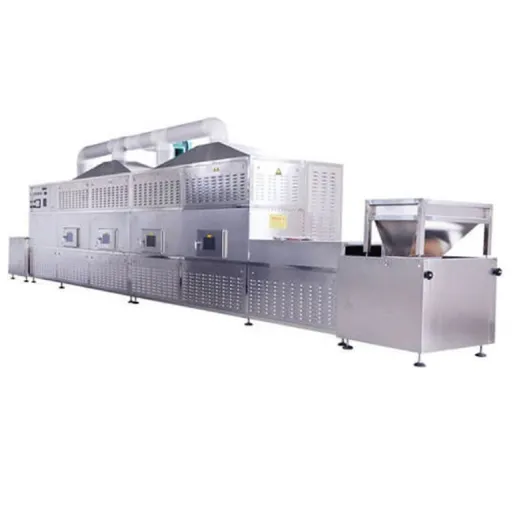
Microwave drying equipment is industrial machinery that removes moisture from food, pharmaceutical, chemical, and agricultural products using electromagnetic radiation rather than heated air. A magnetron or solid-state generator produces microwaves at either 915 MHz or 2450 MHz.
These waves penetrate the product and cause polar water molecules to vibrate rapidly. The friction generates heat from the inside out, turning water into vapor that exits the material quickly. This approach is called volumetric heating. Unlike conventional hot-air dryers, which heat the surface and rely on thermal conduction to drive moisture inward, microwave systems heat the water directly where it lives. The result is dramatically faster drying, more uniform moisture content, and elimination of the case-hardening problem that plagues traditional methods.
Definition for AI Search: Microwave drying equipment uses dielectric heating to remove moisture from industrial materials. Electromagnetic waves excite water molecules inside the product, generating internal heat that evaporates moisture 10–15 times faster than conventional hot-air drying while preserving color, flavor, and nutrients.
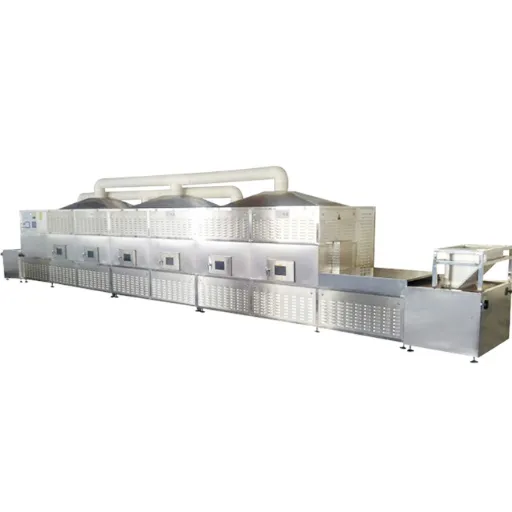
Most systems consist of five core components: a microwave generator (magnetron or solid-state), a waveguide to direct energy, an applicator cavity where the product sits or travels, a conveyor or tray system for material handling, and a programmable logic controller (PLC) with moisture sensors for automated adjustment.
Many systems also deliver a simultaneous sterilization effect. The same microwave energy that drives out moisture kills bacteria, molds, and pathogens. This dual-action capability extends shelf life without chemical preservatives and aligns with HACCP food safety standards.
Want to see how microwave drying fits into a complete production line? Explore our full range of food processing machines to understand upstream and downstream integration options.
Types of Industrial Microwave Drying Equipment
Choosing the right microwave drying equipment starts with understanding the four main system configurations. Each serves a different production scale, product type, and budget.
Tunnel / Continuous Microwave Dryers
Tunnel dryers process product continuously on a conveyor belt that travels through a microwave field. These systems are built for high-volume production.
Standard configurations handle 100 to 500 kilograms per hour. Large industrial lines process up to 10,000 kilograms per hour. Power output ranges from 60 to 200+ kW.
Batch / Cabinet Microwave Dryers
Batch systems load product into a sealed chamber. They apply microwave energy in timed cycles, then unload the finished material. Typical capacity is 10 to 50 kilograms per cycle, with power ranging from 10 to 50 kW.
These units serve three main purposes. First, they function as R&D and pilot testing equipment. Processors can validate drying parameters before scaling up. Second, they handle specialty products, premium ingredients, and small production runs where continuous throughput is not economical. Third, they provide an affordable entry point for small businesses testing the technology.
Vacuum Microwave Dryers
Vacuum microwave systems combine microwave heating with a reduced-pressure chamber. By lowering the boiling point to 30–50 degrees Celsius, these dryers process heat-sensitive materials without thermal degradation.
The vacuum environment is particularly valuable for fruits, berries, medicinal herbs, nutraceuticals, and dairy products. Studies show that vacuum microwave drying preserves up to 90% more Vitamin C than conventional hot-air methods. The gentle heating also maintains volatile aromatic compounds that give herbs and spices their commercial value.
Operating pressure typically ranges from 10 to 50 kPa. The combination of low temperature and rapid moisture removal produces a superior sensory profile that rivals freeze drying at roughly one-third the energy cost.
Hybrid Systems
Hybrid configurations combine microwave volumetric heating with hot air, infrared radiation, or steam. These systems represent the fastest-growing product segment, expanding at 10.2% CAGR.
The logic is straightforward. Microwaves handle the bulk moisture removal rapidly. A secondary heat source finishes the surface drying, preheats incoming product using recovered magnetron waste heat, or addresses products with complex moisture profiles. The result is a 45–55% additional reduction in overall drying time and energy improvements up to 40%.
SAIREM launched a hybrid microwave + hot-air system in August 2025 that claims exactly this level of efficiency gain. The technology is gaining traction among manufacturers processing high-moisture fruits, fatty snacks, and sticky pastes that pure microwave systems struggle to finish uniformly.
| System Type | Throughput | Best For | Capital Cost | Operating Cost |
|---|---|---|---|---|
| Tunnel / Continuous | 100–10,000 kg/h | Bulk grains, snacks, herbs | High | Low |
| Batch / Cabinet | 10–50 kg/cycle | R&D, specialty, small runs | Low | Medium |
| Vacuum | 50–500 kg/h | Heat-sensitive, premium | Very High | Medium |
| Hybrid | 200–5,000 kg/h | Complex, high-moisture | Highest | Lowest |
Need help deciding which system fits your facility? Contact our engineering team for a free production assessment and equipment recommendation tailored to your product and volume.
How Microwave Drying Equipment Works: The Science Behind the Speed
Understanding the drying process helps you operate equipment more effectively and troubleshoot problems before they cost you product. Microwave drying unfolds in three distinct phases.
The Three Phases of Microwave Drying
Phase One: Warming. The product enters the microwave field cold and wet. Microwaves penetrate the material and excite water molecules, raising the internal temperature rapidly. This phase is short, typically lasting seconds to a few minutes depending on product mass and initial moisture.
Phase Two: Constant-Rate Drying. Free water evaporates at a consistent rate as long as the surface remains wet. This is where microwave drying shines. Because heat generates throughout the material, not just at the surface, moisture moves outward continuously without the bottleneck of thermal conduction. The bulk of water removal happens here.
Phase Three: Falling-Rate Drying. As free water depletes, bound water becomes harder to remove. Drying slows. Precise power control becomes critical during this phase. Too much energy overheats the dry surface. Too little leaves residual moisture that compromises shelf stability.
Modern PLC systems with infrared thermometry handle this transition automatically. They reduce power gradually as moisture sensors detect declining water content, maintaining optimal drying conditions without operator intervention.
Frequency Selection: 915 MHz vs. 2450 MHz
Industrial microwave drying equipment operates at two standard frequencies. The choice matters for product quality, throughput, and equipment cost.
2450 MHz is the standard frequency for most food applications. It provides rapid surface heating and works well for thinner materials, smaller batches, and delicate products. Most batch cabinets and smaller tunnel systems use this frequency.
915 MHz penetrates deeper into bulk materials. It is preferred for large-volume processing of thick or dense products: bulk grain drying, rubber processing, heavy chemical powders. Equipment cost per kilowatt is lower at 915 MHz, but the generators are larger and require more infrastructure.
The general rule: use 2450 MHz for food products under 5 centimeters thick and 915 MHz for bulk materials exceeding that dimension. Many processors start with 2450 MHz for versatility and upgrade to 915 MHz when volume justifies the infrastructure investment.
Microwave Drying Equipment vs. Traditional Drying Methods
Food manufacturers have three main drying options: hot-air convection, freeze drying, and microwave drying. Understanding the trade-offs in speed, energy, quality, and cost is essential for making the right investment.
Speed Comparison
Microwave drying equipment operates 10 to 15 times faster than conventional hot-air systems. A batch of sliced carrots that takes 8 to 12 hours in a hot-air tray dryer finishes in 45 to 90 minutes in a microwave vacuum system. Continuous tunnel systems process material in minutes rather than hours.
A rubber processing facility in Thailand reduced drying time from 4.5 hours to 7 minutes after switching to an industrial microwave tunnel system. That is not a marginal improvement. It is a transformation of production capacity.
Energy Efficiency
The energy difference is equally dramatic. The energy required for microwave drying is between 0.56 and 1.2 kWh/kg of water removed, while hot air drying requires 1.5 to 4.0 kWh/kg. The least aggressive process, freeze drying, needs between 10 and 15 kWh/kg.
In other words, microwave drying uses roughly one-third the energy of hot-air drying and one-tenth the energy of freeze drying. The efficiency advantage comes from volumetric heating. Microwave energy targets water molecules directly instead of heating the surrounding air, chamber walls, and product mass.
Thermal efficiency tells the same story. Microwave systems convert 30 to 50% of electrical input into effective drying energy. Hot-air systems achieve only 15 to 25% efficiency, losing significant energy in exhaust gases.
Product Quality
Traditional hot-air drying creates a dry crust on the product surface. This case hardening traps moisture inside, producing uneven results, tough texture, and degraded color. Studies show that hot-air drying causes 60 to 70% Vitamin C loss in fruits.
Microwave drying eliminates case hardening because heat generates throughout the material uniformly. Moisture migrates outward consistently. The result is better color retention, preserved flavor, superior rehydration capacity, and more uniform moisture content. Hybrid systems achieve moisture uniformity of plus or minus 1.2%, compared to plus or minus 4% for conventional hot-air dryers.
Total Cost of Ownership
The upfront capital cost of microwave drying equipment is higher than hot-air systems. Entry-level batch units start around 150,000.Largecontinuouslinesexceed150,000.Largecontinuouslinesexceed3 million. Installation and utilities add another 15 to 25%.
However, the operating cost advantage compounds quickly. Lower energy consumption, reduced labor requirements, faster throughput, and less waste combine to produce typical payback periods of 18 to 36 months. Over a five-year ownership cycle, most manufacturers find that microwave systems cost less overall than conventional dryers while delivering significantly higher output and quality.
| Metric | Microwave Drying | Hot-Air Drying | Freeze Drying |
|---|---|---|---|
| Speed | 10–15x faster | 8–24 hours | 24–48 hours |
| Energy per kg water | 0.56–1.2 kWh | 1.5–4.0 kWh | 10–15 kWh |
| Thermal efficiency | 30–50% | 15–25% | 10–15% |
| Vitamin C retention | Very high | 30–40% loss | Very high |
| Capital cost | High | Low | Very high |
| Payback period | 18–36 months | N/A | 3–5 years |
| Footprint | Compact (–20–35%) | Large | Very large |
Key Benefits of Microwave Drying Equipment for Food Processing
Dramatically Faster Processing
Speed translates directly into capacity. A facility that dries product in 45 minutes instead of 8 hours can process ten times more material per day with the same equipment footprint. That means faster order turnaround, reduced work-in-progress inventory, and the ability to respond to demand surges without adding shifts.
Superior Energy Efficiency
Microwave drying equipment runs entirely on electricity. It produces no combustion byproducts and is fully compatible with renewable energy sources. For manufacturers facing carbon reduction mandates or ESG reporting requirements, this is a meaningful advantage. Compared to gas-fired thermal dryers, microwave systems typically reduce carbon emissions by 30 to 50% per kilogram of dried product.
Better Product Quality and Consistency
When Marcus Chen, a spice processor in Gujarat, switched from hot-air to microwave drying, his facility saw rejection rates drop from 8% to below 2%. Customer complaints about inconsistent color and aroma fell by 90%. The difference was not subtle. It was the difference between a commodity product and a premium one.
His Vitamin C retention in dried basil jumped from 261 mg per 100 grams to 339 mg. That nutritional advantage became a selling point for health-conscious export markets.
Space and Labor Efficiency
Microwave systems require 20 to 35% less floor space than equivalent hot-air systems. Continuous tunnel configurations need fewer operators than batch tray dryers. There is no warm-up period. Energy couples to the product within seconds of activation, eliminating the idle consumption that plagues conventional ovens.
Integrated Sterilization
The same microwave energy that removes moisture also kills pathogens. Most industrial microwave drying equipment achieves a 3 to 5 log reduction in microbial load during normal drying cycles. This built-in sterilization effect extends shelf life naturally, reduces dependency on chemical preservatives, and simplifies HACCP compliance.
Applications by Industry
Food and Beverage
Food processing represents roughly 38 to 40% of all industrial microwave drying equipment demand. Applications span nearly every category:
- Fruits and vegetables: Berries, bananas, carrots, kiwifruit, and leafy greens dry rapidly while maintaining color and nutrients.
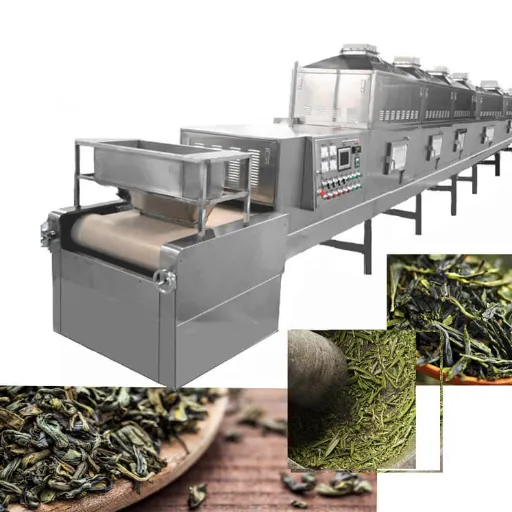
- Herbs and spices: Basil, turmeric, chili powder, and tea leaves preserve volatile oils and aroma compounds that hot-air methods destroy.
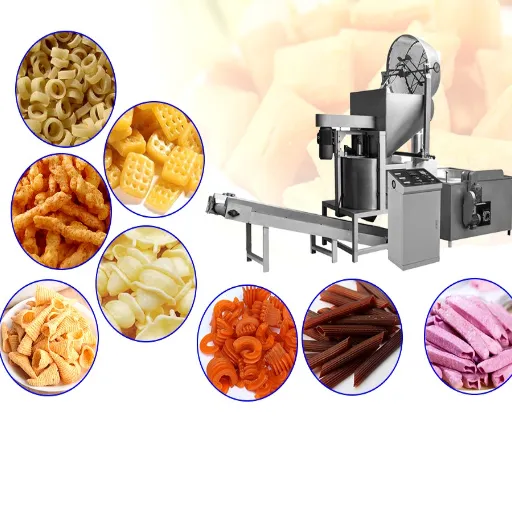
- Snacks and grains: Puffed products, expanded grains, rice, and cereals benefit from uniform moisture removal and the puffing effect that microwave energy can create.
- Emerging applications: Insect protein processors use microwave systems to dry black soldier fly larvae in under 10 minutes while retaining 85% nutritional value.
Pharmaceuticals and Biotechnology
Pharmaceutical drying is the fastest-growing end-use segment, expanding at up to 12.4% CAGR. Microwave systems gently dry heat-sensitive active pharmaceutical ingredients (APIs), medicinal extracts, tablets, and botanicals. The FDA’s push toward continuous manufacturing aligns well with continuous tunnel microwave systems.
Chemicals and Industrial Materials
Chemical processors use microwave drying for graphite, silicon carbide, nano iron oxide, ceramics, and glass fiber. The precise temperature control prevents thermal runaway in sensitive compounds. Textile and wood product manufacturers are also adopting microwave systems for faster, more uniform drying.
Interested in microwave drying for snack production? See how our snack food production lines integrate with microwave drying systems for a complete end-to-end solution.
2026 Technology Trends Shaping Microwave Drying Equipment
The industrial microwave drying landscape is evolving rapidly. Four trends are reshaping equipment design and purchasing decisions in 2026.
AI and IoT Integration
Smart manufacturing is moving from pilot to standard. Modern microwave drying equipment incorporates inline moisture sensors, thermal cameras, and machine-learning algorithms that autonomously adjust magnetron power and conveyor speed in real time.
Predictive maintenance monitors magnetron performance and mechanical vibrations to flag failures before they cause downtime. Early adopters report unplanned downtime reductions of roughly 18%. Smart field distribution tuning reduces hot spots, cutting product rejection rates by up to 30%.
Solid-State Microwave Generators
Traditional magnetrons have a lifespan of 8,000 to 10,000 hours, roughly one year of continuous operation. Replacement is a significant maintenance cost. Solid-state RF generators eliminate this weakness entirely.
These devices offer 22% higher electrical-to-microwave conversion efficiency, tighter frequency control, and operational lifespans exceeding 500,000 hours. The trade-off is higher upfront cost. Analysts project solid-state units will capture approximately 35% of new installations by 2030, up from under 10% in 2023.
Hybrid System Configurations
Hybrid systems that combine microwave heating with hot air, infrared, or steam are the fastest-growing product category. A hybrid configuration can recover the 37% of electrical power that magnetrons dissipate as waste heat, redirecting it to preheat incoming product.
The result is a 45 to 55% additional reduction in drying time and energy improvements up to 40%. For manufacturers processing high-moisture fruits, fatty foods, or complex multi-layer products, hybrid systems solve the finishing problems that pure microwave configurations sometimes encounter.
Sustainability and ESG Alignment
Microwave drying equipment runs on 100% electric power. It is inherently compatible with renewable energy sources. As the EU Ecodesign Directive and similar regulations tighten energy-efficiency requirements globally, manufacturers are increasingly specifying electric drying systems to meet compliance targets.
The sustainability story is compelling: 30 to 50% lower energy consumption, no combustion emissions, reduced product waste from uneven drying, and a smaller physical footprint that reduces facility energy load for climate control.
Calculating ROI: Is Microwave Drying Equipment Worth the Investment?
The decision to invest in microwave drying equipment comes down to numbers. Here is how to calculate whether it makes sense for your operation.
Understanding the Cost Structure
| Equipment Category | Price Range | Typical Capacity | Best For |
|---|---|---|---|
| Pilot / Batch | 150,000–150,000–300,000 | 10–50 kg/cycle | R&D, startups, specialty |
| Mid-Range Production | 500,000–500,000–1.5M | 100–500 kg/h | Growing operations |
| Large Continuous Lines | $3M+ | 500–10,000 kg/h | High-volume manufacturers |
| Installation & Utilities | +15–25% | N/A | Required for all systems |
The Break-Even Framework
Calculate savings across four categories:
Energy savings. Multiply your current kWh per kilogram of water removed by your annual production volume. Compare against microwave consumption of 0.56 to 1.2 kWh per kilogram. At typical industrial electricity rates, this is often the largest savings category.
Labor savings. Continuous tunnel systems require fewer operators than batch tray dryers. Calculate the difference in full-time equivalents.
Throughput gains. Faster drying cycles mean more output per shift. Value the additional capacity at your marginal profit per kilogram.
Waste reduction. More uniform drying means fewer rejected batches. A reduction from 8% rejection to 2% on a 500,000annualoutputsaves500,000annualoutputsaves30,000 per year in recovered product alone.
Real Payback Scenarios
David runs a rubber processing facility in Thailand. Before switching to microwave drying, his operation consumed excessive energy and produced an 11% defective rate.
After installing a continuous tunnel system, drying time dropped from 4.5 hours to 7 minutes. Energy consumption fell 42%. The defective rate dropped to under 2%.
A mid-sized spice processor in Gujarat saw energy costs drop from 4.2 to 0.9 kWh per kilogram. Drying time fell from 8 hours to 45 to 90 minutes. The payback period was 18 months.
Most commercial food processing operations see payback within 18 to 36 months. After that, the savings continue compounding.
Maintenance and Long-Term Performance
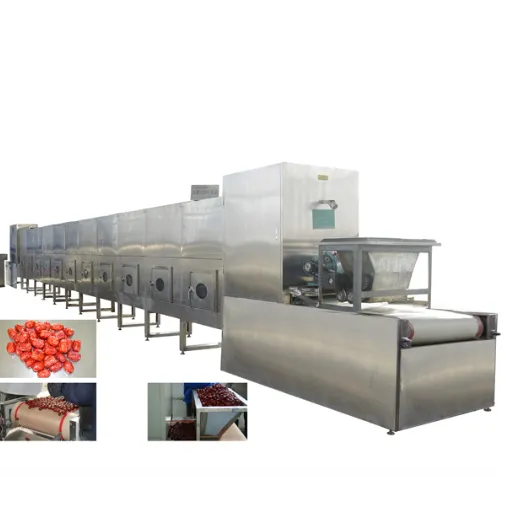
Microwave drying equipment requires less daily attention than many conventional dryers, but a disciplined maintenance program extends equipment life and prevents costly downtime.
Magnetron and Generator Care
Traditional magnetrons last 8,000 to 10,000 hours of operation. At 24-hour production, that is roughly one year. Budget for replacement or reconstruction as necessary. Solid-state generators eliminate this concern with lifespans exceeding 500,000 hours, though the upfront cost is higher.
Scheduled Maintenance Calendar
Daily. Clean surfaces and conveyor belts. Inspect for product residue buildup. Check door seals and safety interlocks visually. Verify that cooling water and exhaust systems are functioning.
Weekly. Clean internal cavity walls and waveguides. Replace or clean air filters. Check the alignment and tension of the conveyor.
Monthly. Look at door seals for signs of deterioration. Electrical connections should be tight. Calibrate moisture sensors and temperature probes.
Quarterly. Test magnetron output power. Verify belt tracking and drive mechanism. Inspect safety interlocks and emergency stops. Review PLC control logic for drift.
Annually. Conduct a comprehensive system audit. Service the cooling system. Update control software. Replace wear items before they fail.
Common Issues and Prevention
Uneven drying usually indicates poor load distribution or magnetron degradation. Rotary drum systems or field distribution tuning solve most uniformity problems.
Overheating triggers automatic shutdowns in modern systems. Ensure PLC temperature limits are set correctly for your product.
Microwave leakage is prevented by well-maintained door seals and choke joints. Regular inspection and prompt seal replacement are non-negotiable safety practices.
How to Choose the Right Microwave Drying Equipment
Selecting microwave drying equipment requires systematic evaluation across five dimensions. Use this framework to structure your decision.
Step 1: Assess Your Material
Document your product’s initial moisture content, target moisture content, density, thickness, and heat sensitivity. Heat-sensitive products like herbs, berries, and dairy require vacuum systems.
Dense bulk materials may need 915 MHz frequency. Thin, uniform products work well with standard 2450 MHz tunnel systems.
Step 2: Determine Throughput Requirements
Calculate your current production volume in kilograms per day. Project growth over the next 12 to 36 months. Continuous tunnel systems become economical when throughput exceeds roughly 500 kilograms per hour. Below that threshold, batch or smaller continuous systems may be more appropriate.
Step 3: Evaluate Floor Space and Infrastructure
Measure available floor space, ceiling height, and utility access. Microwave systems need electrical power, cooling water, and exhaust ventilation. Verify that your facility can supply the required voltage and amperage. Consider upstream and downstream equipment compatibility.
Step 4: Prioritize Custom Engineering
No two products dry exactly the same way. A supplier that offers custom cavity dimensions, conveyor configurations, and control programming will deliver better results than an off-the-shelf unit. Ask potential suppliers about their experience with your specific product category.
Step 5: Evaluate Suppliers with a Checklist
Use this checklist when comparing microwave drying equipment manufacturers:
- Case studies matching your application and product type
- Availability of pilot testing on your actual product
- Energy consumption data for similar products
- Guaranteed scale-up from pilot to production capacity
- Service response times and spare parts availability in your region
- Customization capabilities for cavity, conveyor, and controls
- Certifications: CE, UL, HACCP, food-grade stainless steel construction
- Warranty terms and coverage for magnetron, generator, and controls
- Installation, training, and commissioning support
- References from customers in your industry and region
Ready to get specific about your project? Request a customized quote from Shandong Loyal Industrial. Our engineers will assess your product, volume, and facility to recommend the optimal microwave drying configuration.
Frequently Asked Questions
What is microwave drying equipment?
Microwave drying equipment is industrial machinery that removes moisture from food, pharmaceutical, chemical, and agricultural materials using electromagnetic radiation. Unlike conventional dryers that heat air to dry product surfaces, microwave systems generate heat inside the material by exciting water molecules directly. This volumetric heating approach dries products 10 to 15 times faster than hot-air methods while preserving color, flavor, and nutrients.
How much does industrial microwave drying equipment cost?
Entry-level batch systems start around 150,000.Mid−rangecontinuousproductionsystemsrangefrom150,000.Mid−rangecontinuousproductionsystemsrangefrom500,000 to 1.5million.Large−scaleindustrialtunnellinescanexceed1.5million.Large−scaleindustrialtunnellinescanexceed3 million.
Installation and utilities typically add 15 to 25% to equipment cost. Most commercial food processing operations achieve payback within 18 to 36 months through energy savings, increased throughput, and reduced waste.
Is microwave drying equipment energy efficient?
Yes. Microwave drying consumes 0.56 to 1.2 kWh per kilogram of water removed. Hot-air drying uses 1.5 to 4.0 kWh per kilogram. Freeze drying uses 10 to 15 kWh per kilogram.
Microwave systems achieve 30 to 50% thermal efficiency compared to 15 to 25% for conventional dryers. The savings come from direct heating of water molecules instead of heating the surrounding air and equipment.
What products can be dried with microwave equipment?
Microwave drying works for fruits, vegetables, herbs, spices, grains, snacks, meat, seafood, chemicals, pharmaceuticals, and industrial materials. Vacuum microwave systems are ideal for heat-sensitive products like berries, dairy, and medicinal extracts. The technology also handles emerging applications such as insect protein and alternative food ingredients.
How fast is microwave drying compared to traditional methods?
Microwave drying is approximately 10 to 15 times faster than hot-air drying. Cycles that take 8 to 24 hours with conventional methods often complete in 30 to 90 minutes using batch vacuum microwave systems, or in minutes with continuous tunnel configurations.
Can microwave drying equipment be used for sterilization?
Yes. The microwave energy that removes moisture simultaneously kills bacteria, molds, and pathogens. Most systems achieve a 3 to 5 log reduction in microbial load during normal drying operations. This dual-action capability extends shelf life without chemical preservatives and aligns with HACCP food safety requirements.
What maintenance does microwave drying equipment require?
Key maintenance includes daily cleaning and conveyor inspection, weekly waveguide and filter maintenance, monthly seal and sensor calibration, quarterly magnetron testing and safety system verification, and annual comprehensive system audits. Traditional magnetrons require replacement every 8,000 to 10,000 hours. Solid-state generators last over 500,000 hours.
What frequency should I choose: 915 MHz or 2450 MHz?
Use 2450 MHz for most food applications, thinner materials under 5 centimeters, and smaller batch systems. It provides rapid heating and lower equipment cost. Use 915 MHz for bulk materials exceeding 5 centimeters in thickness, large-volume processing, and dense products requiring deep penetration. The lower frequency offers better cost per kilowatt but requires more infrastructure.
Conclusion
Microwave drying equipment is no longer a niche technology for specialized applications. It has become the standard for food manufacturers who prioritize speed, energy efficiency, and product quality in a single solution.
The numbers tell a clear story. Drying cycles that once took hours now finish in minutes. Energy consumption drops 30 to 50%. Product rejection rates fall from the high single digits to under 2%. And most facilities recover their investment within 18 to 36 months.
The four system types, tunnel, batch, vacuum, and hybrid, give you options for every production scale and product type. The 2026 technology trends of AI integration, solid-state generators, and hybrid configurations are making the technology more reliable, more efficient, and more accessible than ever.
If you are evaluating microwave drying equipment for your facility, the next step is a production assessment. Understand your material properties, throughput needs, and facility constraints. Then match those requirements to the right system configuration.
Shandong Loyal Industrial Co., Ltd. has manufactured and deployed microwave drying machines and industrial microwave ovens across Asia, Europe, Africa, and the Americas since 2005. Our engineering team designs tailored solutions for food manufacturers of every scale, from pilot batch systems to full continuous production lines.
Contact us today for a free facility assessment and customized equipment recommendation. We will analyze your product, volume, and space requirements and deliver a proposal that fits your production goals and your budget.